
Blog
What You Need to Know Before Donating Stock Ahead of a Sale
How a contribution-date business valuation supports a pre-sale gift of closely held stock, including Hoensheid timing, DLOM/DLOC, and Form 8283.
Published
When a founder plans to give closely held stock or a partnership interest to a donor-advised fund, a charitable remainder trust, or another public charity in the same year as a company sale, two questions usually collide. First: will the gift be respected as a gift of the equity itself, or will the IRS treat you as if you sold the interest and then donated cash? Second: what is the fair market value of the interest on the contribution date, and will the appraisal hold up if the return is examined?
This guide is written for business owners and their advisors who need a defensible business valuation for a charitable donation. It focuses on how the valuation date, independence rules, and discounts for lack of marketability and control interact with a pending sale. For the assignment-of-income timeline itself, see our earlier walkthrough of lessons from the Hoensheid case and the companion rules for what makes a business appraisal a qualified appraisal under IRS rules.
Why the Contribution-Date Valuation Is the Center of the Gift
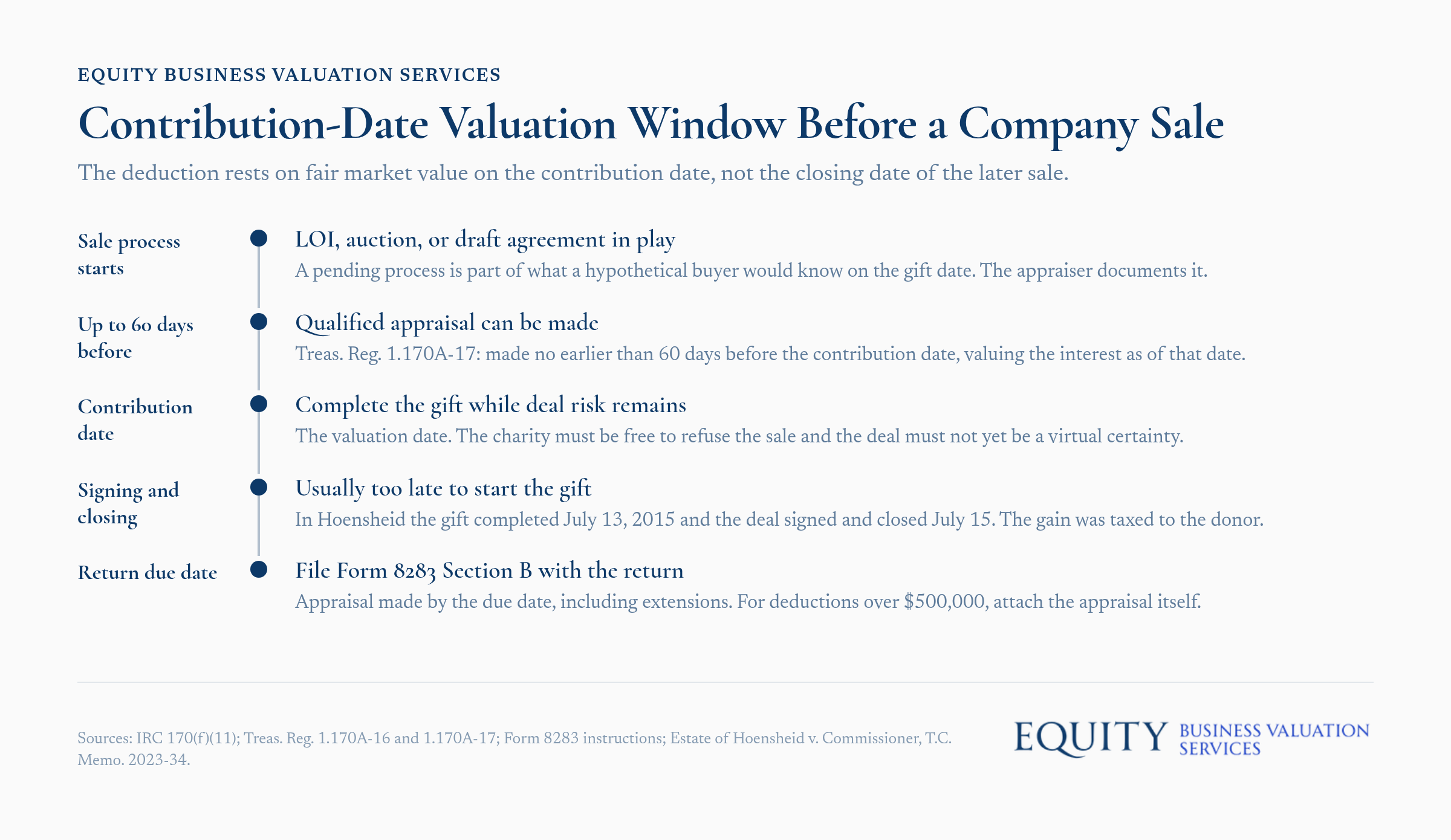
For noncash gifts valued over $5,000, the Internal Revenue Code requires a qualified appraisal by a qualified appraiser, and Form 8283 Section B must accompany the return (IRC §170(f)(11); Treas. Reg. §1.170A-16; Form 8283 instructions). For claimed deductions over $500,000, the appraisal itself is attached.
The appraisal must relate to an appraisal made no earlier than 60 days before the contribution date and no later than the due date of the return (including extensions), and it must state fair market value on the (expected) contribution date (Treas. Reg. §1.170A-17). That date, not the closing date of a later sale and not a banker's pitch-book date, is what the deduction rests on.
A pending letter of intent, auction process, or draft purchase agreement is part of what a hypothetical buyer with reasonable knowledge would know on that date. Ignoring it can understate value; treating a still-contingent deal as a done deal can overstate certainty. The appraiser's job is to document what was known or knowable on the valuation date and to apply approaches and discounts that fit the interest actually transferred.
Assignment of Income Sets the Window the Appraiser Has to Work Inside
The anticipatory assignment of income doctrine asks whether the donor had already earned the gain before giving the property away. Courts look at whether the sale was practically certain on the gift date, whether a binding agreement existed, and whether the charity was free to refuse the sale. Rev. Rul. 78-197 addresses a related redemption fact pattern: the IRS treats proceeds as the donor's income when the donee is legally bound, or can be compelled, to surrender the shares.
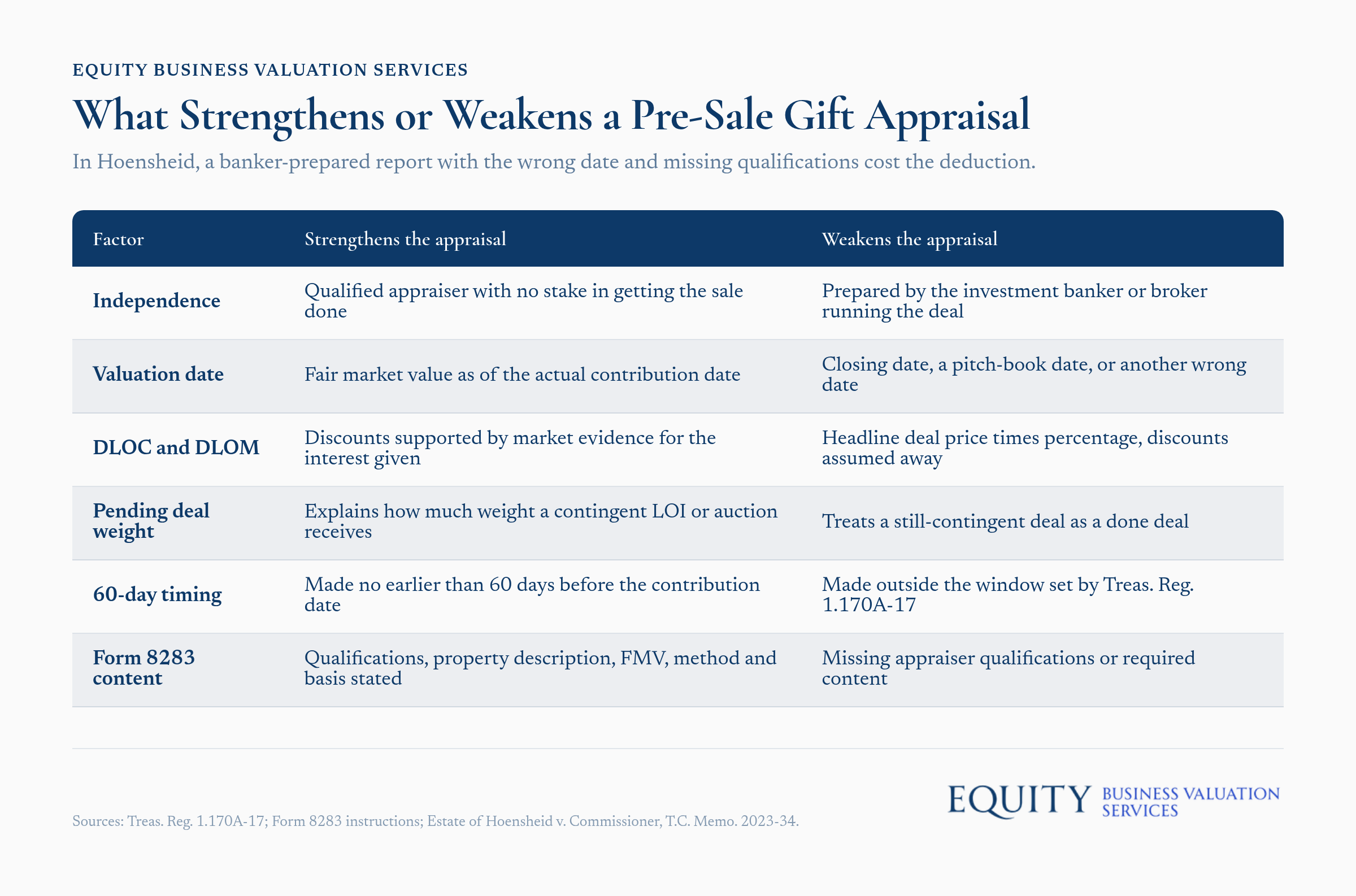
Estate of Hoensheid v. Commissioner, T.C. Memo. 2023-34 shows how tight that window can be. The Tax Court found the gift of closely held shares completed on July 13, 2015, with the purchase agreement signed and the sale closed on July 15. Even without a legal obligation on the charity to sell, the court treated the sale as a virtual certainty and taxed the gain to the donor. It also denied the charitable deduction because the appraisal was not a qualified appraisal: it was prepared by the investment banker working the deal, omitted required qualifications, and used the wrong contribution date.
For valuation planning, that means two practical constraints. The gift, and therefore the valuation date, usually needs to fall while real deal risk remains. And the person signing the appraisal cannot be the banker, broker, or other party with a stake in getting the sale done.
What a Pre-Sale Gift Appraisal Has to Get Right
A defensible report for donated closely held stock or a business interest typically addresses:
- The exact interest transferred. Share class, percentage, voting rights, transfer restrictions in the governing documents, and any drag-along, tag-along, or repurchase rights the charity inherits.
- Standard of value and premise. Fair market value for income-tax charitable contribution purposes, as of the contribution date, under the willing-buyer/willing-seller definition the IRS and courts use for donated property.
- Approaches applied. Income, market, and/or asset approaches reconciling to a conclusion for that interest, not a mechanical average and not a simple take-out of the pending deal price.
- Discounts that fit the interest. A minority block often supports a discount for lack of control. Closely held shares almost always support analysis of a discount for lack of marketability. A signed letter of intent or active sale process can narrow DLOM relative to an unsolicited minority stake with no exit path, but the discount still has to be evidence-based, not assumed away because a buyer exists.
- Independence and credentials. The appraiser must meet the qualified-appraiser rules in Treas. Reg. §1.170A-17(b), regularly perform appraisals for compensation, and have verifiable education and experience in valuing the type of property. Someone whose firm is pitching or running the sale is the fact pattern Hoensheid rejected.
- Content and timing. Description of the property, contribution date, appraiser identifying information and qualifications, statement that the appraisal was prepared for income-tax purposes, appraisal date(s), FMV, and the method and specific basis for the valuation, all within the 60-day window.
None of those items is optional window dressing. In Hoensheid, missing qualifications and the wrong date were enough, together with the other defects, to deny the deduction even before the assignment-of-income holding.
How Discounts Interact With a Pending Sale
Owners sometimes expect the donated block to be valued at the headline enterprise price times their percentage. That is rarely how a minority or restricted interest is valued for a charitable deduction. The question is what a hypothetical buyer would pay for the specific interest on the gift date, with the rights and restrictions that travel with it.
A pending sale can raise value by improving exit visibility and reducing marketability risk. It does not automatically erase a lack-of-control discount on a non-controlling block, and it does not turn every letter of intent into a binding price. The report should explain, with market evidence where available, how much weight the pending process receives and why. Over-weighting a still-contingent deal or under-weighting transfer restrictions are both common audit pressure points.
For partnership and LLC interests, capital-account mechanics, preferential distribution waterfalls, and consent requirements can matter as much as headline EBITDA multiples. The same is true for S corporation interests when the charity's ability to hold the interest and the company's eligibility rules constrain who can be a substitute owner.
How Equity Business Valuation Services Helps Founders and Advisors
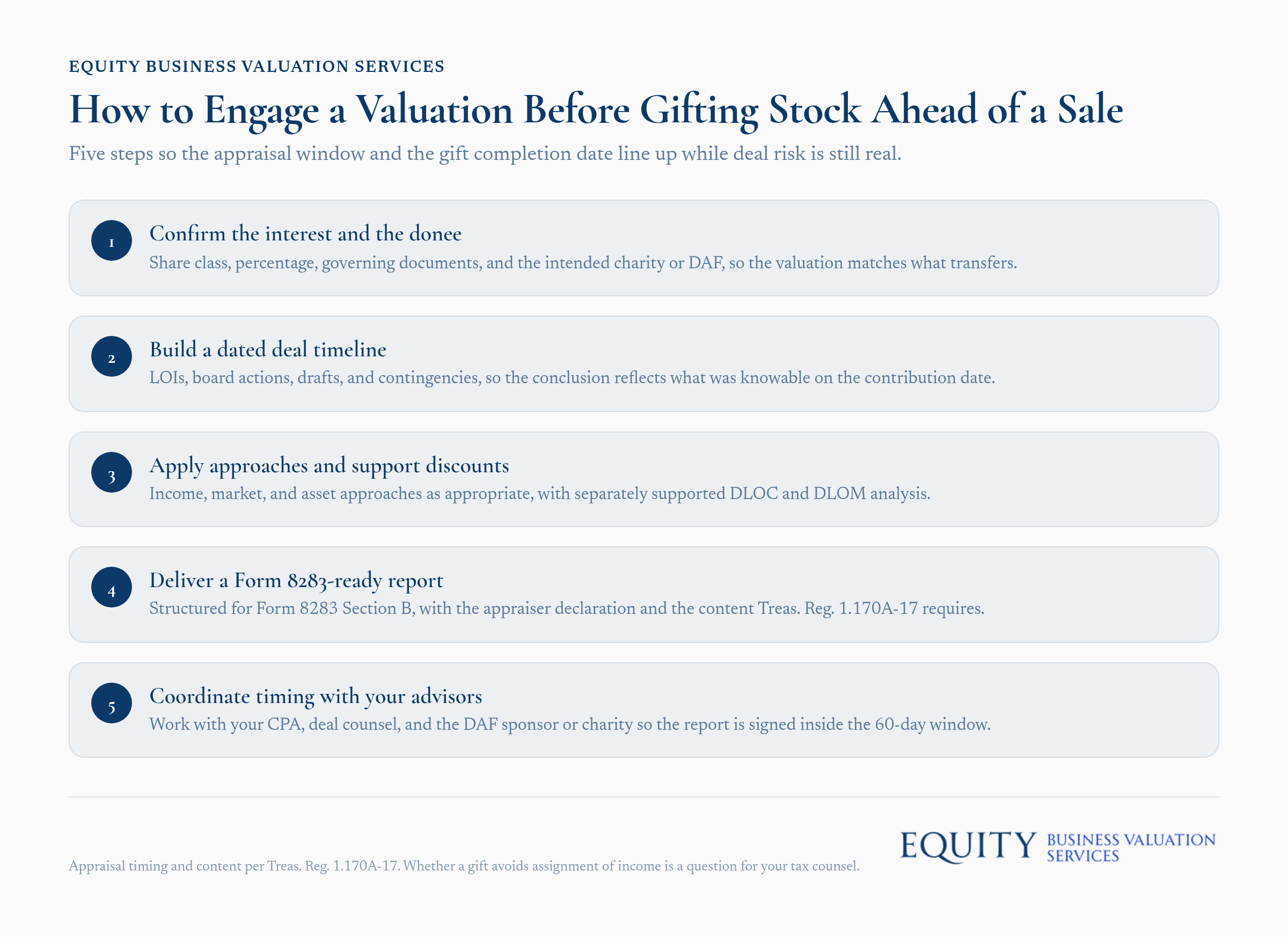
Equity Business Valuation Services prepares USPAP-compliant business valuations and qualified appraisals of closely held equity for charitable contribution, gift, estate, and related tax uses. On a pre-sale gift engagement we typically:
- Confirm the interest, governing documents, and intended donee so the valuation matches what will actually transfer.
- Build a dated timeline of LOIs, board actions, drafts, and contingencies so the contribution-date conclusion reflects what was knowable then, not what closed later.
- Apply income, market, and asset approaches as appropriate, with separately supported DLOC and DLOM analysis where the interest warrants it.
- Deliver a report structured for Form 8283 Section B, with the appraiser declaration and the content Treas. Reg. §1.170A-17 requires.
- Coordinate with your CPA, deal counsel, and the donor-advised fund sponsor or charity on timing so the appraisal window and the gift completion date line up.
We do not provide legal or tax advice on whether a particular gift avoids assignment of income. That call belongs to your tax counsel. What we do provide is an independent, credentialed valuation of the business interest as of the right date, written so the deduction has a chance to survive scrutiny.
If a sale process is already in motion and you are weighing a gift of shares or units, request a business valuation early enough that the report can be signed inside the 60-day window and the transfer can finish while deal risk remains real.