
Blog
Valuing S Corporations: Tax Affecting, Gross v. Commissioner, and the IRS Job Aid
Valuing an S corporation hinges on whether you tax affect its earnings, a question the Tax Court, the Sixth Circuit, and the IRS have each answered differently since 1999. This guide walks through Gross v. Commissioner, the IRS's 2014 Job Aid, and why no fixed premium or discount replaces a facts-and-circumstances analysis.
There are now more S corporations in the United States than C corporations, and yet valuing one remains one of the most contested exercises in business appraisal. The entire debate turns on a single technical question: should an appraiser "tax affect" an S corp's earnings, meaning apply a hypothetical corporate income tax to them before capitalizing or discounting the cash flow? Get that question wrong and the resulting value can swing by double digits. This guide walks through how the law and the IRS's own guidance answer it, and where the real judgment calls still live.
Why Tax Affecting Is the Central Question in S Corp Valuation
An S corporation generally pays no federal income tax at the entity level. Income passes through and is taxed once, on the shareholder's personal return, instead of twice (once at the corporate level, again when distributed to shareholders as in a C corporation). All else equal, that single layer of taxation leaves more cash available to the S corp shareholder than a C corp shareholder would receive from the same pre-tax earnings.
The valuation question is what to do with that advantage when you build an income approach. Most income and market approach data, comparable company multiples, discount rates, industry benchmarks, is built from publicly traded C corporations that do pay entity-level tax. An appraiser has to decide whether to normalize the S corp's earnings down to a C corp equivalent (tax affecting), leave them alone, or land somewhere in between. For decades, the default answer was to tax affect. That default no longer holds.
The Old Approach: Treating S Corp Earnings Like a C Corp's
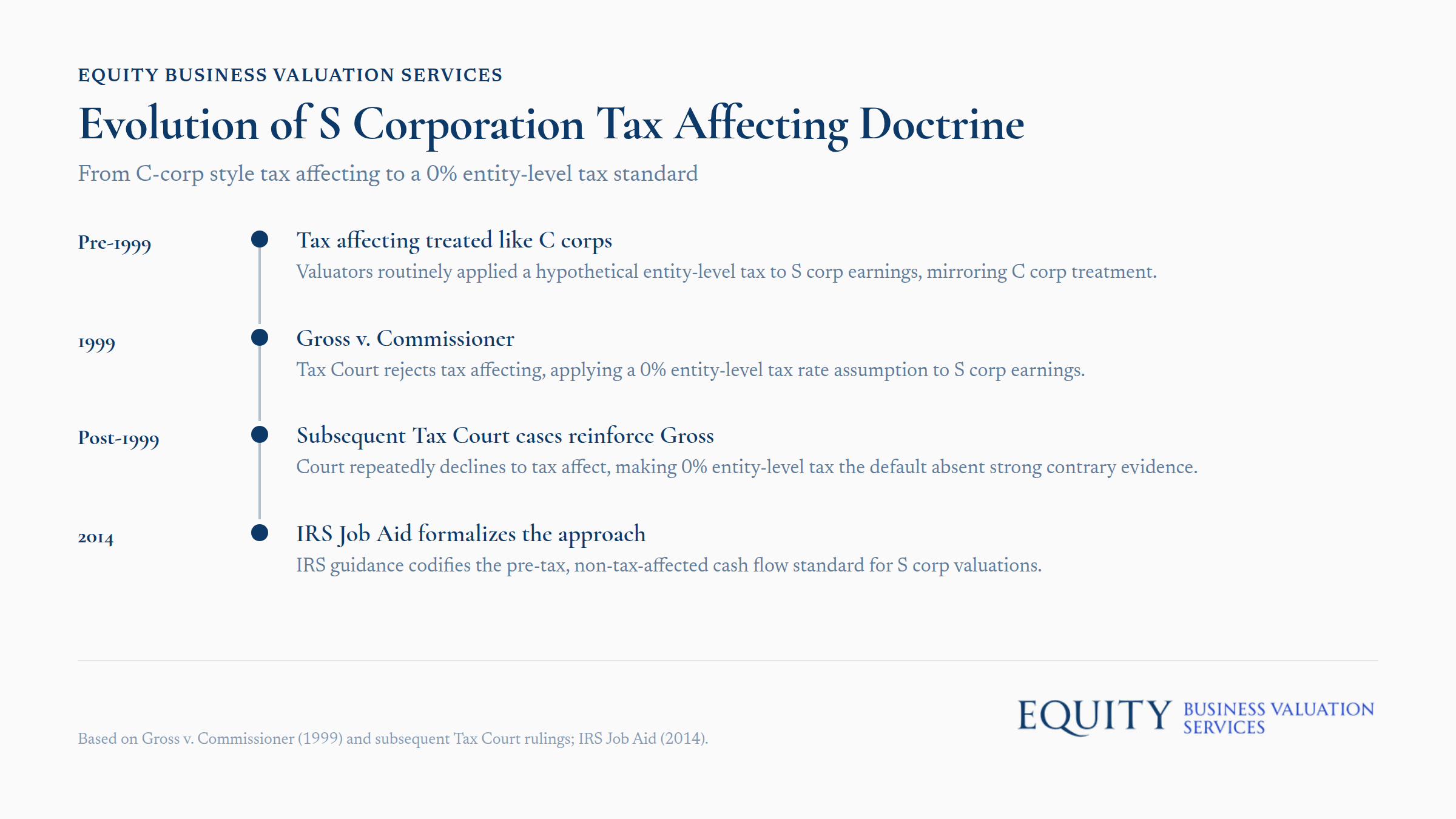
Before 1999, the common practice among appraisers, including many working for the IRS, was to simply deduct a hypothetical corporate tax rate from an S corporation's earnings before applying an income approach, as though the company were a C corporation. The logic was administrative convenience: it let appraisers plug S corp cash flows into cost-of-capital data and pricing multiples drawn entirely from C corp markets without adjustment.
The problem is that this practice erases the exact economic benefit that makes an S corp election worth electing in the first place. If a $10 million pre-tax earnings stream is taxed at a hypothetical 35% corporate rate before it ever reaches the shareholder, the valuation treats the S corp as if it had no tax advantage at all, even though the shareholder never actually pays that entity-level tax.
Gross v. Commissioner: The Case That Changed S Corp Valuation
The turning point was the Tax Court's 1999 decision in Gross v. Commissioner, later affirmed by the Sixth Circuit Court of Appeals. The IRS's own expert had tax affected the S corporation's earnings using a C corp rate; the Tax Court rejected that approach and effectively applied a 0% entity-level tax rate to the company's earnings for valuation purposes.
The court's reasoning was straightforward: the tax savings created by the S election is a real, quantifiable economic benefit that accrues to the shareholder, not an accounting fiction to be assumed away. Wiping it out through mechanical tax affecting understated the value of what a willing buyer would actually be purchasing.
Watch out: Don't confuse "no entity-level tax" with "no adjustments at all." Gross didn't say S corps and C corps are worth the same; it said the pass-through tax benefit is real and has to be reflected somewhere in the analysis, whether through cash flow, cost of capital, or a combination of both.
The Post-Gross Tax Court Cases
Gross was not an isolated ruling. In the years that followed, the Tax Court repeatedly declined to tax affect S corporation earnings in subsequent cases, reinforcing that a 0% entity-level tax assumption had become the court's default starting point absent compelling evidence to the contrary. This line of decisions solidified what had been a single controversial ruling into a consistent judicial position, and it is the reason nearly every S corp valuation prepared today starts from pre-tax, not tax-affected, cash flow.
The IRS's 2014 Job Aid for Valuation Analysts
The IRS eventually formalized its own position in a document titled a Job Aid for its valuation professionals, dated October 29, 2014, addressing the valuation of non-controlling interests in electing S corporations. The document is explicit that it is not official IRS position and was prepared for internal reference only, but it reflects how IRS valuation staff are instructed to approach these engagements, and it is publicly available through the IRS's S Corporation Valuation Job Aid.
The Job Aid grounds its analysis in Revenue Ruling 59-60, the foundational guidance that has governed closely held business valuation since 1959, and it acknowledges directly that the absence of entity-level tax is a factor that tends to enhance an S corp's value relative to an otherwise identical C corp.
But the Job Aid does not stop there. It also flags real, potential disadvantages inherent in S corp status that a defensible valuation has to weigh:
- Cost of capital differences: restrictions on who can own S corp stock and how distributions must be handled can add risk that a buyer would price into a higher required return.
- Marketability discounts: S corp shares can face additional transfer restrictions that make them harder to sell than an equivalent C corp interest.
- Discount for lack of control, in certain cases: a non-controlling shareholder in an S corp may have less ability to influence distribution policy or preserve the S election than a controlling shareholder would.
Key takeaway: the IRS's own guidance treats S corp status as a two-sided coin. It boosts value through the tax benefit, but it can also justify offsetting discounts through cost of capital and marketability. Neither side cancels the other out automatically; both have to be supported by the specific facts of the company.
What the Empirical Data Actually Shows About S Corp Premiums
A reasonable next question is: how much is the S corp tax advantage actually worth in a real transaction? The empirical research here is mixed, and that inconsistency is itself an important lesson for anyone tempted to apply a rule-of-thumb premium.
One study examining controlling-interest stock sales, with an average transaction value around $50 million, found that S corporations sold at a 12% to 17% premium over comparable C corporations. A second, broader study looking across a wider range of transactions found no discernible difference between S corp and C corp sale prices at all.
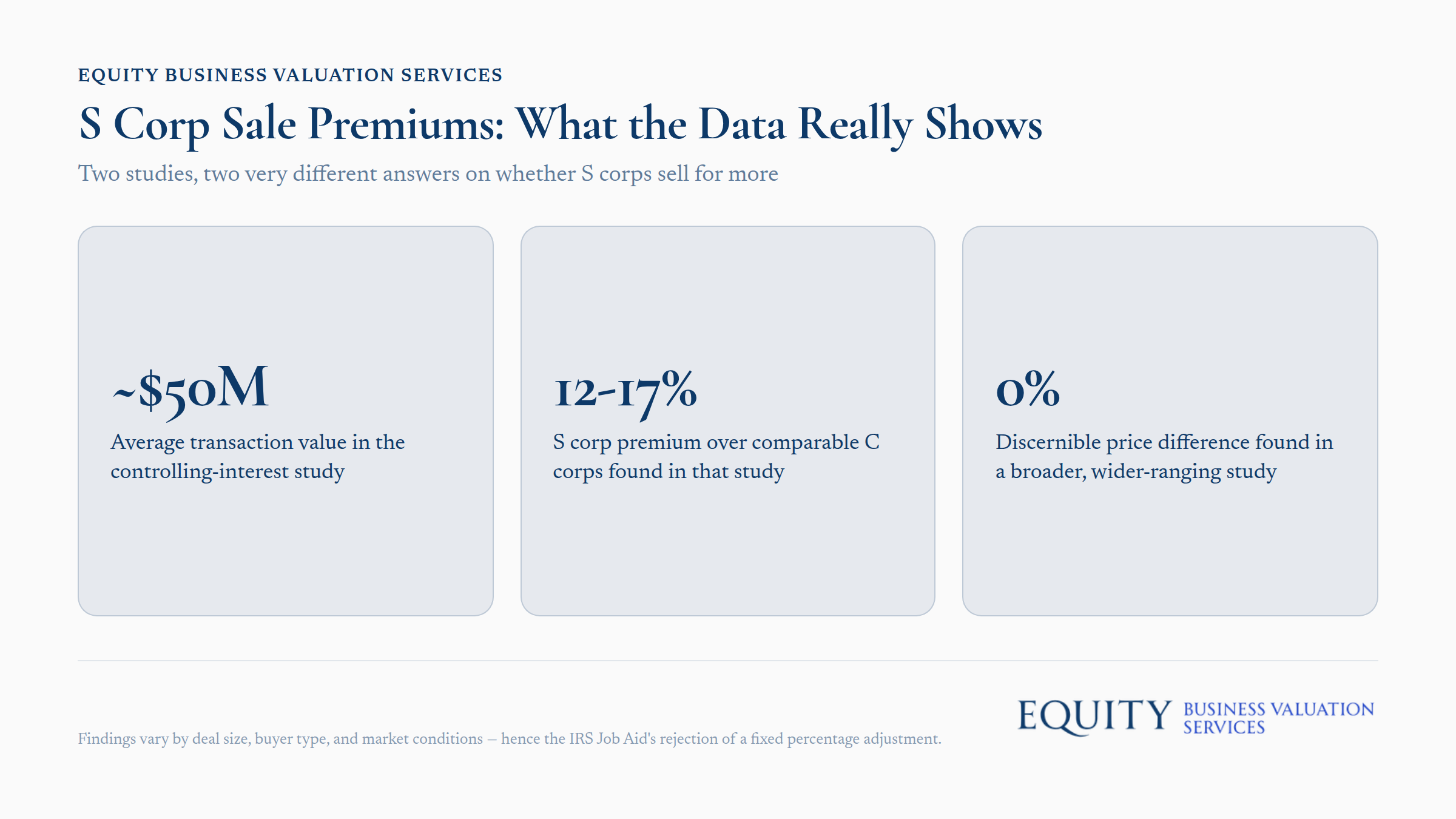
Those two findings do not contradict each other so much as they illustrate that the S corp premium, if one exists in a given transaction, depends heavily on deal size, buyer type, and market conditions at the time of sale. A tax-exempt buyer or one that cannot fully use the pass-through benefit will not pay the same premium a taxable individual buyer would. This is exactly why the IRS Job Aid and the Tax Court cases that preceded it both reject a fixed percentage adjustment in favor of a facts-and-circumstances analysis.
Built-In Gains Tax: A Different Discount Entirely
It's worth separating tax affecting from a related but distinct concept: the built-in gains (BIG) tax discount. This issue arises mainly under the asset approach, not the income approach, and it applies when a company, including an S corp that converted from C corp status or that holds significantly appreciated assets, would owe corporate-level capital gains tax if it hypothetically liquidated those assets.
Because many S corps carry a history as C corporations or hold appreciated real estate, equipment, or goodwill, a hypothetical asset sale inside the valuation can trigger a real tax liability that reduces the net value available to shareholders. Courts have recognized discounts for this built-in tax exposure in asset-approach valuations, but the size and applicability of the discount depend on the specific asset mix, the holding period remaining under the recognition period rules, and whether a sale is actually contemplated. This is a separate analytical step from deciding whether to tax affect the income stream, and a thorough valuation addresses both where relevant.
Getting a Defensible S Corp Valuation
If there's one theme running through Gross, the Tax Court cases that followed it, and the IRS's own Job Aid, it's that a defensible S corp valuation cannot be built on a mechanical formula. A credentialed appraiser working through cost of capital, marketability, control premiums or discounts, and built-in gains tax exposure where applicable, grounded in the same Revenue Ruling 59-60 factors that have governed closely held business valuation for over 60 years, is doing exactly the kind of judgment call this area of tax law demands.
Our valuation team holds credentials including the American Society of Appraisers (ASA), the CFA Institute's Chartered Financial Analyst designation, and the AICPA's Accredited in Business Valuation (ABV) credential, and we prepare every report in accordance with USPAP. Business valuations are performed remotely, which keeps the engagement efficient without sacrificing the depth this kind of analysis requires.
If you're an owner, CPA, or attorney facing an S corp valuation for a gift, estate, buy-sell, or IRS matter, this is not the place to guess at a premium or discount. See our business valuation pricing for what a properly supported engagement involves, or request an appraisal to start the process. For related reading on how minority interest discounts play out in adjacent contexts, see our piece on qualified opportunity fund minority interest valuation.
This article is provided for general informational purposes only and does not constitute legal, tax, or financial advice. Readers should consult a qualified attorney or CPA regarding their specific circumstances.