
Blog
What Makes a Business Appraisal a Qualified Appraisal Under IRS Rules?
A qualified appraisal under IRS rules has specific appraiser, content, and timing requirements that an ordinary business valuation report does not automatically satisfy. This guide explains exactly what a donation of closely held stock or a partnership interest needs before you claim the deduction.
Donating shares in a closely held corporation, an S-corp interest, or a stake in a family partnership can generate a meaningful charitable deduction. It can also generate an IRS problem if the paperwork behind it isn't a qualified appraisal in the technical sense the tax code demands. We see this mix-up constantly: a business owner has a perfectly good business valuation for a charitable donation prepared by a credentialed professional, assumes that's enough, and later learns the report doesn't meet the specific form and content rules the IRS requires for noncash gifts over $5,000.
This guide walks through what actually separates a qualified appraisal from a standard valuation report, who is allowed to sign one, what it must contain, and when it has to be dated. Get this wrong and the deduction can be denied even if the underlying value conclusion was accurate.
What Is a Qualified Appraisal Under IRS Rules?
A qualified appraisal is a written appraisal document prepared by a qualified appraiser, following generally accepted appraisal standards, that meets the specific content and timing rules set out in Treasury Regulation 1.170A-17. It is not a label any valuation professional can simply apply to their own work. The term has a defined legal meaning tied to Internal Revenue Code Section 170(f)(11), and it applies when a taxpayer claims a deduction for a noncash charitable contribution.
For donations of nonpublicly traded stock, S-corp shares, or partnership interests, the appraisal has to value the specific interest being given away, not the entire company. A gift of 8% of a family business is appraised as that 8% stake, with whatever minority and marketability considerations apply to it, not as a slice of total enterprise value.
When Does Donating a Business Interest Require a Qualified Appraisal?
A deduction for a noncash charitable contribution of nonpublicly traded stock or a business interest over $5,000 generally requires a qualified appraisal and Section B of Form 8283. Below that threshold, taxpayers can typically rely on simpler substantiation, but once the claimed deduction for the interest (or a group of similar items) exceeds $5,000, the written appraisal becomes mandatory.
It's worth being precise about what Form 8283 actually is. The IRS Instructions for Form 8283 make clear that the form is an appraisal summary, not the appraisal itself. Section B requires the donor, and separately the appraiser, to attest to specific facts, but the full appraisal report is a standalone document that the donor keeps on file and that the IRS can request. Submitting a completed Form 8283 without a compliant underlying appraisal does not satisfy the requirement, even though the form itself looks complete.
Watch out: A CPA or financial advisor sometimes prepares a letter estimating the value of a business interest for gift purposes. That letter, however well reasoned, is not a qualified appraisal unless it was prepared by a qualified appraiser and meets every content and timing requirement below.
Who Qualifies as a Qualified Appraiser for a Business Interest?
Not every valuation professional automatically counts as a qualified appraiser for a specific donated asset. Treasury Regulation 1.170A-17(b) sets out several requirements the individual must meet:
- The appraiser must hold a recognized appraiser designation from a professional appraiser organization, or have completed relevant coursework plus at least 2 years of experience valuing the type of property being appraised.
- The appraiser must regularly perform appraisals for compensation as part of their business or profession, rather than valuing property as an occasional side task.
- The appraiser must declare in the report, based on their education and experience, that they are qualified to value the specific type of property involved.
- The appraiser must sign the appraiser declaration in Part IV of Form 8283, confirming they understand the penalties for a false or fraudulent overstatement.
- The appraiser cannot be the donor, the donee organization, a party to the transaction by which the donor acquired the property, or otherwise excluded under the regulation's conflict-of-interest rules.
For a closely held business interest, experience matters in a specific way. A generally credentialed personal property or real estate appraiser does not automatically qualify. The relevant experience is in valuing equity interests, partnership stakes, and closely held companies, which is a distinct discipline built around income, market, and asset-based approaches rather than comparable sales of physical assets. Credentials such as the ASA (American Society of Appraisers) and the NACVA (National Association of Certified Valuators and Analysts) are examples of designations that signal this specific background, though no single appraiser holds every credential in the field, and our team assigns engagements based on the specific experience a given business interest requires.
What the Qualified Appraisal Report Must Include
Treasury Regulation 1.170A-17(a) spells out the content a qualified appraisal must contain. Skipping any one of these elements can be enough for the IRS to disregard the appraisal entirely:
- A description of the business interest in enough detail that someone unfamiliar with it could identify exactly what was contributed, including the number or percentage of shares, units, or partnership interests.
- The fair market value of the interest and the specific valuation date used.
- The date of the actual contribution to the charity.
- The valuation method used, whether the income approach, the market approach, or an asset-based approach, along with the specific basis for the conclusion reached.
- The appraiser's qualifications, including relevant background, education, and experience valuing this type of interest.
- The appraiser's signed declaration confirming their qualifications and their understanding of the penalties for a false appraisal.
- Full disclosure of the fee arrangement for the appraisal. A fee tied to a percentage of the appraised value disqualifies the appraisal outright.
The report also needs to be prepared consistent with generally accepted appraisal standards, which for our profession means following the Uniform Standards of Professional Appraisal Practice (USPAP). A report that skips methodology explanations or simply states a number without supporting analysis will not meet this bar, regardless of who signed it.
The 60-Day Timing Rule Most Donors Miss
The appraisal must be signed and dated no earlier than 60 days before the date of the contribution, and the donor must have it in hand by the due date of the tax return (including extensions) on which the deduction is first claimed. The IRS Instructions for Form 8283 reinforce this same window.
Example: A business owner plans to gift a 15% LLC interest to a donor-advised fund on June 1. The appraisal needs to be signed and dated no earlier than April 2 of that year. An appraisal dated the previous November, even if the value hasn't materially changed, falls outside the allowed window and will not support the deduction.
Pro tip: Build the appraisal timeline backward from your intended filing date, not forward from the gift date. Valuing a closely held business interest properly, with normalized financials and a defensible discount analysis, takes real time, and rushing it to hit the 60-day window is where errors creep in.
Why Your Buy-Sell or Litigation Valuation Report Probably Isn't a Qualified Appraisal
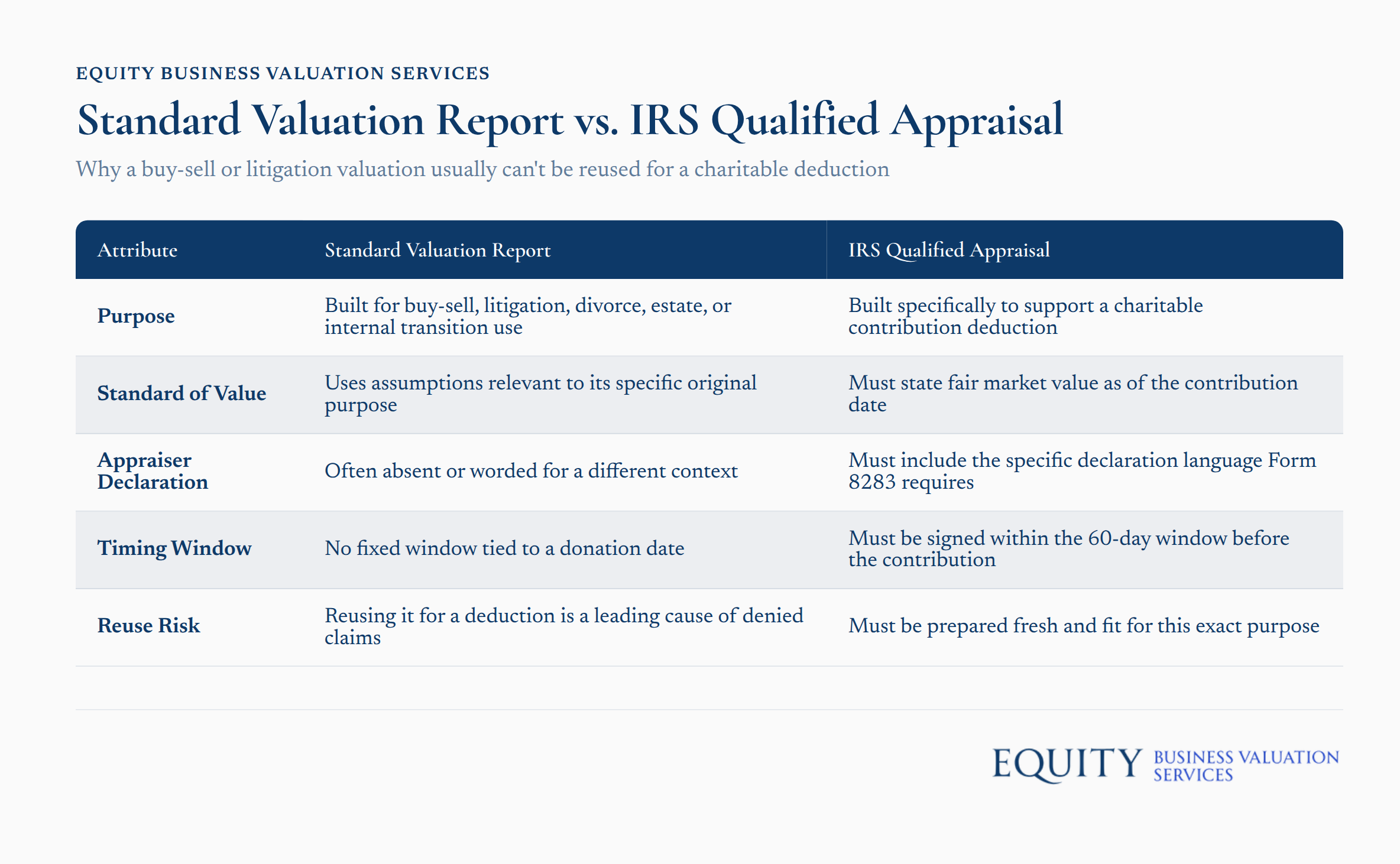
This is the mix-up that causes the most denied deductions. A business might already have a recent valuation report prepared for a buy-sell agreement, a divorce proceeding, estate planning, or an internal ownership transition. That report can be thorough, well-documented, and prepared by a highly credentialed appraiser, and it still will not automatically qualify for a charitable deduction.
The reason comes down to purpose and form, not competence. A valuation prepared for litigation or a buy-sell agreement is built around the standard of value and assumptions relevant to that specific use. It may not state fair market value as of the contribution date, may not include the specific appraiser declaration language Form 8283 requires, and may fall outside the 60-day signing window entirely. Reusing an old report, or a report built for a different purpose, is one of the fastest ways to lose a deduction on audit.
Which Valuation Methods Satisfy the IRS Standard?
The regulation does not mandate one specific formula for valuing a closely held business interest. It requires that the appraiser disclose the method used and the specific basis for the conclusion. In practice, qualified appraisals of business interests rely on the same three approaches used across the valuation profession generally: the income approach, the market approach, and the asset-based approach, sometimes in combination depending on the nature of the entity and the interest being valued.
For a minority interest in a family partnership or an S-corp, the analysis typically also addresses discounts for lack of control and lack of marketability, since a non-controlling, illiquid stake is worth less per unit than a pro rata slice of the whole enterprise. These adjustments need to be explained and supported within the report itself, not just asserted as a flat percentage.
Get the Appraisal Right Before You File
A qualified appraisal is a specific legal and procedural requirement, not just a label attached to good valuation work. If you're planning to donate a closely held business interest, confirm upfront that the appraiser you engage understands the Form 8283 declaration, the 60-day timing rule, and the content requirements under Treasury Regulation 1.170A-17, not just how to value the entity. Our valuation team prepares these reports to meet that standard from the outset, and you can request an appraisal to get the timeline and documentation right before your filing deadline.
This article is provided for general informational purposes only and does not constitute legal, tax, or financial advice. Readers should consult a qualified attorney or CPA regarding their specific circumstances.