
Blog
Valuing a Minority Limited Partnership Interest When the Fund Won't Share Data
Minority limited partnership interest valuation gets complicated fast when a general partner withholds portfolio-level detail. Here is how we build a defensible Form 706 or Form 709 valuation using the data that is actually available, plus properly documented DLOC and DLOM discounts.
Why Illiquid Holdings Make Minority LP Interests Hard to Value
A limited partnership interest in a family real estate fund, a private equity vehicle, or a closely held investment entity rarely trades hands. There is no ticker, no bid-ask spread, and often no willing comparable transaction to point to. That absence of a market is exactly why the IRS still expects a fair market value conclusion: the price at which the interest would change hands between a willing buyer and a willing seller, neither one under compulsion, both reasonably informed about the relevant facts. That standard underlies every business valuation we prepare for estate tax reporting and every valuation submitted with a gift tax return.
The practical problem is data. The underlying assets inside these partnerships, whether they're apartment buildings, venture stakes, or thinly traded debt, are themselves hard to price. When you layer a noncontrolling, nonmarketable partnership interest on top of hard-to-value assets, you get an appraisal problem with two distinct layers: valuing what the partnership owns, and then discounting for what the limited partner actually holds.
What Happens When the General Partner Won't Share Full Data
Many general partners provide only the minimum: a capital account statement, a Schedule K-1, and maybe an annual letter with narrative commentary. Full portfolio-level financials, asset-by-asset valuations, and internal projections often stay locked inside the GP's own records. That is a common and, frankly, expected constraint in this kind of engagement, not a reason to abandon the analysis.
When full transparency isn't available, we build the valuation from what we can verify and document every gap along the way:
- Audited or reviewed fund-level financials, when they exist, to establish a baseline net asset value
- Capital account statements and K-1s covering multiple years to identify contribution, distribution, and allocation patterns
- Distribution history to model realistic cash flow to the limited partner rather than theoretical entity-level cash flow
- The partnership agreement itself, which defines voting rights, transfer restrictions, consent requirements, and any redemption or liquidation mechanics
- Secondary market data or industry benchmarks for the fund's asset class, used to sanity-check NAV or fill gaps where direct data is unavailable
When a data point simply cannot be obtained, the report says so. A valuation that quietly assumes its way past a missing NAV update is far weaker under scrutiny than one that states the limitation and explains how it was addressed.
Watch out: A report that stays silent about data limitations invites challenge later. Stating the constraint and the workaround in the report is what makes the conclusion defensible if the IRS asks questions.
Discount for Lack of Control (DLOC) and Discount for Lack of Marketability (DLOM)
A minority limited partnership interest is valued down from its pro-rata share of net asset value for two separate reasons, and both need to be supported on their own terms.
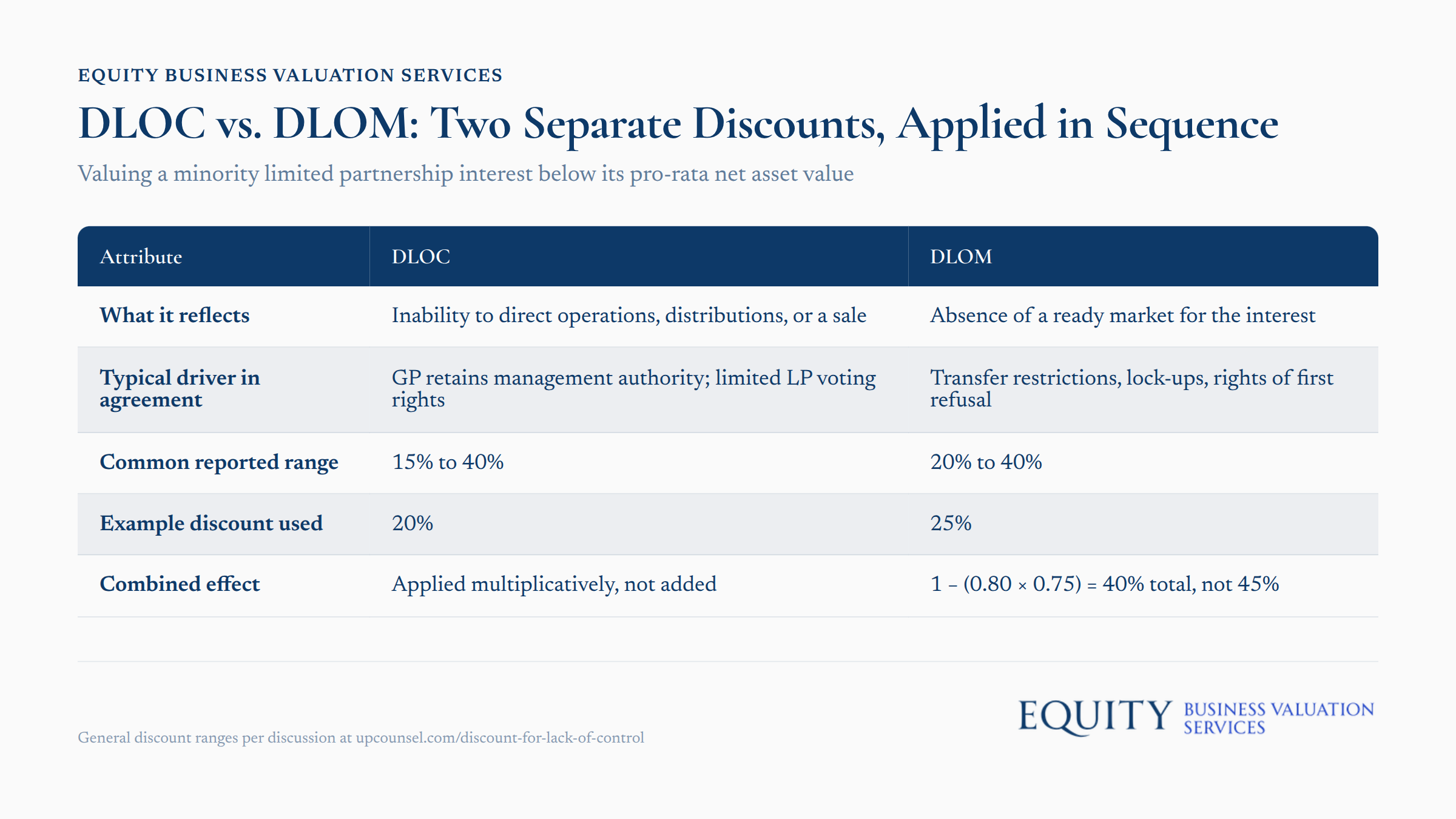
Discount for lack of control (DLOC) reflects that a limited partner cannot direct management, compel a sale of assets, remove the general partner, or change investment strategy. Reported ranges for DLOC in closely held partnerships commonly fall between 15% and 40%, depending on how restrictive the governing agreement is, as general discussions of the discount explain.
Discount for lack of marketability (DLOM) reflects the simple fact that there is no ready market to sell the interest into. No public listing, transfer restrictions, lock-up periods, and consent requirements all push this discount higher. DLOM ranges for minority interests in closely held entities often land between 20% and 40%, with more restrictive structures supporting discounts toward the higher end.
The two discounts are applied in sequence, not added together.
| Discount | What it reflects | Typical driver in the partnership agreement |
|---|---|---|
| DLOC | Inability to direct operations, distributions, or a sale | GP retains management authority; LPs have limited voting rights |
| DLOM | Absence of a ready market for the interest | Transfer restrictions, lock-ups, rights of first refusal, thin distribution history |
Example: If DLOC is 20% and DLOM is 25%, the combined discount is not 45%. It is calculated as 1 minus (0.80 times 0.75), which equals 40%. Applying discounts multiplicatively rather than additively is standard practice and matters when the IRS or a court reviews the math.
Key takeaway: DLOC and DLOM address two different economic disadvantages. A report that conflates them into a single blended number, without showing the separate analysis behind each, is harder to defend.
Applying the Income, Market, and Asset-Based Approaches With Incomplete Information
Even with limited data, a minority interest valuation still relies on the same three approaches used in any business valuation engagement, just adapted to what is actually available.
Asset-based approach
For partnerships that primarily hold real estate or investment portfolios, the asset-based approach starts with the fair market value of the entity's assets and liabilities, then applies DLOC and DLOM to the resulting per-unit NAV. When property-level appraisals or fund NAV statements exist, they anchor this calculation. Where they don't, independent appraisals, comparable property data, or reported NAV lagged by a known interval can substitute, with the lag and its effect on the conclusion disclosed in the report.
Income approach
The income approach models the cash flow the limited partner actually expects to receive, historical distributions, capital calls, and any known liquidation timeline, rather than the total cash flow of the entity. Discussions of family limited partnership valuation note that when the model is already built around the limited partner's own expected cash flow, the result sits at a minority level from the start, which changes how DLOC gets applied on top of it, as broader coverage of FLP valuation methodology explains. Discount rates in this approach account for illiquidity and the added uncertainty that comes from limited transparency into the fund's operations.
Market approach
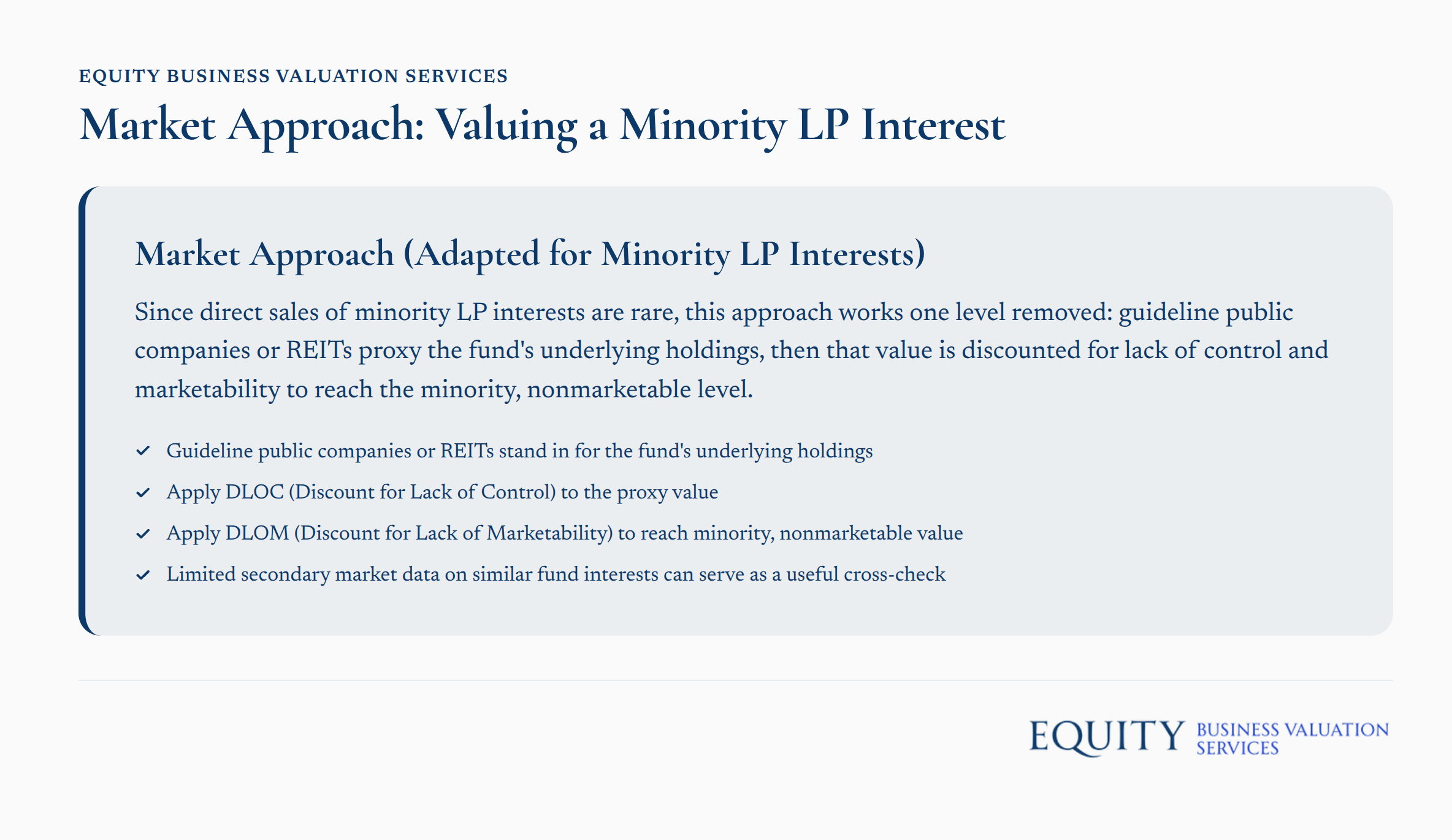
Direct transactions in minority LP interests are rare, so the market approach usually works one level removed: guideline public companies or REITs stand in for the partnership's underlying holdings, and the resulting value is then reduced by DLOC and DLOM to reach the minority, nonmarketable level. When secondary market data for similar fund interests does exist, even limited data points can serve as a useful cross-check against the other two approaches.
How We Approach These Engagements
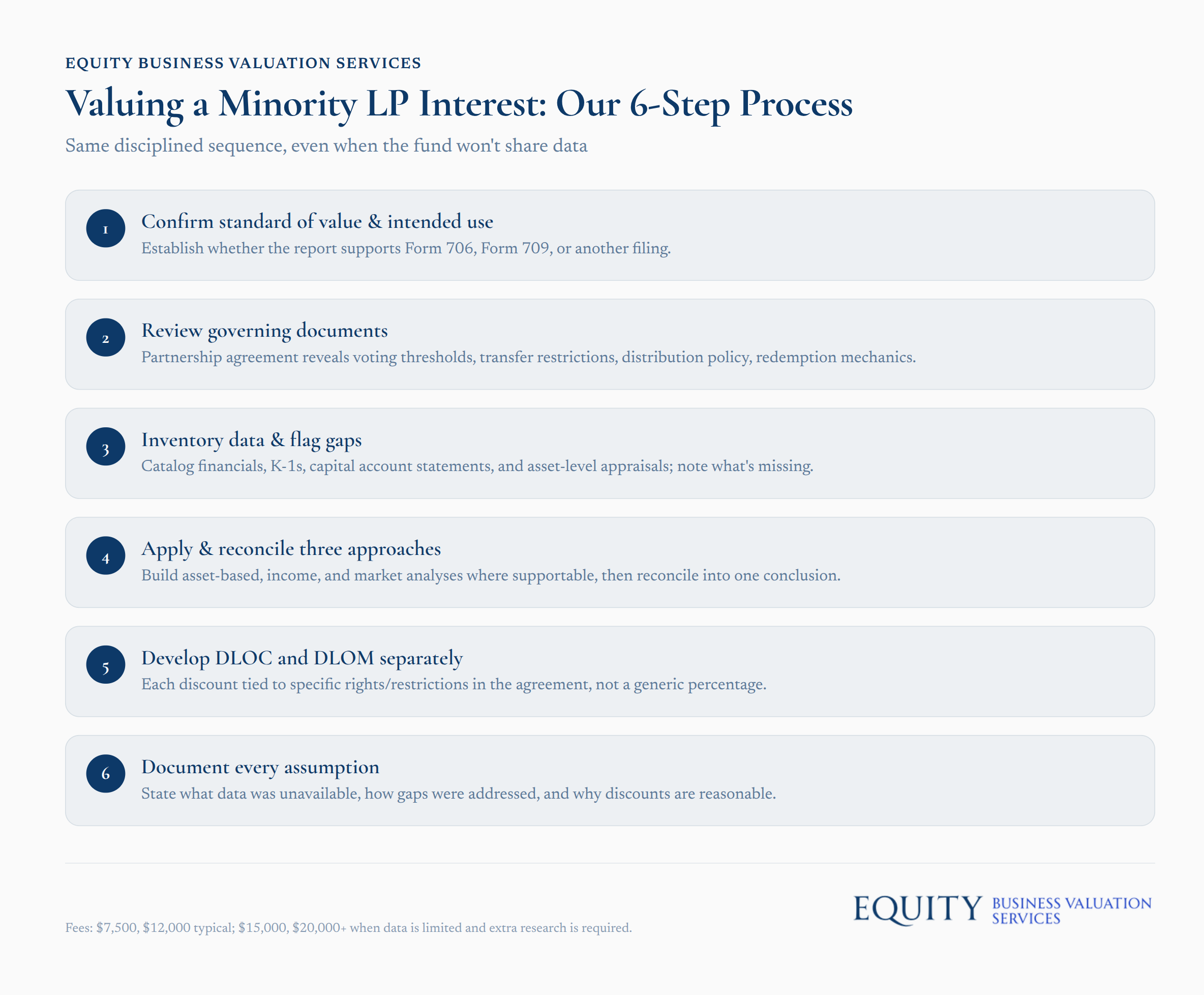
Every minority limited partnership interest engagement follows the same disciplined sequence, regardless of how much the fund manager is willing to share.
- Confirm the standard of value and intended use. We establish upfront whether the report supports Form 706, Form 709, or another filing, since that shapes documentation requirements from the start.
- Review the governing documents. The partnership agreement tells us what rights the limited partner actually has: voting thresholds, transfer restrictions, distribution policy, and any redemption mechanics.
- Inventory available data and flag the gaps. We catalog what financials, K-1s, capital account statements, and asset-level appraisals exist, and note explicitly what is missing.
- Apply and reconcile the three approaches. We build asset-based, income, and market analyses where each is supportable, and reconcile them into a single conclusion rather than picking one in isolation.
- Develop DLOC and DLOM separately. Each discount gets its own analysis tied to the specific rights and restrictions in the agreement, not a generic percentage pulled from an unrelated case.
- Document every assumption. The final report states what data was unavailable, how the gap was addressed, and why the resulting discounts and conclusion are reasonable given the facts.
Pro tip: Gather K-1s and capital account statements going back several years before the engagement starts. A longer distribution history gives the appraiser more to work with and often supports a more precise discount conclusion.
Business valuations of this type are quoted as a fixed fee before work begins, never billed hourly. Fees for a minority limited partnership interest generally fall between $7,500 and $12,000 when records are reasonably organized, and can run $15,000 to $20,000 or more when the fund provides limited data and additional research or benchmarking is required to fill the gaps.
Why a Defensible, Well-Documented Report Still Matters for Form 706 and Form 709
Estate and gift tax returns are exactly where the IRS scrutinizes limited partnership valuations most closely. Reporting a limited partnership interest on Form 706 or Form 709 without a clear explanation of methodology, data sources, and discount support is an invitation for examination, and courts have reduced or denied discounts in cases where the underlying analysis was thin or where the partnership's structure looked primarily tax-motivated rather than economically justified.
A report that shows its work holds up better. That means walking through the governing agreement's actual restrictions, showing DLOC and DLOM as separate and supported figures, reconciling all three valuation approaches rather than leaning on just one, and stating plainly where information was unavailable and how that gap was addressed. Our appraisers hold credentials with organizations including the ASA and NACVA, and every report we prepare follows USPAP, giving executors, donors, and their attorneys a valuation built to hold up if the IRS asks questions.
If you're reporting a minority limited partnership interest on an estate or gift tax return, the quality of the documentation matters as much as the number itself. Our related guide on applying Revenue Ruling 59-60 to limited partnership interests walks through the fair market value framework in more depth.
This article is provided for general informational purposes only and does not constitute legal, tax, or financial advice. Readers should consult a qualified attorney or CPA regarding their specific circumstances.