
Blog
Minority Discount or Pro Rata Value? Valuing a Partnership Buyout
Whether a partnership buyout is valued as a discounted minority interest or a pro rata share of enterprise value depends on your governing agreement and the standard of value it invokes, not on which number feels fairer to either side. This guide explains how appraisers determine which standard applies and what that decision does to the buyout price.
When one partner buys out another, the single biggest driver of the final number often isn't the business's performance. It's a valuation question that sounds technical but has enormous financial consequences: should the departing partner's interest be valued as a discounted minority interest, or as a pro rata slice of the whole enterprise with no discounts at all? The two methods can produce wildly different prices for the exact same ownership percentage in the exact same company, and partners are frequently surprised to learn the answer isn't up to the appraiser. It's usually already written into an agreement they signed years ago.
This matters most in partnership dissolutions, LLC member buyouts, and shareholder exits, where the appraisal often doubles as the basis for business valuation in a divorce or an internal ownership transition. Getting the standard wrong doesn't just produce an inaccurate number; it produces a number that won't hold up if either side pushes back.
The Conceptual Distinction: Minority Discount vs Pro Rata Enterprise Value
A minority interest valued under fair market value principles is typically worth less per unit than a proportionate slice of the whole company. That's the entire concept in one sentence.
The reasoning is straightforward once you separate the two things being measured. A pro rata share of enterprise value starts with what the whole business is worth as a going concern and simply multiplies that number by the ownership percentage. A 25% owner gets 25% of the total, full stop, with no adjustment for anything else.
A discounted minority interest, by contrast, starts with that same enterprise value but then reduces the holder's slice to reflect two real economic disadvantages:
- Discount for lack of control (DLOC): the holder cannot unilaterally direct company decisions, set distributions, force a sale, or trigger a liquidation.
- Discount for lack of marketability (DLOM): there is no ready market for the interest, and finding a buyer, if one exists at all, takes time and typically requires a price concession.
These discounts aren't a judgment about whether the business itself is doing well. They reflect the practical reality that a noncontrolling, illiquid slice of a private company is worth less to a hypothetical buyer than an equivalent slice of a business they could actually run or easily resell. That's why the same 25% interest can appraise very differently depending on whether the assignment calls for a minority interest value or an enterprise-level pro rata value.
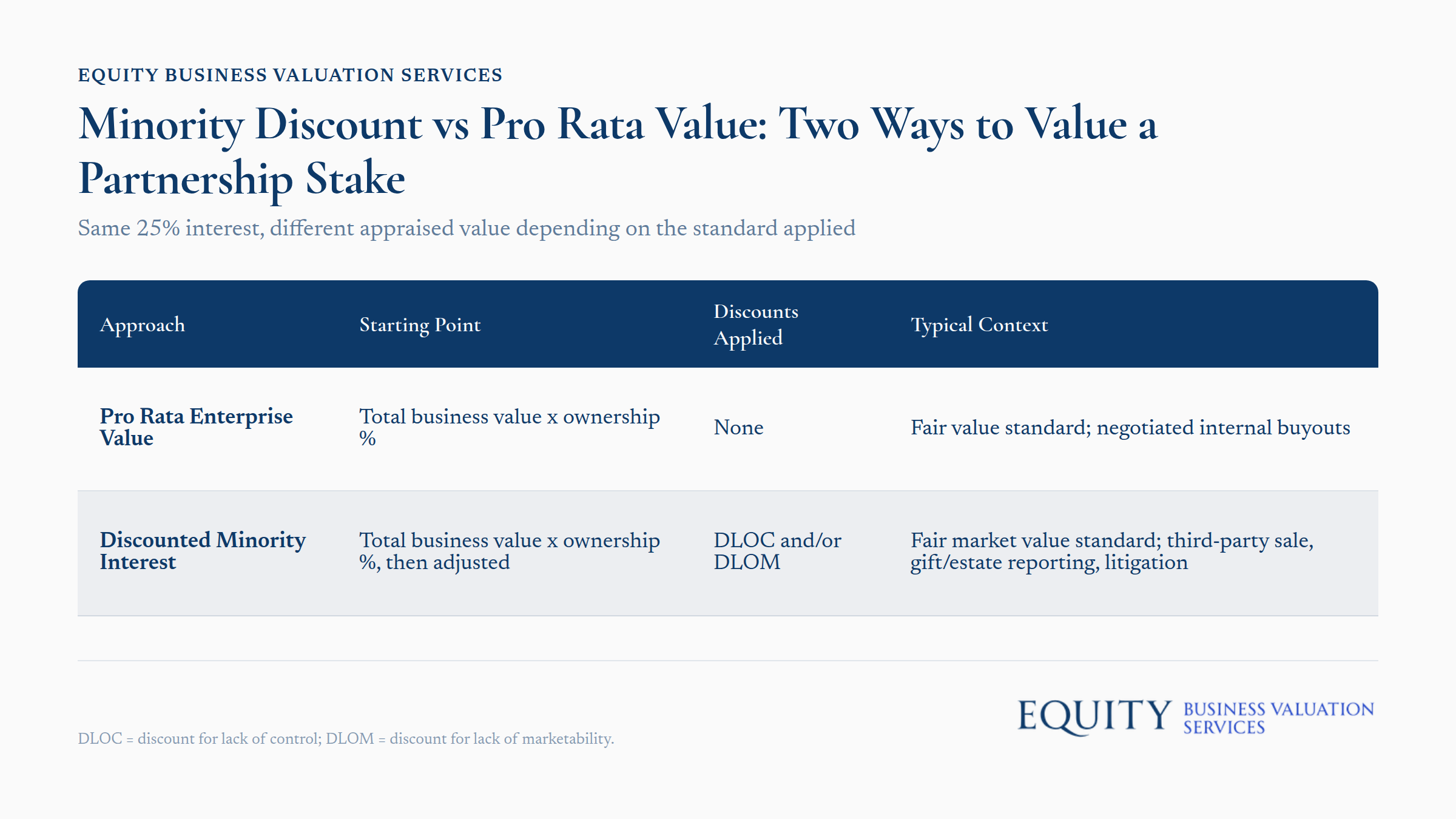
| Approach | Starting point | Discounts applied | Typical context |
|---|---|---|---|
| Pro rata enterprise value | Total business value x ownership % | None | Fair value standard; negotiated internal buyouts |
| Discounted minority interest | Total business value x ownership %, then adjusted | DLOC and/or DLOM | Fair market value standard; third-party sale, gift/estate reporting, litigation |
Your Partnership Agreement Controls First
Before any appraiser opens a spreadsheet, the governing document has to be read closely, because in most cases it already answers the question. Partnership agreements, LLC operating agreements, and buy-sell agreements frequently specify a valuation standard, and when they do, that language typically controls the appraiser's assignment ahead of any general legal doctrine.
The problem is that a large share of agreements use loose language: "fair market value," "fair value," "appraised value," or simply "value," without ever clarifying the level of value intended. A well-drafted agreement specifies three things: the standard of value, the level of value (whether the number represents the entire enterprise divided pro rata, or a specific minority interest), and whether, and how much, minority and marketability discounts apply.
Ambiguous or silent agreements are the single most common cause of buyout disputes. Both sides can read the identical clause to support opposite outcomes, and the disagreement often has to be worked out through negotiation, mediation, or litigation before an appraiser can even finalize a number.
Example: An operating agreement states that a departing member is entitled to "their proportional interest in the company." One partner reads that as a straightforward pro rata share of enterprise value. The other reads "interest" as shorthand for a specific, noncontrolling ownership stake that should be discounted. Both readings are defensible on the text alone, and that ambiguity is exactly what drives partners into a valuation dispute.
Watch out: Language referring to a share of "the assets" or "the value of the company" tends to point toward enterprise-level pro rata value. Language referring to a partner's "interest" tends to invite a minority-interest reading. Neither phrasing is a guarantee, which is why the agreement should be reviewed by counsel alongside the appraiser before the engagement scope is finalized.
Fair Market Value vs Fair Value: The Standard That Drives the Outcome
When the agreement is silent or ambiguous, the applicable standard of value usually decides whether discounts apply, and the two standards point in different directions.
Fair market value asks what a hypothetical willing buyer would pay a hypothetical willing seller, with neither party compelled to act and both reasonably informed. Under this standard, a noncontrolling, non-marketable interest is generally recognized as being worth less per unit than a proportionate share of the whole business, so lack of control and lack of marketability discounts are normally expected and appropriate.
Fair value is a different standard, used in many state corporate and LLC statutes and applied by courts in dissenting shareholder appraisal-rights cases, oppression cases, and some dissolution proceedings. In many of these legal contexts, courts and legislatures have moved toward excluding minority discounts, on the reasoning that an owner being squeezed out or dissenting from a major transaction shouldn't be penalized for lacking control they never chose to give up. Treatment of marketability discounts under fair value is more mixed: some jurisdictions permit a form of DLOM even under fair value, while many others limit or disallow it entirely.
Key takeaway: The words "fair value" and "fair market value" sound interchangeable in casual conversation, but in an appraisal they can point to two different dollar amounts for the same ownership stake. Confirm which one your agreement or the applicable statute actually specifies before assuming either result.
How Courts Have Split on Discounts in Oppression and Dissenting Shareholder Cases
There is a genuine and long-standing split of authority on this question across jurisdictions, and it deserves to be described honestly rather than papered over.
A substantial body of legal authority treats fair value, in dissenting shareholder and oppression contexts, as a pro rata, going-concern measure that does not permit a minority discount. The reasoning is remedial: the purpose of these statutes is to compensate an owner for their proportionate share of the business, not to price a hypothetical arm's-length sale of a minority block they never intended to sell.
A more limited set of authorities allows some form of discounting in certain circumstances, particularly where the statute, precedent, or transaction context in that jurisdiction points toward a market-based or fair-market-value-like approach instead.
Because this split turns on state statute and case law rather than a single national rule, this article intentionally does not cite specific states or case outcomes. If your buyout involves a dissenting shareholder claim, an oppression remedy, or a court-supervised dissolution, confirm the governing standard and its treatment of discounts with an attorney licensed in the relevant jurisdiction before the appraisal is finalized.
How Negotiated Buyouts Are Handled in Practice
Most partnership buyouts never see a courtroom, and that changes the analysis. Partners voluntarily agreeing to an internal buyout are not bound by a court's fair value doctrine unless their own agreement or an applicable statute imports it.
In practice, negotiated buyouts between continuing partners very often default toward a pro rata share of enterprise value with no discounts applied. That tendency shows up for a few consistent reasons:
- The partners see themselves as equals settling accounts on an ongoing business, not as an arm's-length buyer and seller in an open-market transaction.
- The buy-sell agreement's language, or the parties' shared understanding of it, points toward the value of the business as a whole rather than a discounted slice.
- A departing partner who never intended to sell to a stranger often won't accept a heavily discounted number, and continuing partners frequently agree that it wouldn't be fair to impose one.
Discounts are more likely to apply, even in a negotiated context, when the agreement clearly calls for fair market value of the specific interest changing hands, or when the appraisal serves a different purpose entirely, such as gift and estate tax reporting, a sale to an outside third party, or litigation where fair market value is the governing legal standard rather than an internal buyout. Our work on limited partnership interest valuation under IRS Rev. Rul. 59-60 walks through how that fair-market-value framework applies once the assignment shifts to a tax or third-party context.
Pro tip: If your partnership group wants certainty, address the standard of value and discount treatment directly in the buy-sell agreement itself, before a buyout is ever triggered. Partners are free to specify pro rata enterprise value, a discounted minority interest, or a defined formula; the earlier that decision is made in writing, the less room there is for a dispute later.
The Appraiser's Role: Applying the Standard, Not Choosing It
A qualified, independent business appraiser does not pick a standard of value because it produces a more favorable number for either side. The governing agreement, applicable statute, or court order controls, and the appraiser's job is to identify which standard applies, apply it consistently, and disclose exactly what was applied and why.
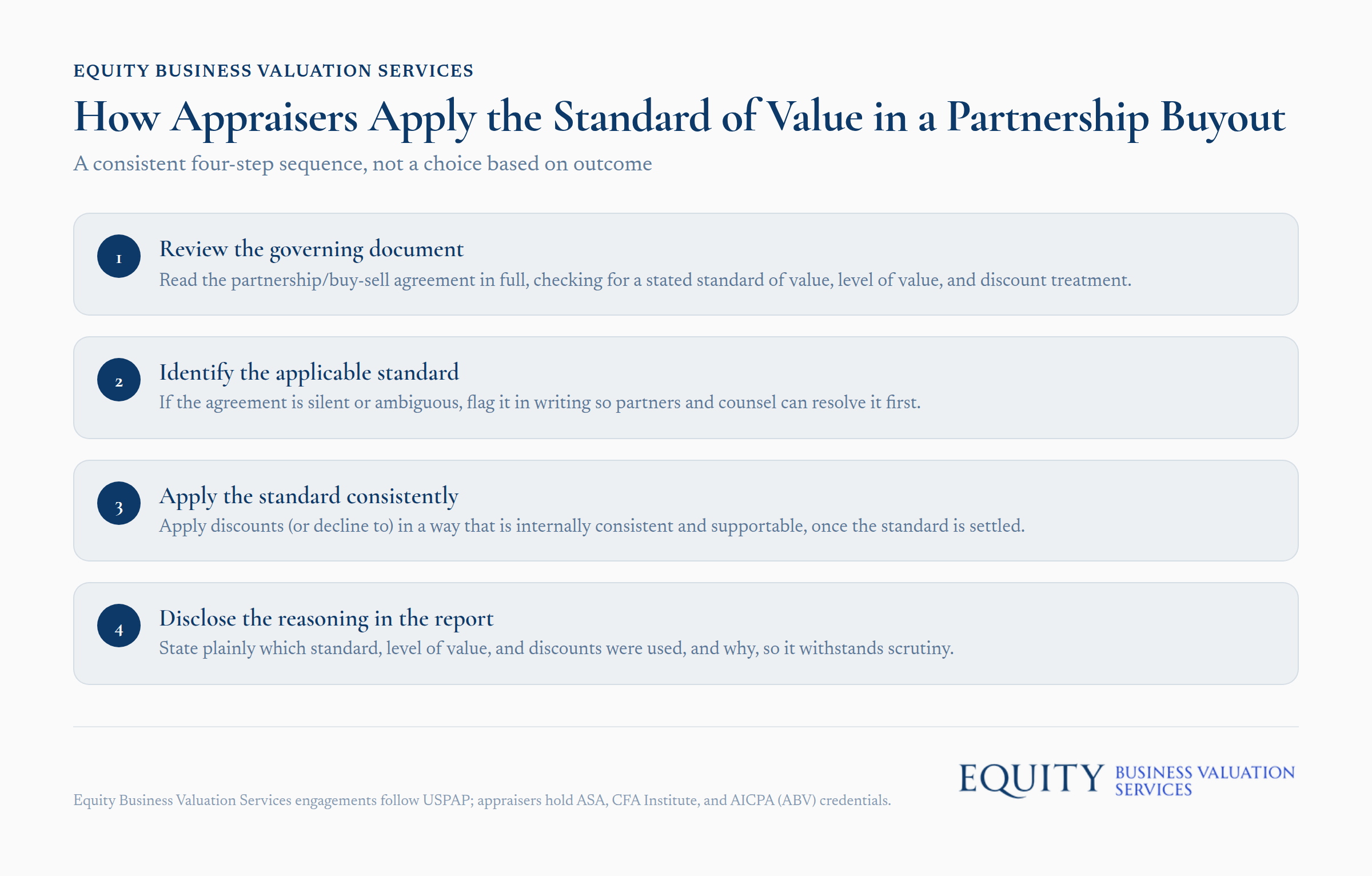
That process generally follows a consistent sequence:
- Review the governing document. The appraiser reads the partnership, operating, or buy-sell agreement in full before scoping the engagement, looking specifically for a stated standard of value, level of value, and discount treatment.
- Identify the applicable standard. If the agreement is silent or the language is genuinely ambiguous, the appraiser flags that in writing rather than guessing, so the partners and their counsel can resolve it before the number is finalized.
- Apply the standard consistently. Once the standard is settled, whether fair market value or fair value, the appraiser applies discounts (or declines to) in a way that is internally consistent and supportable.
- Disclose the reasoning in the report. The final report states plainly which standard, which level of value, and which discounts (if any) were used, and why, so the conclusion can withstand scrutiny from both partners and their advisors.
At Equity Business Valuation Services, we request the governing partnership, operating, or buy-sell agreement before we begin scoping a buyout valuation. We identify whether it specifies fair market value, fair value, a formula, or is silent or ambiguous, and when it's ambiguous, we say so plainly so the partners and their counsel can resolve the standard before the number is finalized rather than after. Our appraisers hold credentials with organizations such as the ASA, CFA Institute, and AICPA (ABV), and every engagement is prepared in accordance with USPAP. Buyout valuation fees are quoted as a fixed fee after we review the governing agreement and scope the assignment; the analysis never bills by the hour.
Frequently Asked Questions
Q: Does our partnership agreement decide this, or does the appraiser? The agreement decides it first. If your partnership, operating, or buy-sell agreement specifies a standard of value and discount treatment, that language generally controls the assignment. The appraiser's role is to interpret and apply what the agreement says, or to flag it clearly when the language is silent or ambiguous, not to substitute their own preference.
Q: What if our buy-sell agreement doesn't mention discounts at all? This is the most common scenario that leads to disputes. When the agreement is silent, the appraiser and the parties' attorneys typically need to determine which standard of value applies based on the agreement's other language, any applicable statute, and how the parties have historically treated similar situations. It's worth resolving this question in writing before the appraisal is finalized.
Q: Is a partnership buyout always valued at fair market value? No. Many negotiated internal buyouts default to a pro rata share of enterprise value with no discounts, particularly when partners view the transaction as settling accounts among equals rather than an arm's-length sale. Fair market value, with its associated discounts, is more common when the agreement specifically calls for it or when the appraisal serves a different purpose, such as tax reporting or a sale to an outside buyer.
Q: Can partners agree to override the default and use enterprise pro rata value instead of a discounted minority value? Yes. Partners are generally free to specify whichever standard and discount treatment they want in their governing agreement, as long as that language is clear. The earlier this is written down, ideally before any buyout is triggered, the less likely it is to become a point of dispute later.
Q: How much can minority and marketability discounts change the buyout price? The combined effect of a lack-of-control discount and a lack-of-marketability discount can be substantial, often reducing a minority interest's appraised value well below its straight pro rata share of enterprise value. The exact magnitude depends on the specific facts, including the size of the interest, the company's distribution history, and its transfer restrictions, which is why a formula or fixed discount percentage in an agreement can be risky without professional input at the time it's drafted.
Q: Our situation involves a dissenting shareholder claim, does fair value automatically mean no discounts? Not automatically, and this varies by jurisdiction. Many states treat fair value in dissenting shareholder and oppression cases as excluding minority discounts, but treatment of marketability discounts is more mixed across jurisdictions. Confirm the specific rule in your jurisdiction with an attorney before assuming either outcome.
This article is provided for general informational purposes only and does not constitute legal, tax, or financial advice. Readers should consult a qualified attorney or CPA regarding their specific circumstances.