
Blog
How We Apply IRS Rev. Rul. 59-60 to Value Limited Partnership Interests
Our valuation firm applies IRS Rev. Rul. 59-60 as the governing framework for valuing limited partnership interests, including Qualified Opportunity Fund LP interests, and this guide explains how the ruling's eight factors, and DLOC and DLOM discounts, shape a defensible report.
Valuing a limited partnership (LP) interest is not the same exercise as valuing the assets the partnership owns. When a client holds a minority interest in an LP, including an interest in a Qualified Opportunity Fund (QOF) structured as a limited partnership, the value of that interest depends on what the interest holder can actually do with it, not just on the value of the fund's real estate, securities, or operating businesses underneath.
What Rev. Rul. 59-60 Says and Why it Governs LP Valuations
Rev. Rul. 59-60, published by the IRS, is the foundational federal guidance for valuing closely held business interests for estate, gift, and income tax purposes. It defines fair market value as the price at which property would change hands between a willing buyer and a willing seller, with neither under compulsion and both reasonably informed, a standard the Tax Notes summary of the ruling and other tax commentary continue to cite decades after its original publication.
The ruling was written with closely held corporate stock in mind, but the IRS and the courts have extended its logic to other closely held entities, including family limited partnerships and, by the same reasoning, LP interests in investment vehicles such as QOFs, as The Tax Adviser's analysis of FLP valuation explains. Section 4 of the ruling lists eight factors an appraiser must consider, covering the nature of the business, economic conditions, book value, earnings, distribution capacity, goodwill, prior transactions, and comparable market data. We walk through how those factors adapt to a partnership interest later in this article.
Our firm prepares these valuations in accordance with USPAP (the Uniform Standards of Professional Appraisal Practice), published by The Appraisal Foundation, which governs the development and reporting of the appraisal itself regardless of the tax-specific factors Rev. Rul. 59-60 requires us to address.
Why an LP Interest Is Worth Less Than a Slice of the Fund's Assets
A limited partner does not own a proportional slice of the fund's real estate or operating businesses in any usable sense. They own a contractual interest in the partnership, and that interest carries whatever rights, and whatever restrictions, the partnership agreement assigns to limited partners.
That distinction matters most for QOF LP interests. A Qualified Opportunity Fund typically holds real estate or operating businesses subject to statutory holding periods and asset tests under the Opportunity Zone rules. A limited partner in that structure generally cannot force a sale of the underlying property, cannot compel a distribution ahead of the general partner's timeline, and cannot unwind the investment early without breaching the fund's own restrictions or losing tax benefits tied to the holding period. An appraiser valuing the LP interest has to price all of that in, not just the pro-rata share of the fund's net asset value.
This is the gap between what the underlying assets are worth and what the LP interest itself is worth on the open market. Closing that gap is the job of two specific, well-established valuation discounts.
Discounts for Lack of Control and Lack of Marketability
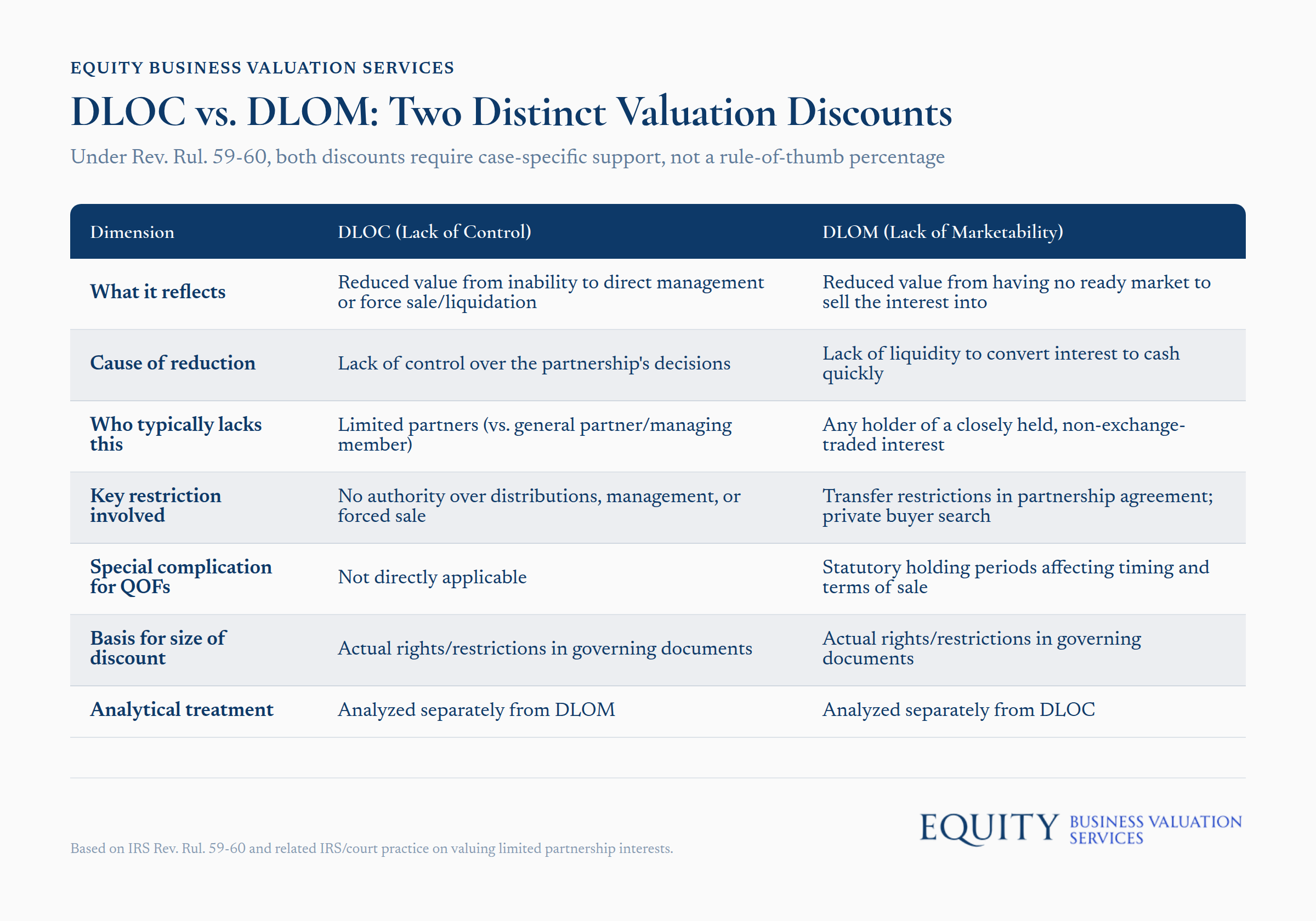
A discount for lack of control (DLOC) and a discount for lack of marketability (DLOM) are related but distinct adjustments, and a properly supported valuation analyzes them separately rather than blending them into one number.
DLOC reflects the reduced value of an interest that cannot direct the partnership's management, does not control distribution timing or amount, and cannot force a sale or liquidation of the fund's holdings. A general partner or managing member typically holds those powers; a limited partner does not.
DLOM reflects the reduced value of an interest that has no ready market to sell into. Unlike a share of publicly traded stock, an LP interest in a closely held fund cannot be sold on an exchange in a matter of days. A buyer has to be found privately, transfer restrictions in the partnership agreement typically apply, and QOF interests carry the added complication of statutory holding periods that affect how quickly, and how favorably, an interest could realistically change hands.
Both discounts are widely recognized in IRS practice and in the courts, and both require case-specific support rather than a rule-of-thumb percentage. The size of each discount depends on the actual rights and restrictions in the governing documents, not a fixed industry figure, which is why the diligence step described in the next section matters so much.
What Our Valuation Firm Does in This Type of Engagement
Our appraisers build these valuations from the partnership's own governing documents and financial history, adapting the Rev. Rul. 59-60 factors to a limited partnership interest rather than corporate stock. We typically need the following documents to begin an LP interest valuation:
- The partnership agreement and any amendments, which establish voting rights, transfer restrictions, distribution mechanics, and dissolution terms.
- The fund's offering documents or private placement memorandum, particularly for a QOF, which disclose the investment strategy, holding period expectations, and risk factors.
- Capital account statements showing the client's contributed capital and current ownership percentage.
- Distribution history and the general partner's stated distribution policy, including any restrictions imposed by loan covenants or tax elections.
- A schedule of the underlying assets held by the partnership, along with any independent appraisals of those assets as of the valuation date.
- Prior Schedule K-1s and partnership tax returns for a reasonable look-back period.
- Financial statements covering several years where available, to support the earnings and book value analysis.
With that documentation in hand, we walk through the eight Rev. Rul. 59-60 factors as applied to a partnership interest: the nature and history of the partnership, the economic outlook for its underlying assets, the adjusted net asset value of the fund's holdings, its earnings and distribution capacity, the presence or absence of goodwill, any prior arm's-length transactions in similar interests, the size of the block being valued, and comparable data from similar partnership interests or guideline entities. For investment and real estate holding partnerships, Rev. Rul. 59-60 itself instructs that adjusted net asset value should generally carry more weight than earnings, a point that continues to guide how we weight approaches for QOF interests where the underlying asset value is the clearest available benchmark.
Our appraisers hold credentials with organizations such as the American Society of Appraisers, NACVA, CFA Institute, and the AICPA's Accredited in Business Valuation (ABV) credential, though not every credential is held by every appraiser on a given engagement. Every report we prepare follows USPAP's development and reporting standards, with clearly stated assumptions, a defined scope of work, and explicit support for any DLOC or DLOM applied.
Supporting a Defensible Tax Position
A Rev. Rul. 59-60 valuation of an LP interest exists to support the taxpayer's own reporting position, not to guarantee a particular outcome with the IRS. We do not, and cannot, promise IRS acceptance, approval, or any acceptance rate for a valuation report; the reviewing agency, court, or counterparty makes that determination on its own.
What we can deliver is a report prepared in accordance with USPAP and the factors set out in Rev. Rul. 59-60, with the underlying documentation, methodology, and discount support laid out clearly enough that the client's CPA or attorney can stand behind the number. That documentation, more than any specific conclusion, is what gives a valuation staying power if it is ever questioned.
This article is provided for general informational purposes only and does not constitute legal, tax, or financial advice. Readers should consult a qualified attorney or CPA regarding their specific circumstances.
Frequently Asked Questions
Q: What documents does our firm need to value a Qualified Opportunity Fund LP interest? We generally need the partnership agreement, the fund's offering documents, capital account statements, distribution history, a schedule of underlying assets (with any independent appraisals of those assets), prior K-1s, and available financial statements. QOF engagements also require documentation of the fund's Opportunity Zone compliance and holding period status, since those facts directly affect marketability.
Q: Does every minority LP interest automatically qualify for a discount? No. Whether a discount applies, and how large it should be, depends on the specific facts and circumstances: the rights and restrictions in the partnership agreement, the interest's voting and distribution rights, transfer restrictions, and the presence of any features that might reduce or enhance control or marketability. A blanket assumption of a discount without that analysis is not defensible.
Q: What is the difference between DLOC and DLOM? DLOC addresses the value lost because a limited partner cannot direct management, distributions, or liquidation decisions. DLOM addresses the value lost because there is no ready market to sell the interest into. They stem from different causes and are generally analyzed and supported separately, even though both often apply to the same LP interest.
Q: How do Rev. Rul. 59-60's eight factors apply to a partnership interest versus corporate stock? The factors carry over conceptually but shift in emphasis. For an investment or real estate holding partnership, adjusted net asset value of the underlying holdings typically weighs more heavily than earnings, which is the reverse of how an operating corporation is often analyzed. Factors like prior transactions and comparable market data are drawn from partnership interest transfers and similar fund interests rather than public stock trades.
Q: Can the same methodology be used for a controlling LP interest, not just a minority interest? Yes, though the analysis changes. A controlling interest may still warrant a marketability discount since there is no public market for the interest, but a discount for lack of control generally does not apply, or applies at a much smaller magnitude, since the holder can direct the partnership's decisions.
Our firm has direct experience applying Rev. Rul. 59-60 to limited partnership and Qualified Opportunity Fund interests, and we build every report around the documentation and factor-by-factor analysis described above. If you need a USPAP-compliant valuation of an LP or QOF interest for a tax, estate, or planning purpose, our business valuation services are built specifically for this kind of engagement.