
Blog
FLP Valuation Discounts: How Lack of Marketability and Minority Interest Are Determined
A family limited partnership interest is routinely worth less than its pro rata share of the underlying assets, and the gap comes from two distinct, separately substantiated discounts. This guide explains how minority interest and lack of marketability discounts for FLP interests are determined, documented, and defended against IRS challenge.
A family limited partnership is one of the most common structures used to transfer wealth between generations while keeping assets under family control. It is also one of the IRS's favorite audit targets, precisely because the interests being gifted or bequeathed are almost never worth a simple pro rata slice of the partnership's balance sheet. FLP valuation discounts (the minority interest discount and the discount for lack of marketability) are what separate a defensible transfer tax filing from an audit that unwinds the entire plan.
This article walks through what these discounts measure, how appraisers substantiate them with empirical data and partnership agreement terms, and why Section 2036 can wipe out both discounts entirely if the transferor kept too much control. If your practice handles estate tax business valuations or gift tax business valuations involving family entities, the distinction between these two discounts, and the documentation each one requires, is the single biggest driver of whether the reported value survives examination.
Why an FLP Interest Is Worth Less Than a Pro Rata Share of the Assets
A limited partner in a family limited partnership does not own a proportional slice of the partnership's cash, securities, or real estate. They own a contractual interest that typically cannot vote to sell assets, cannot compel a distribution, cannot remove the general partner, and cannot force liquidation. That gap between what the underlying assets are worth and what the contractual interest is worth is the minority interest discount, sometimes called a discount for lack of control.
Courts and appraisers have long recognized that a controlling owner and a passive, non-voting owner are not holding equivalent economic positions, even when their percentage stakes are calculated off the same balance sheet. Our approach follows the methodology described in Revenue Ruling 59-60, which we cover in more depth in our guide to applying Rev. Rul. 59-60 to limited partnership interests. The ruling directs appraisers to weigh the specific rights and restrictions attached to an interest rather than simply dividing net asset value by ownership percentage.
Example: A family partnership holds $10 million in marketable securities. A limited partner owns a 20% interest, which on paper represents $2 million of net asset value. Because that limited partner cannot force a distribution or a sale, cannot vote on partnership decisions, and cannot compel liquidation, the appraised value of that 20% interest is discounted below $2 million to reflect the absence of control.
Discount for Lack of Marketability: Why FLP Interests Can't Be Readily Sold
A discount for lack of marketability, commonly abbreviated DLOM, accounts for the fact that an FLP interest cannot be converted to cash the way a publicly traded stock can. There is no exchange listing the interest, no daily bid and ask, and often a partnership agreement that restricts who the interest can even be sold to.
This discount is layered on top of, and is analytically distinct from, the minority interest discount. The minority discount addresses the rights attached to the interest; the marketability discount addresses how difficult it is to convert that interest into cash at all, regardless of what rights it carries. Even a controlling interest in a closely held entity can carry a marketability discount, because there is still no ready market for it.
Three features of a typical FLP push the marketability discount higher:
- Transfer restrictions: Partnership agreements commonly require general partner consent before an interest can be assigned, or grant existing partners a right of first refusal.
- No redemption right: Limited partners usually cannot demand that the partnership buy back their interest.
- Indefinite holding period: Without a market or a buyback mechanism, a limited partner may hold the interest for years before any liquidity event occurs.
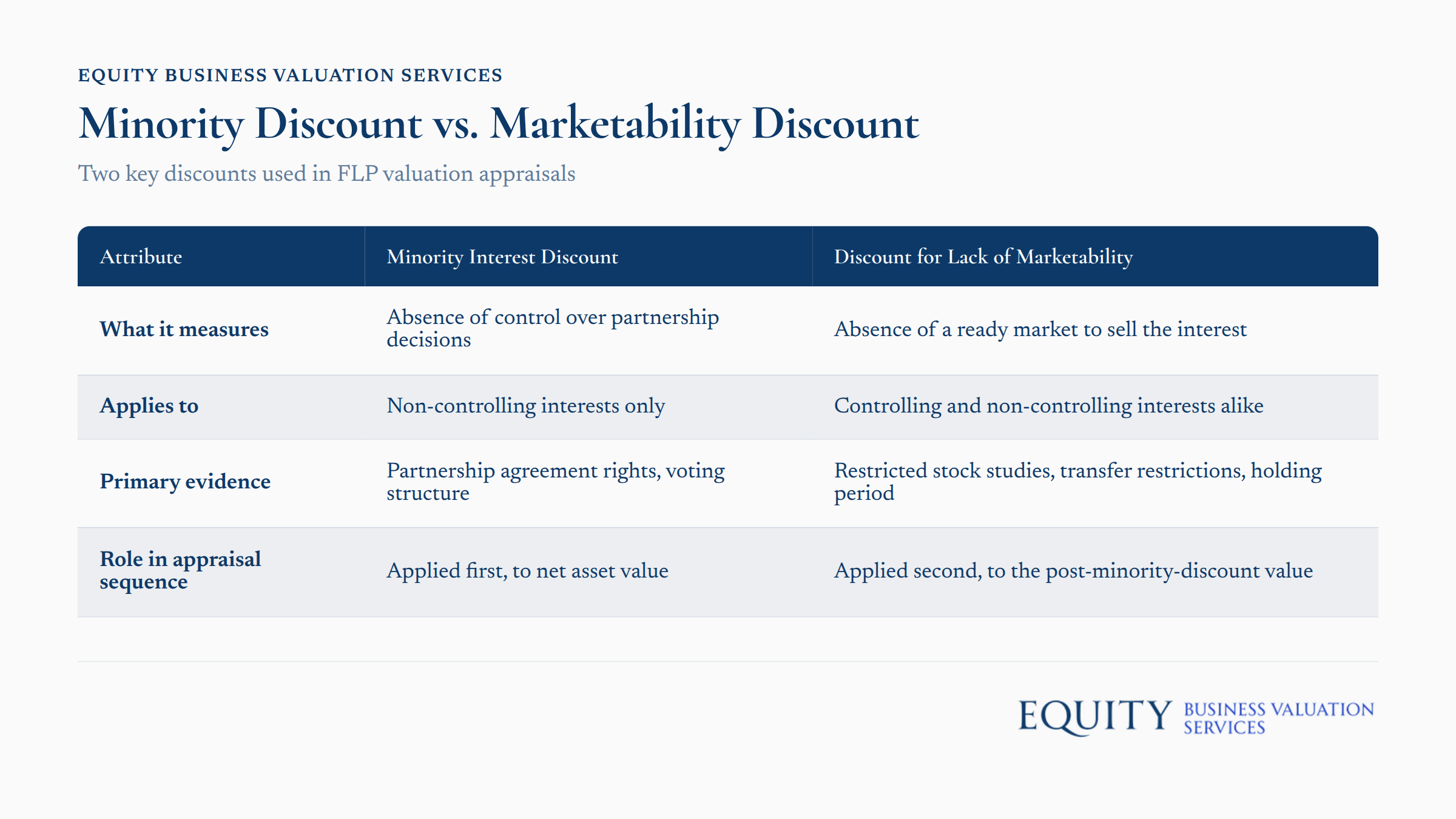
Minority Discount vs. Marketability Discount at a Glance
| Minority Interest Discount | Discount for Lack of Marketability | |
|---|---|---|
| What it measures | Absence of control over partnership decisions | Absence of a ready market to sell the interest |
| Applies to | Non-controlling interests only | Controlling and non-controlling interests alike |
| Primary evidence | Partnership agreement rights, voting structure | Restricted stock studies, transfer restrictions, holding period |
| Typical role in the appraisal | Applied first, to net asset value | Applied second, to the post-minority-discount value |
How Appraisers Substantiate FLP Discounts
A discount is only as strong as the evidence behind it, and the IRS's own discount for lack of marketability job aid makes clear that examiners expect appraisers to tie a concluded discount to specific, documented support rather than a round number pulled from a prior deal.
The empirical backbone of a marketability discount typically comes from two bodies of research. Restricted stock studies compare the prices of publicly traded shares that carry contractual resale restrictions against the unrestricted shares of the same company, isolating the value effect of illiquidity alone. Partnership Profiles Inc. studies track actual secondary-market transactions in real estate limited partnership units, showing the discounts buyers demanded to purchase an illiquid, non-controlling interest for cash. Appraisers use both bodies of data as reference points, then adjust up or down based on the specific facts of the partnership being valued.
Beyond the empirical studies, a defensible discount rests on:
- The actual partnership agreement: Transfer restrictions, buy-sell terms, voting rights, and the general partner's discretion over distributions all get read and cited, not assumed.
- The nature of the underlying assets: A partnership holding a diversified securities portfolio behaves differently, and carries different risk, than one holding a single illiquid parcel of real estate.
- Distribution history: A partnership that has never made a distribution supports a larger marketability discount than one with a consistent payout record.
- Comparable transaction data: Where available, actual sales of similar restricted or minority interests provide a market-based check on the concluded discount.
Pro tip: Ranges reported in valuation literature and prior court decisions for combined minority and marketability discounts on FLP interests have varied widely, often landing in the broad range other practitioners commonly cite, but every case turns on its own facts. Treat any percentage you've seen in a different case as a reference point, never as a number to import wholesale into a new appraisal.
Section 2036 Can Eliminate the Discounts Entirely
Even a well-documented discount is worthless if the IRS successfully argues that the underlying assets belong back in the transferor's gross estate under Internal Revenue Code Section 2036. That provision pulls previously transferred property back into the estate if the transferor retained the right to the income from, or the enjoyment of, the transferred assets.
The statute contains a bona fide sale exception: transfers made for adequate and full consideration, in a genuine business transaction with a legitimate non-tax purpose, generally escape Section 2036. Courts have applied this exception unevenly to family partnerships, and outcomes have turned heavily on the specific facts of each case.
Watch out: In cases such as Estate of Strangi and Kerr v. Commissioner, courts examined whether the transferor commingled personal and partnership funds, continued to use partnership assets for personal expenses, or failed to observe partnership formalities after the transfer. Facts pointing to continued personal control or enjoyment of the assets have been the recurring theme that put transfers at risk of full inclusion, discounts included, in the taxable estate.
The practical lesson for practitioners: the valuation discount and the entity's operational reality have to match. A partnership agreement that says the transferor has no control means little if the transferor keeps signing checks from the partnership account to pay personal expenses.
Why the IRS Scrutinizes FLP Discounts So Closely
Family limited partnerships sit at the intersection of two things examiners look at hardest: related-party transactions and valuation discounts that reduce reported gift and estate tax values. Every dollar of discount claimed on a Form 706 or Form 709 is a dollar removed from the taxable transfer, which makes FLP appraisals a recurring audit focus.
That scrutiny is exactly why the discount amount has to be built from documented, verifiable inputs rather than a market convention. An appraiser who can point to the specific restrictive terms in the partnership agreement, the specific empirical studies relied on, and the specific facts distinguishing the partnership from a fully liquid holding is in a far stronger position than one who applies a discount because it is what other partnerships in the file cabinet have used.
Building a Defensible FLP Valuation
A qualified, USPAP-compliant appraisal prepared by a credentialed business appraiser is the foundation of a discount that holds up under examination. Standards published by The Appraisal Foundation require the appraiser to document the methodology, the data relied on, and the reasoning connecting that data to the concluded discount, which is exactly the paper trail an IRS examiner will look for.
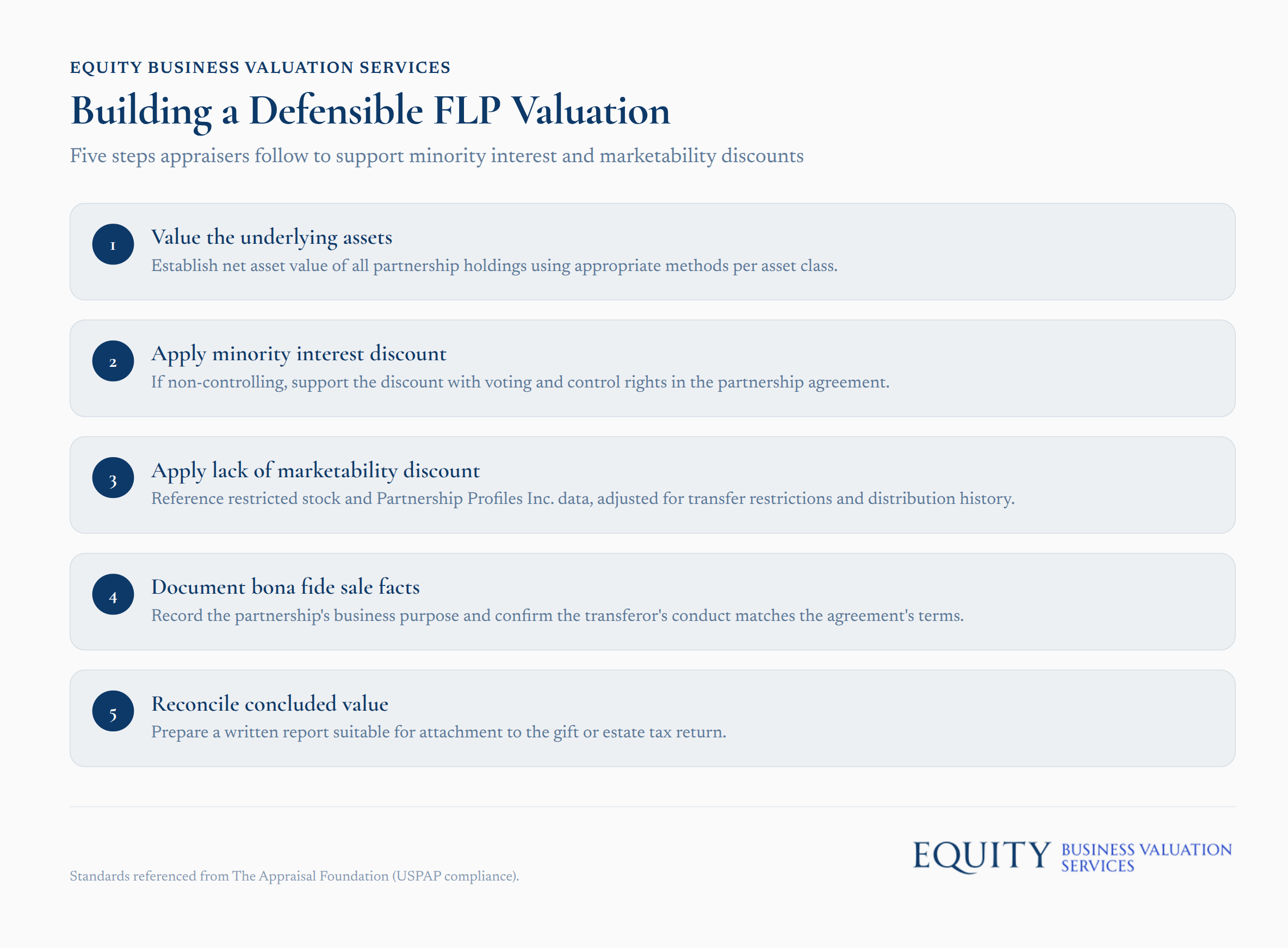
A well-built FLP valuation generally includes the following steps:
- Value the underlying assets first. Establish the net asset value of everything the partnership holds, using appropriate methods for each asset class.
- Apply a minority interest discount, if the interest is non-controlling. Support the discount amount with the specific voting and control rights defined in the partnership agreement.
- Apply a discount for lack of marketability. Reference restricted stock and Partnership Profiles Inc. data, then adjust for the partnership's own transfer restrictions and distribution history.
- Document the bona fide sale facts. Record the business purpose for the partnership, and confirm the transferor's actual conduct matches the formal terms of the agreement.
- Reconcile the concluded value and prepare a written report suitable for attachment to the gift or estate tax return.
Our firm prepares business valuations for estate tax filings and gift tax reporting involving family limited partnerships, closely held businesses, and minority interests. When a client is planning a transfer well before the filing deadline, we also work through the same discount analysis for estate planning engagements, so the numbers used for planning purposes match what a defensible appraisal will support later.
Getting the discount right takes more than a formula. It takes a credentialed appraiser who can show their work, tie every number to a specific piece of evidence, and stand behind the report if the IRS asks questions.
This article is provided for general informational purposes only and does not constitute legal, tax, or financial advice. Readers should consult a qualified attorney or CPA regarding their specific circumstances.