
Blog
Family Limited Partnership Valuation Discounts: What Drives Them and How to Defend Them
Family limited partnership valuation discounts hinge on two factors: lack of control and lack of marketability. This guide explains what drives each discount, how they combine, and what makes a valuation defensible enough to survive an IRS estate or gift tax audit.
A family limited partnership can move a meaningful share of a family's wealth to the next generation while the parents keep day-to-day control of the underlying assets. But the tax savings that make an FLP attractive rest on a single number: the discounted value the IRS is willing to accept for the limited partnership interests being transferred. This guide explains what drives family limited partnership valuation discounts, how the discount for lack of control and the discount for lack of marketability interact, and what makes a valuation defensible enough to hold up under IRS review.
What Is a Family Limited Partnership?
A family limited partnership (FLP) is an entity, typically formed under state limited partnership law, that holds family assets such as real estate, marketable securities, or an operating business under a single ownership structure. One or more family members serve as general partners, retaining management authority and decision-making control. Other family members, often children or grandchildren, hold limited partner interests that carry an economic stake but no say in how the partnership is run.
Families use FLPs for reasons that go beyond tax planning: consolidating fragmented assets under one management structure, protecting assets from creditors, and creating a mechanism to transfer wealth gradually. The general partner can gift or sell limited partnership interests to heirs over a period of years, often using the annual gift tax exclusion, or transfer larger blocks in a single year reported on IRS Form 709 for gift tax. When FLP interests remain in the estate at death, they are valued and reported as part of the estate on IRS Form 706 for estate tax.
The reason valuation matters so much in this structure is straightforward. A limited partnership interest is worth less to a hypothetical buyer than its pro-rata share of the partnership's underlying assets, because that buyer would receive no control and no easy way to cash out. Capturing that difference correctly, and defending it, is the core work of an FLP valuation.
The Two Discounts That Shape an FLP Interest's Value
Two discounts drive the value of a limited partnership interest below its pro-rata share of net asset value: the discount for lack of control (DLOC) and the discount for lack of marketability (DLOM). Both are grounded in the fair market value standard applied to gift and estate tax valuations: the price a hypothetical willing buyer and willing seller would agree to, with neither under compulsion and both reasonably informed.
The discount for lack of control reflects the fact that a limited partner cannot compel distributions, cannot force a sale or liquidation of partnership assets, and has no vote in management decisions. A minority interest holder in a private partnership. Even a wealthy one, is at the mercy of the general partner's decisions about cash flow, leverage, and timing of any liquidity event.
The discount for lack of marketability reflects something different: there is no public market for an FLP interest, no exchange where it can be quickly sold, and the partnership agreement typically restricts who a partner can transfer an interest to. A buyer for a minority FLP interest is hard to find, and finding one takes time, negotiation, and often a further price concession.
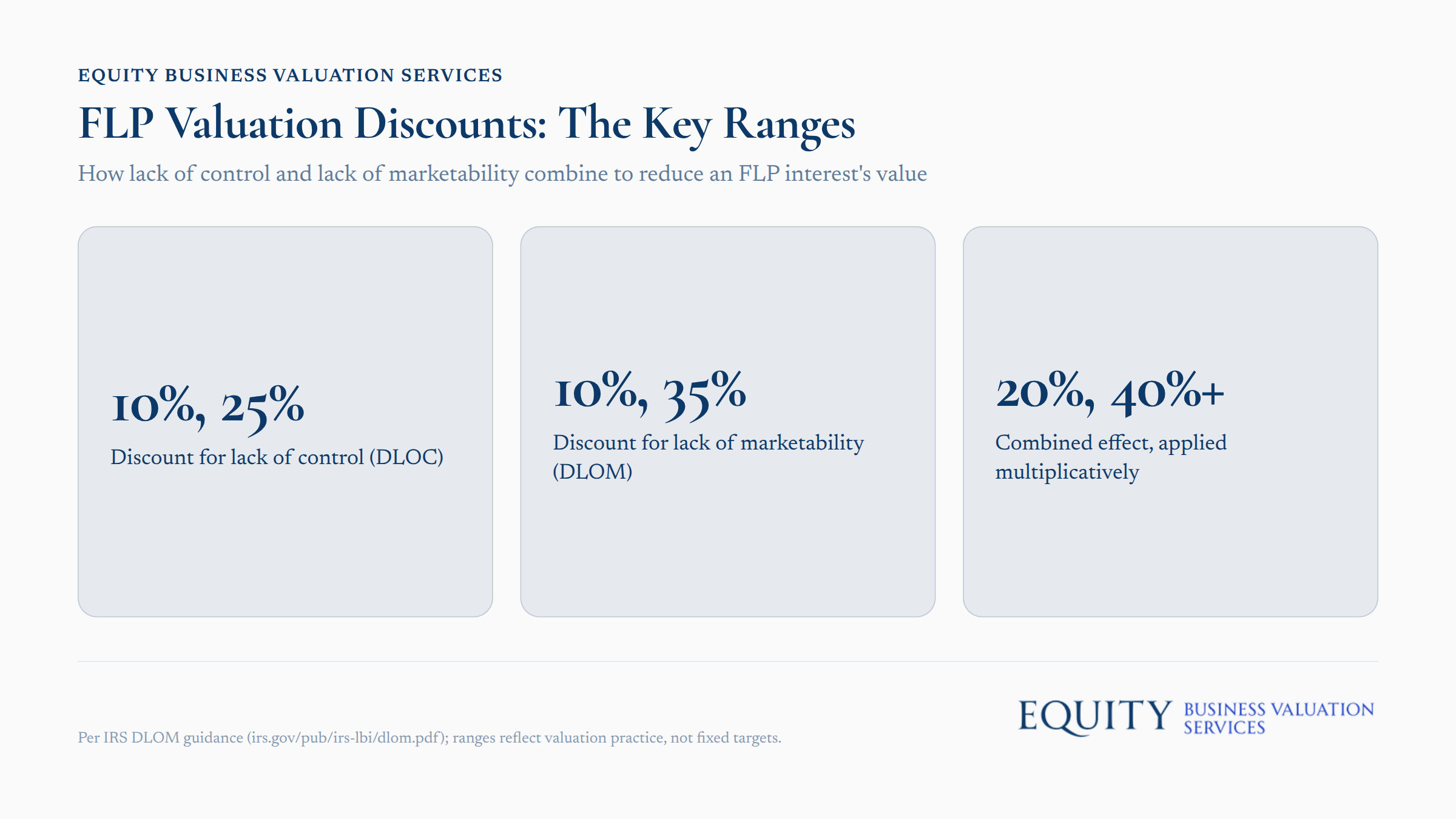
Valuation literature commonly discusses lack-of-control discounts in roughly the 10% to 25% range and lack-of-marketability discounts in roughly the 10% to 35% range, with the combined effect frequently landing somewhere between 20% and 40% or more, depending heavily on the specific partnership agreement, the underlying asset mix, and the restrictions in place. These are ranges reported across valuation practice, not fixed targets, and no appraiser should promise a specific discount before reviewing the entity's actual facts.
It matters that these two discounts are applied multiplicatively, not additively. An appraiser first applies the lack-of-control discount to the pro-rata net asset value, then applies the lack-of-marketability discount to that already-discounted figure.
Example: If an FLP interest's pro-rata share of net asset value is $1,000,000, an 18% discount for lack of control brings that to $820,000. Applying a 25% discount for lack of marketability to that reduced figure, not the original $1,000,000, brings the final value to $615,000. Adding the two percentages together and applying 43% in one step would overstate the discount and understate the value, which is exactly the kind of shortcut that draws IRS scrutiny.
The IRS itself has acknowledged, in its own guidance on the discount for lack of marketability, that this discount reflects "the relative absence of marketability" for an ownership interest without an established trading market, and treats it as a distinct, empirically supported adjustment rather than a rule-of-thumb percentage.
What Drives the Size of Each Discount?
The size of both discounts is fact-specific. No two FLPs warrant the same combined discount, because the underlying rights, assets, and restrictions differ from one partnership agreement to the next.
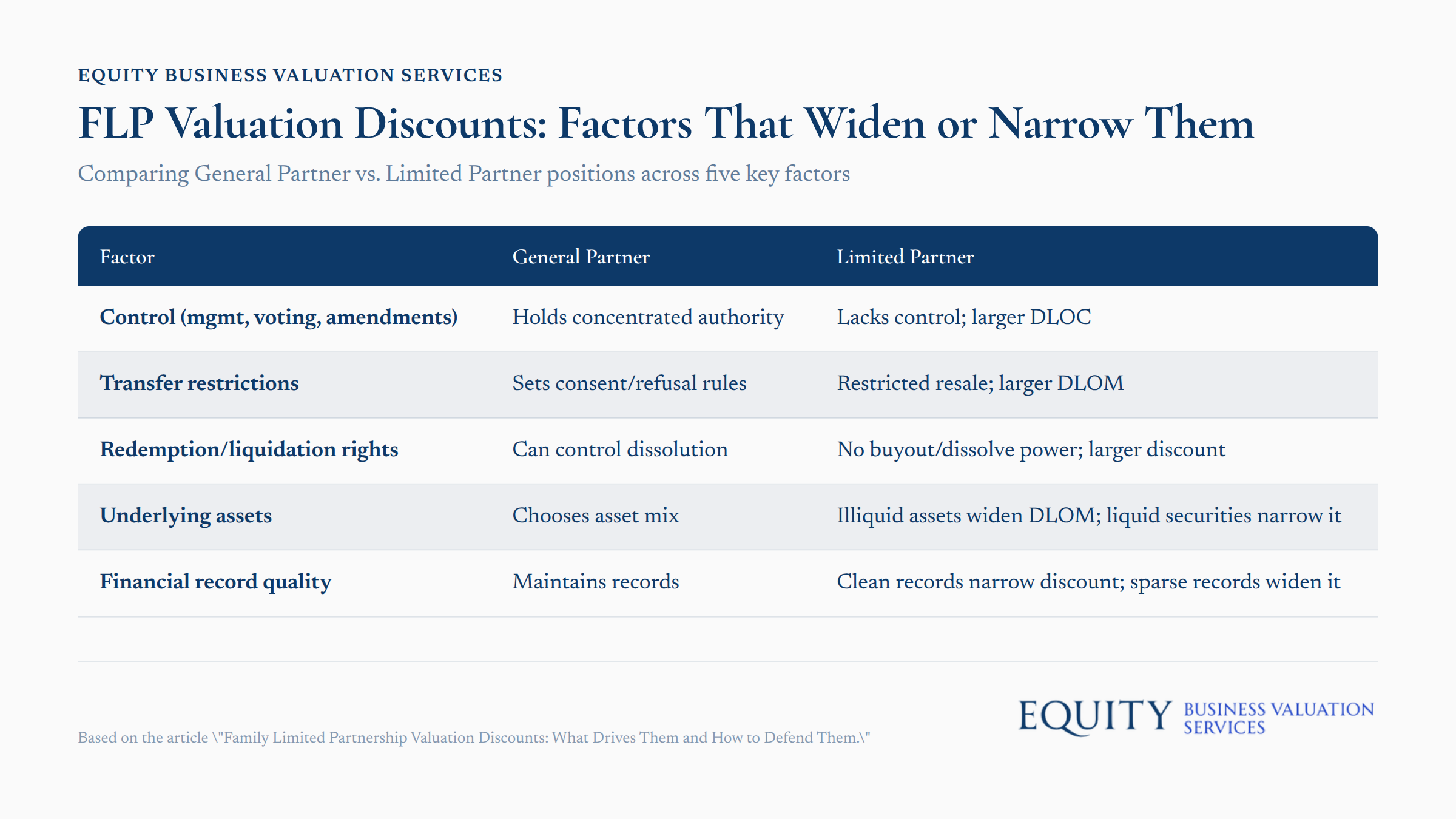
Appraisers look at a consistent set of factors when sizing the discounts for a given FLP interest:
- Degree of control retained by the general partner versus limited partners: The more concentrated the management, voting, and amendment authority is in the general partner, the larger the justified discount for lack of control on the limited partner interests.
- Transfer restrictions in the partnership agreement: Rights of first refusal, required consent from other partners, and outright prohibitions on transfers outside the family all reduce marketability and support a larger DLOM.
- Redemption and liquidation rights: An agreement that gives limited partners no ability to compel a buyout, force a distribution, or dissolve the entity supports a larger discount than one with built-in liquidity mechanisms.
- The underlying assets held by the FLP: A partnership holding easily valued, liquid marketable securities generally supports a narrower marketability discount than one holding illiquid real estate or an operating business with no ready buyers.
- The quality of the partnership's financial records: Clean capital accounts, consistent distribution history, and well-documented asset values give an appraiser more to work with and produce a more defensible discount conclusion than sparse or commingled records.
Pro tip: The partnership agreement itself is the single most important document in an FLP valuation. An appraiser cannot size a discount for lack of control accurately without reading the actual governance and distribution provisions, not just assuming a generic limited partner has no rights at all.
Why USPAP Compliance and IRC Chapter 14 Matter for Defensibility
A family limited partnership valuation that will support a gift or estate tax filing needs to be prepared in accordance with the Uniform Standards of Professional Appraisal Practice (USPAP) and grounded in the statutory framework Congress built specifically for family-controlled entities. Chapter 14 of the Internal Revenue Code, Sections 2701 through 2704, governs how transfers of interests in family-controlled entities are valued for estate and gift tax purposes. Section 2704 in particular allows certain restrictions written into a family partnership agreement to be disregarded for valuation purposes when those restrictions are more limiting than what an unrelated party would agree to at arm's length. That means a discount based on a restriction that only exists because the family imposed it on itself, rather than one that reflects genuine market conditions, may not hold up.
Treasury and IRS studies have noted that valuation discounts are frequently claimed on estate tax returns involving family-controlled entities, which is part of why these filings draw close review. Reported IRS estate tax return data on family-controlled entities reflects how common this planning technique is, and how much weight the underlying valuation has to carry. Proposed regulatory changes under Section 2704 over the years have also aimed to narrow the circumstances under which certain family-controlled restrictions can support a discount, which makes it important to structure and document an FLP valuation around genuine economic restrictions rather than paper provisions.
Professional standards reinforce the same point from the appraiser's side. The AICPA's own practice guidance on business valuations for estate and gift tax purposes calls for a clearly stated standard of value, a documented scope of work, and empirically supported conclusions, the same elements USPAP requires of an independent appraisal. Tax Court review of FLP discount cases has shown that judges will reject a discount conclusion that is not tied to specific, documented facts about the partnership. In one such published Tax Court decision, the court scrutinized both the size and the methodology behind the taxpayer's claimed discounts, underscoring that a defensible report has to show its work, not just state a conclusion.
None of this means a properly prepared appraisal guarantees a particular outcome with the IRS or any court. It means a valuation prepared in accordance with USPAP, tied to the specific rights and restrictions in the partnership agreement, and supported by empirical data, is structured to withstand the level of scrutiny these filings routinely receive.
Common Mistakes That Invite IRS Scrutiny
Most FLP valuation problems trace back to a handful of recurring mistakes, not to the discount percentages themselves.
- Poor documentation of the FLP's formation and business purpose: An entity with no records showing why it was formed, how assets were contributed, or what business rationale it serves looks like a shell built solely to generate a discount.
- No legitimate business purpose beyond tax reduction: Commingling personal and partnership assets, or using partnership funds to pay a partner's personal expenses, undermines the argument that the FLP operates as a genuine business entity separate from its owners.
- An appraiser without recognized valuation credentials: A discount conclusion carries far less weight when it comes from someone without formal training in business valuation methodology and no accountability to a professional standards body.
- An appraisal that is not independent: A valuation prepared by the family's own accountant, or anyone with a financial or personal stake in the outcome, raises an obvious conflict-of-interest question that an examiner will not overlook.
Watch out: A partnership agreement drafted the same week as the gift, with no operating history and no arm's-length business rationale, is one of the fastest ways to draw an audit. Documentation and timing matter as much as the valuation math.
How Our Valuation Team Supports a Defensible FLP Valuation
Our appraisers prepare family limited partnership valuations as independent, third-party engagements. We are not the family's accountant, we do not have a financial interest in the outcome, and our conclusions are based on the partnership's actual governance documents, capital accounts, and asset mix, not on a target discount someone hopes to reach.
Our team holds credentials with organizations including the American Society of Appraisers (ASA), the CFA Institute, and the AICPA's Accredited in Business Valuation (ABV) designation, and every report is prepared in accordance with USPAP. Not every appraiser on our team holds every one of these credentials individually; we assign the right expertise to each engagement based on the entity, the asset mix, and the intended use of the report.
Because FLP engagements vary enormously in complexity, from a partnership holding a single marketable securities account to one holding multiple real estate parcels and an operating business, we quote each engagement as a fixed fee after reviewing the partnership agreement, capital accounts, and underlying asset mix. There is no hourly billing and no surprise invoice once the scope has been set.
If you are planning a gift or estate transfer involving a family limited partnership, request a business valuation and our team will scope the engagement around your partnership's specific structure and assets.
This article is provided for general informational purposes only and does not constitute legal, tax, or financial advice. Readers should consult a qualified attorney or CPA regarding their specific circumstances.