
Blog
What Is an Excess Benefit Transaction Under IRC Section 4958, and How Does a Valuation Help?
An excess benefit transaction valuation gives your board the independent comparability data it needs to satisfy the IRC Section 4958 safe harbor and shift the burden of proof to the IRS. Here's how the penalties work, what the three-part rebuttable presumption requires, and where an appraisal fits.
Nonprofit boards approve executive pay packages, property leases, and related-party deals every year without a second thought. Under IRC Section 4958, some of those routine decisions carry real financial exposure for the individuals who benefit and the board members who signed off. Understanding how an excess benefit transaction valuation supports your compliance process is one of the most practical steps a 501(c)(3) or 501(c)(4) board can take before a related-party deal closes.
What Is an Excess Benefit Transaction Under IRC Section 4958?
An excess benefit transaction happens when a tax-exempt organization gives an insider more economic value than it receives in return. The IRS's own overview of the rule describes this as any transaction in which an applicable tax-exempt organization provides an economic benefit to a disqualified person, directly or indirectly, and the value of that benefit exceeds the value of the consideration the organization receives, including services performed.
The benefit does not have to be a cash salary. It can be a bonus, a below-market lease, personal use of an organization-owned vehicle or residence, a deferred compensation arrangement, or a property sale between the nonprofit and an insider's business. The statutory text at 26 U.S.C. 4958 reaches direct and indirect benefits alike, so routing a payment through a related entity does not avoid the rule.
Who Counts as a Disqualified Person?
A disqualified person is anyone who was in a position to exercise substantial influence over the organization's affairs at any point in the five years before the transaction. In practice, this usually means:
- Founders, executive directors, presidents, and chief financial officers.
- Voting members of the board of directors or trustees.
- Substantial contributors and their family members.
- Entities that a disqualified person controls, such as a family-owned business that leases space to the nonprofit.
Example: A nonprofit pays its founder and executive director a total compensation package worth $600,000 in salary, bonus, and benefits. An independent compensation review concludes that reasonable pay for a comparable role at a similarly sized, similarly situated organization is $450,000. The $150,000 gap is the excess benefit.
The Excise Tax Penalties for Excess Benefit Transactions
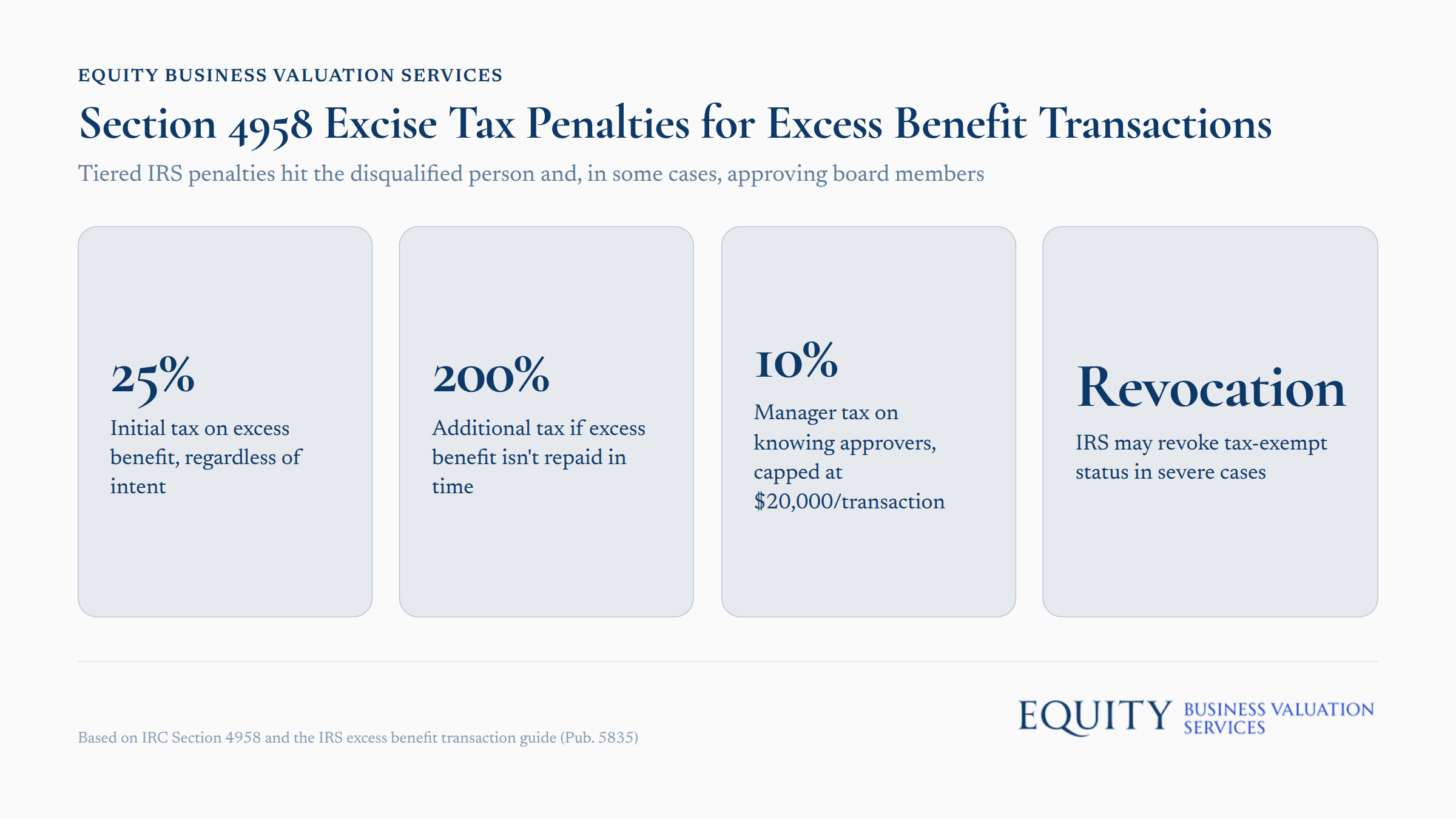
Section 4958 penalties fall on the individual who received the excess benefit, not just on the organization, and a separate tax can hit any board member who knowingly approved the deal. Both the statute and the IRS's excess benefit transaction guide lay out the same tiered structure:
- 25% initial tax: The disqualified person owes 25% of the excess benefit amount, regardless of whether the excess was intentional.
- 200% additional tax: If the excess benefit is not corrected (repaid to the organization) within the correction period, an additional tax equal to 200% of the excess benefit applies on top of the initial 25%.
- 10% organization-manager tax: A board member or other manager who knowingly and willfully approved the transaction, without reasonable cause, can owe 10% of the excess benefit, capped at $20,000 per transaction.
- Loss of tax-exempt status: In egregious or repeated cases, the IRS retains separate, independent authority to revoke the organization's exempt status entirely. This is a distinct and far more severe consequence, not an automatic result of every excess benefit finding.
Using the $150,000 excess benefit example above, the disqualified person's initial tax alone would be $37,500. If the payment is never corrected, the additional 200% tax adds another $300,000 in exposure.
Watch out: These taxes apply to the individual who received the benefit, not the charity's general fund. A board member who approved the deal in good faith with reasonable cause generally avoids the manager tax, which is exactly why the safe harbor procedure described below matters.
The Rebuttable Presumption of Reasonableness: Shifting the Burden of Proof
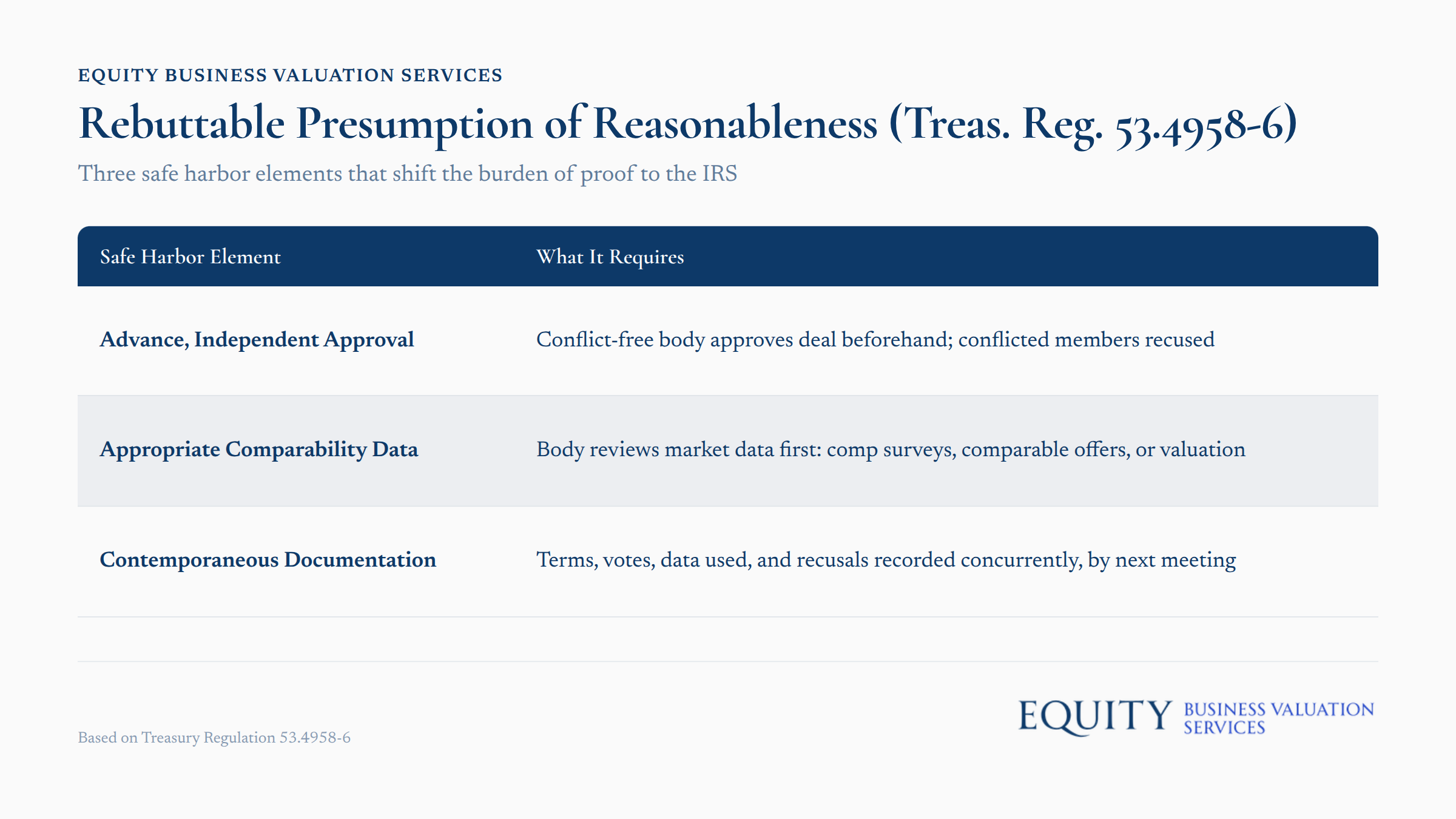
Without any protective procedure, the organization or the disqualified person bears the burden of proving a transaction was reasonable if the IRS challenges it. Treasury Regulation 53.4958-6 offers a way to flip that burden: satisfy three requirements in advance, and the compensation or property transfer is presumed reasonable unless the IRS develops sufficient contrary evidence.
| Safe Harbor Element | What It Requires |
|---|---|
| Advance, independent approval | An authorized body (full board or a committee) with no member having a conflict of interest in the transaction approves the deal before it happens; any conflicted member is recused from the vote and ideally the discussion. |
| Appropriate comparability data | The authorized body obtains and relies on relevant market data before approving, such as compensation surveys, comparable offers, or an independent valuation establishing fair market value. |
| Contemporaneous documentation | The body records the terms and approval date, who was present and how they voted, the comparability data reviewed and how it was obtained, and any recusals, all documented concurrently with the decision (generally by the next meeting). |
Satisfying all three elements does not make an organization immune from IRS scrutiny. It is a rebuttable presumption, not a guarantee. But it does something significant: instead of the charity needing to affirmatively prove the deal was fair, the IRS must produce evidence that the arrangement was unreasonable to impose the excise tax. That shift in who carries the burden is often the difference between a routine compensation decision and a costly audit dispute.
How an Independent Valuation Satisfies the Comparability Data Requirement
The second safe harbor element, appropriate comparability data, is where an independent business valuation does its work. A board cannot simply assert that a salary or a lease rate is fair; it has to point to data it relied on before approving the transaction. A defensible, third-party analysis is the strongest form of that evidence for anything beyond a straightforward salary comparison.
Our team prepares the kind of USPAP-compliant analysis boards use to document that step. If your organization is weighing a related-party deal, our business valuation pricing page outlines how engagements are scoped and quoted as a fixed fee before work begins, based on the complexity of the compensation package or asset and the depth of analysis required, never on the dollar value of the underlying transaction.
Compensation Studies vs. Related-Party Asset Transactions
Comparability data looks different depending on what the organization is exchanging with the insider:
- Executive compensation: A valuation benchmarks the total pay package (salary, bonus, benefits, deferred compensation, and perquisites) against what similarly qualified people earn at similarly situated nonprofit and, where relevant, market organizations. The analysis should cover the entire arrangement, not just base salary, since the IRS has noted that isolated salary comparisons can miss the full picture.
- Related-party asset transactions: When a nonprofit buys, sells, or leases property, a business interest, or equipment to or from an insider or an entity the insider controls, an independent appraisal establishes fair market value on both sides of the exchange. That figure becomes the comparability data the board relies on before approving the deal.
Understanding which valuation methodology applies, whether an asset, income, or market approach, also matters when a related party transaction involves a business interest rather than a simple asset; our guide to the three approaches to valuing a business walks through how appraisers choose between them.
Pro tip: Commission the valuation before the board votes, not after. The regulation requires the comparability data to be obtained and relied on in advance of approval; a valuation completed after the fact does not satisfy element two of the safe harbor.
Where Our Role Starts and Stops
Our appraisers, credentialed through organizations such as the American Society of Appraisers (ASA) and the National Association of Certified Valuators and Analysts (NACVA), and working in accordance with USPAP and the standards published by The Appraisal Foundation, prepare the independent valuation report that gives your board the market data element of the safe harbor.
We do not provide legal advice on whether your overall transaction satisfies Section 4958, and a valuation report alone does not complete the safe harbor. The recusal procedures, documentation timing, and board approval process are legal and governance questions. Boards should consult qualified tax counsel or a CPA to confirm the full three-part procedure is followed correctly, including who must be recused and how meeting minutes should be worded.
Getting the Comparability Data Right Before the Vote
An excess benefit transaction valuation is not a formality. It is the piece of evidence that lets a board shift the burden of proof to the IRS instead of carrying it themselves. Getting an independent, defensible number in hand before the vote, whether for an executive compensation package or a related-party property deal, is one of the most cost-effective risk management steps a nonprofit board can take.
If your organization is preparing for a related-party transaction or a compensation decision involving an insider, our team can scope an independent valuation engagement built for the safe harbor requirement. Request an appraisal to discuss your timeline and the comparability data your board will need.
This article is provided for general informational purposes only and does not constitute legal, tax, or financial advice. Readers should consult a qualified attorney or CPA regarding their specific circumstances.