
Blog
Estate Tax Portability: The DSUE Election and Why You Need a Defensible Appraisal
Estate tax portability lets a surviving spouse claim a deceased spouse's unused $15 million exclusion, but only through a timely Form 706 election, and the value reported on that return has to hold up to scrutiny.
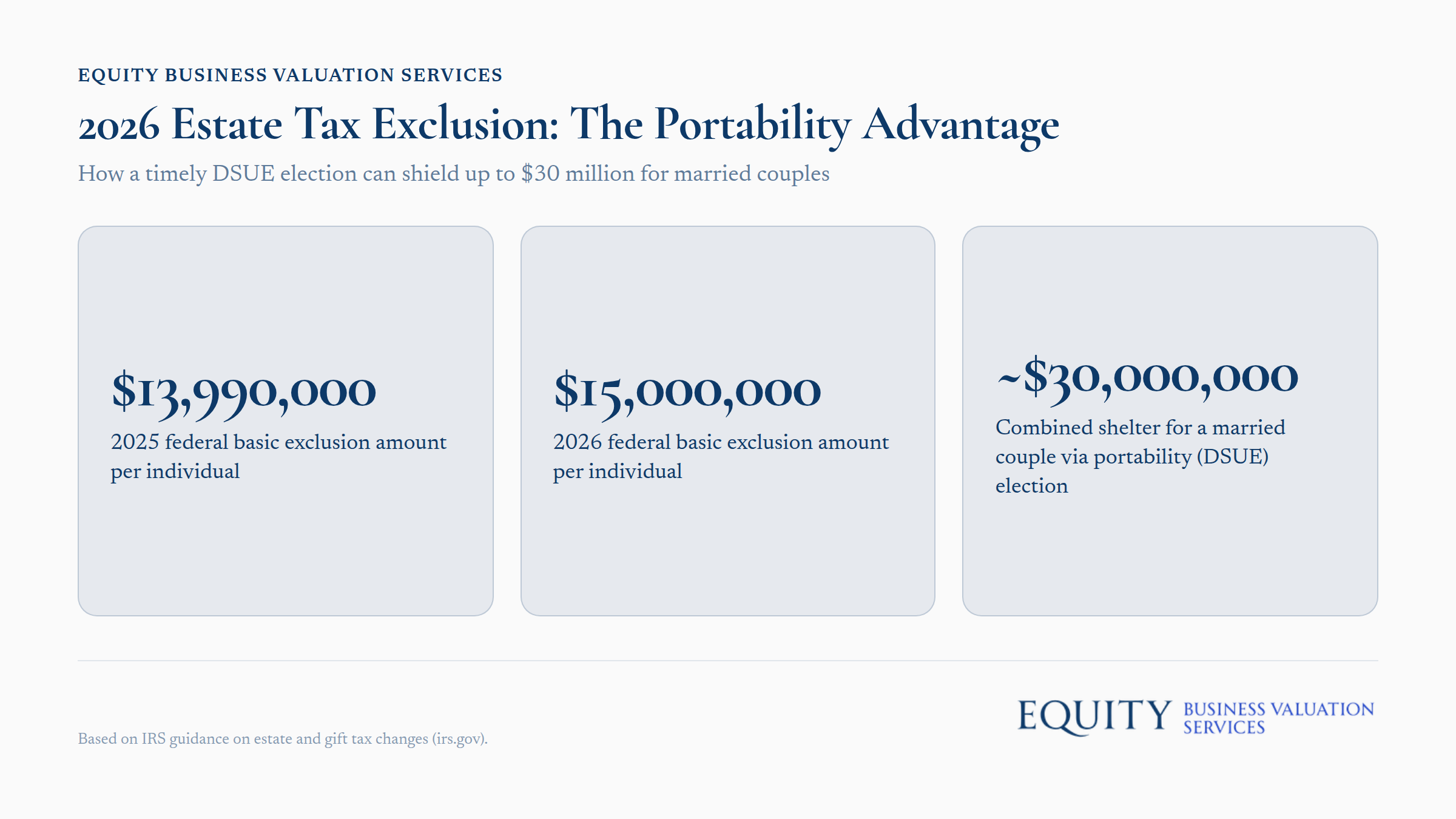
Estate tax portability sounds like a paperwork formality until you realize it can determine whether a married couple shields $15 million or $30 million from federal estate tax. For 2026, the federal basic exclusion amount rises to $15,000,000 per individual, up from $13,990,000 in 2025, according to the IRS's inflation adjustments for tax year 2026. Married couples who elect portability correctly can carry that number to roughly $30 million combined. For estates that include a closely held business interest, the value reported on the estate tax return does double duty: it sets the size of the taxable estate and it sets the amount of unused exclusion being carried forward. Get that number wrong and both calculations are compromised.
This matters directly to the work we do at Equity Business Valuation Services. When an estate's assets include a family business, a professional practice, or a minority interest in a partnership, the fair market value of that interest has to be established with the same rigor the IRS applies when it reviews the return. A portability election built on a soft valuation is a portability election that invites an audit.
What Is Estate Tax Portability?
Estate tax portability allows a surviving spouse to add the deceased spouse's unused exclusion amount, known as the DSUE, to their own basic exclusion amount. Without portability, any exclusion the first spouse to die didn't use simply disappears. With it, the surviving spouse's own estate can shelter both exclusions when they eventually pass assets to heirs.
The mechanism sits in Internal Revenue Code Section 2010(c). The statute defines the applicable exclusion amount as the basic exclusion amount plus, for a surviving spouse, the DSUE amount carried over from a deceased spouse. That DSUE figure is defined under the same section of the code and is calculated on the deceased spouse's estate tax return.
Portability is not automatic. It has to be elected, and the only way to elect it is to file a complete and timely Form 706, even when the estate's value falls well below the filing threshold and no return would otherwise be required. The Form 706 instructions are explicit on this point: no portability election exists without a filed return.
The 2026 Exclusion Amount and Why It Doubled the Stakes
The jump from $13,990,000 in 2025 to $15,000,000 in 2026 is a meaningful increase, and the IRS confirms portability remains fully available under the new exclusion for 2026, per the IRS's ongoing guidance on estate and gift tax changes. For a married couple who both plan carefully, that means:
- A surviving spouse who inherits an unused $15,000,000 exclusion from a deceased spouse can add it to their own $15,000,000 basic exclusion.
- Combined, that produces roughly $30,000,000 in shielded value before federal estate tax applies to the survivor's estate.
- The DSUE amount is fixed at the time of the first spouse's death and does not grow with future exclusion increases, so the timing of the election and the accuracy of the underlying estate value both matter.
That last point is easy to miss. The DSUE a surviving spouse carries forward is locked in based on the first spouse's estate as reported, not adjusted later for inflation. If the reported estate value was understated or overstated because of a weak business valuation, the DSUE calculation inherits that error permanently.
How and When to File the Portability Election
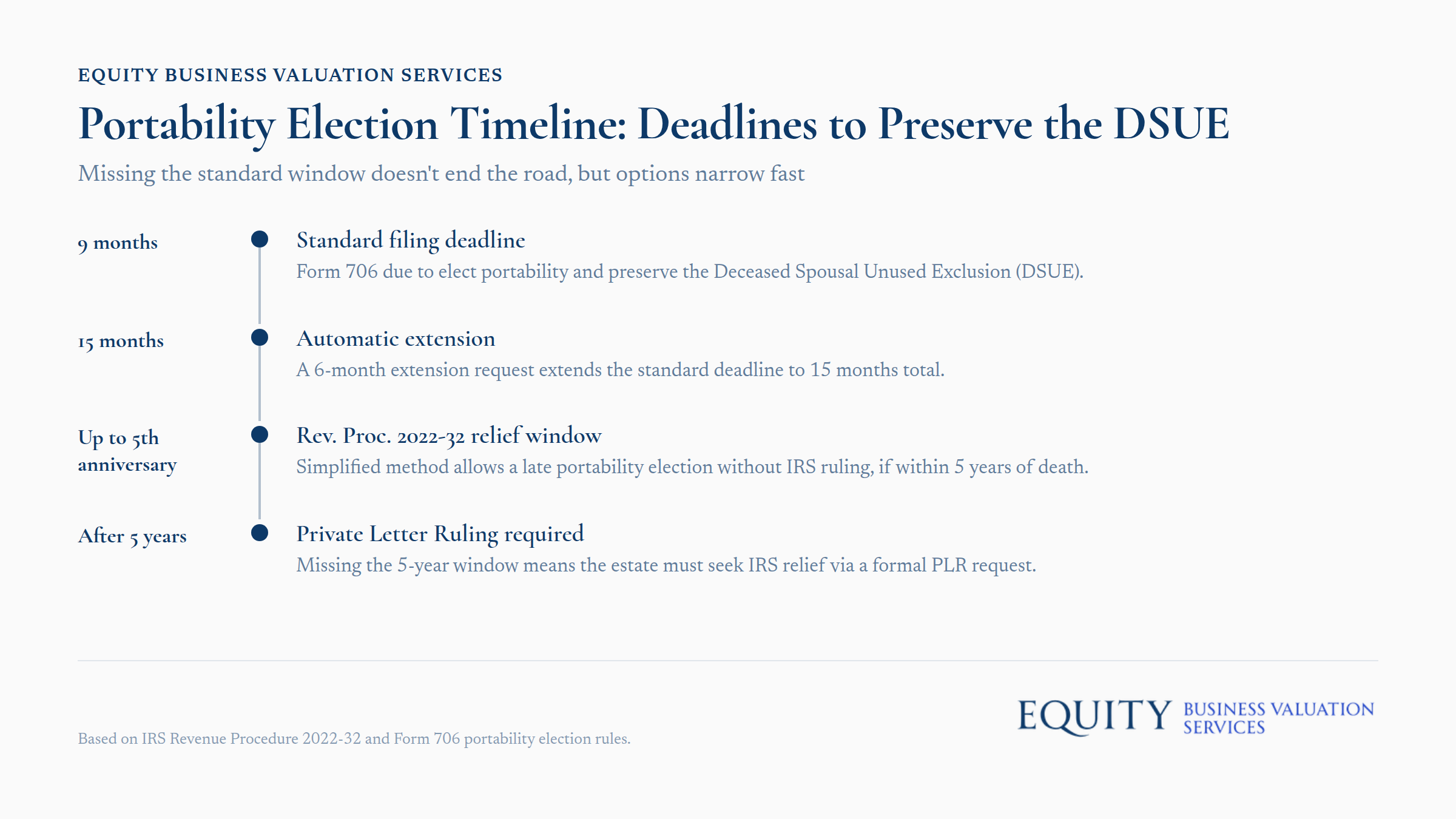
The standard deadline to elect portability is 9 months after the date of death, with an automatic 6-month extension available if requested in time, for a maximum of 15 months. Estates that are required to file Form 706 anyway (because the gross estate exceeds the exclusion amount) simply check the portability election box on a timely return.
Estates that are not otherwise required to file, because the estate falls under the exclusion amount, face a different clock. If that estate misses the 9-month (or extended 15-month) deadline, IRS Revenue Procedure 2022-32 provides a simplified method for a late portability election. The executor can file a complete Form 706 any time up to the fifth anniversary of the decedent's date of death, provided the return includes a specific legend at the top citing Revenue Procedure 2022-32 and IRC Section 2010(c)(5)(A).
Watch out: if the 5-year window under the simplified procedure closes without a portability election on file, the only remaining path is a private letter ruling request to the IRS, a process that is slower, less certain, and involves a separate user fee. Executors and their advisors should treat the 5-year mark as a hard deadline, not a soft target.
Why Business Valuation Accuracy Drives the Whole Calculation
The direct answer: appraisals prepared for federal estate tax purposes use fair market value as of the date of death (or the alternate valuation date, if elected) as the governing standard, and that value flows straight into both the taxable estate and the DSUE math. When the estate holds a closely held business interest, that number rarely comes from a public market quote. It comes from an appraisal.
The foundational public guidance for valuing closely held stock for estate and gift tax purposes instructs appraisers to weigh "all available financial data, as well as all relevant factors affecting the fair market value," rather than relying on a single formula or shortcut. In practice, that means an appraiser has to examine the company's earnings history, its balance sheet, comparable transactions, the nature of any transfer restrictions, and the specific rights attached to the decedent's interest.
When the IRS examines an estate tax return that includes a closely held business, it looks for that same documentation: sales history of the stock or interest, governing documents, rights of first refusal, and support for the fair market value conclusion. An estate that reports a business interest at a number pulled from a rule of thumb, a prior informal valuation, or the owner's own estimate is exposed on two fronts. First, the reported estate value itself can be challenged, changing the estate tax due. Second, if the estate is also relying on a portability election, an increased business valuation on audit can eat into the exclusion the surviving spouse thought was preserved.
Key takeaway: a USPAP-compliant valuation of the closely held business interest is not a formality tacked onto Form 706. It is the number the entire estate tax and portability calculation is built on.
What a Defensible Estate Tax Business Valuation Involves
A business valuation prepared for estate tax purposes should stand on its own if it is ever reviewed. That generally means the valuation:
- States fair market value as of the date of death or the elected alternate valuation date, consistent with federal estate tax standards.
- Documents the methodology applied, whether income-based, market-based, or asset-based, and explains why that approach fits the specific business or interest. Our earlier discussion of the three approaches to valuing a business walks through how appraisers choose among them.
- Applies discounts for lack of control or lack of marketability where the decedent's interest genuinely warrants them, with support for the discount percentage rather than a round number pulled from habit.
- Is prepared in accordance with the Uniform Standards of Professional Appraisal Practice (USPAP), published by The Appraisal Foundation, and reflects the kind of analysis credentialed appraisers holding ASA or NACVA credentials are trained to produce.
At Equity Business Valuation Services, our appraisers prepare these reports specifically for estate and gift tax filings. Business valuation engagements for estate tax purposes are quoted as a fixed fee once we understand the entity's complexity, the completeness of its financial records, and whether the report needs to meet the IRS-qualified appraisal standard. As a general reference, standard business valuation engagements start from $4,500 and IRS-qualified engagements start from $5,500, with most estate and gift matters falling between $7,500 and $12,000 depending on the number of entities and the depth of analysis required. More complex estates, such as those with multiple interrelated entities or disputed valuation positions, can run $15,000 to $20,000 or more. These are never hourly fees; the scope and price are set before work begins.
Getting the Filing and the Number Right Together
Portability is a genuine planning opportunity, especially with the exclusion at $15,000,000 for 2026. But the benefit only materializes if the executor files on time (or uses the Revenue Procedure 2022-32 window correctly) and if the estate's reported value, including any closely held business interest, can withstand review. Executors, attorneys, and CPAs handling an estate with a family business or a partnership interest should treat the business valuation and the portability election as one project, not two separate tasks handled by different people on different timelines.
Working with appraisers who understand both the deadline mechanics of Form 706 and the substantive valuation standards the IRS applies gives an estate its best shot at a clean filing. If your estate includes a closely held business interest and you need a defensible, USPAP-compliant valuation to support an estate tax filing or a portability election, you can request an appraisal from our team at Equity Business Valuation Services; this is our core work.
How to Request an Estate Tax Business Appraisal
Getting an appraisal started is more straightforward than most executors expect, and starting early matters given the Form 706 deadlines described above. The process generally runs in four steps:
- Scope the engagement. We identify every closely held business interest, partnership stake, or professional practice in the estate, along with the date-of-death (or alternate valuation date) each one has to be valued as of.
- Gather documentation. Financial statements, tax returns, cap tables, governing documents, and any prior valuations are collected so the appraiser has the full picture before analysis starts.
- Analyze and report. The appraiser applies the income, market, and asset approaches as appropriate, supports any discounts for lack of control or marketability, and produces a USPAP-compliant report built to withstand IRS review.
- Deliver on a fixed fee and timeline. Because the scope is set upfront, the estate knows the cost and the expected turnaround before work begins, which makes it easier to coordinate with the executor's and attorney's Form 706 timeline.
If your estate includes a closely held business interest and you're working against a portability deadline, you can request an appraisal directly from our team. See our pricing page for a general sense of fee ranges by engagement type before you reach out.