
Blog
Equity Value vs Enterprise Value: Why Business Owners Confuse These Numbers
Equity value and enterprise value measure two different things, and mixing them up can distort a deal price or misstate the taxable value on an estate or gift tax return. This guide walks through the bridge formula that connects them, with a worked numeric example.
Equity value and enterprise value sound like two ways of saying the same thing, but they measure different pieces of a business. Mixing them up can distort a negotiated deal price, confuse a lender's collateral analysis, or misstate the taxable value reported on an IRS Form 706 or 709. This guide breaks down the mechanical difference between the two figures, walks through the bridge formula that connects them, and shows why the number a shareholder actually owns is rarely the number quoted in a deal headline. Our equity business valuation services build both figures correctly from the ground up, so the value reported to a lender, a court, or the IRS matches the exact interest being valued.
What Is Equity Value?
Equity value answers a narrow question: what belongs to the shareholders once every other claim on the business has been paid?
For a public company, equity value is easy to compute: share price multiplied by shares outstanding, which is simply market capitalization, according to Corporate Finance Institute. A private company has no daily quoted share price, so equity value has to be derived through a formal appraisal that applies recognized valuation methods under the asset, income, and market approaches.
Equity value is the figure that actually changes hands in most ownership transfers. It is the number that matters when:
- A shareholder sells stock or a membership interest in a closely held company
- An owner gifts a minority interest in the business to a family member
- An estate reports a decedent's ownership stake on a federal tax return
- Partners buy out a departing owner under a buy-sell agreement
What Is Enterprise Value for a Private Company?
Enterprise value measures the value of the whole operating business, independent of how that business happens to be financed. It represents what it would cost a buyer to acquire the entire company, debt included, net of whatever cash is already sitting on the balance sheet, per Wall Street Prep.
This matters because two companies with identical operations but different capital structures can carry very different equity values. A company financed heavily with debt has a smaller slice of value left over for shareholders than an all-equity company generating the same operating profit, even when both businesses carry the same enterprise value. Enterprise value strips out the financing decision so operating businesses can be compared on equal footing.
The EV to Equity Bridge: How the Two Numbers Connect
The relationship between the two figures runs through a bridge formula that appraisers and investment bankers rely on every day:
Enterprise Value = Equity Value + Net Debt + Preferred Stock + Minority Interest
Net debt is total interest-bearing debt minus cash and cash equivalents, and the same formula rearranges cleanly to solve for the number most private business owners actually want, according to Breaking Into Wall Street:
Equity Value = Enterprise Value - Net Debt - Preferred Stock - Minority Interest
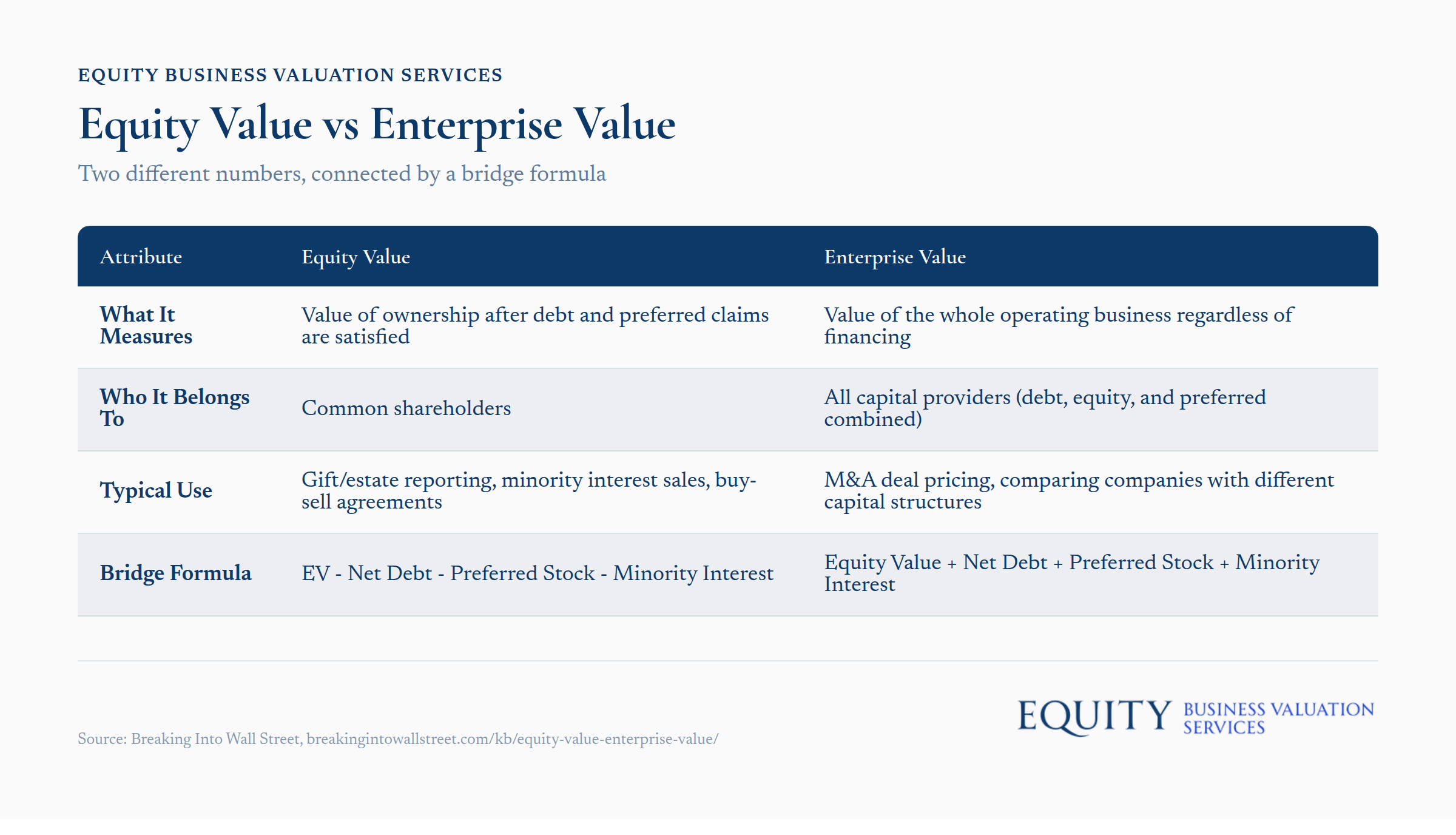
Many small and mid-sized private companies have no preferred stock and no minority interest sitting on another entity's books, which simplifies the bridge to just enterprise value minus net debt. The table below summarizes what each metric captures and who it belongs to.
| Metric | What It Measures | Who It Belongs To | Typical Use |
|---|---|---|---|
| Equity Value | Value of ownership after debt and preferred claims are satisfied | Common shareholders | Gift and estate reporting, minority interest sales, buy-sell agreements |
| Enterprise Value | Value of the whole operating business regardless of financing | All capital providers (debt, equity, and preferred combined) | M&A deal pricing, comparing companies with different capital structures |
Watch out: A term sheet or letter of intent that quotes a single number without specifying whether it is equity value or enterprise value is a red flag. Ask which figure is being quoted before you compare it to anything else.
Worked Example: Bridging a $5 Million Enterprise Value to Equity Value
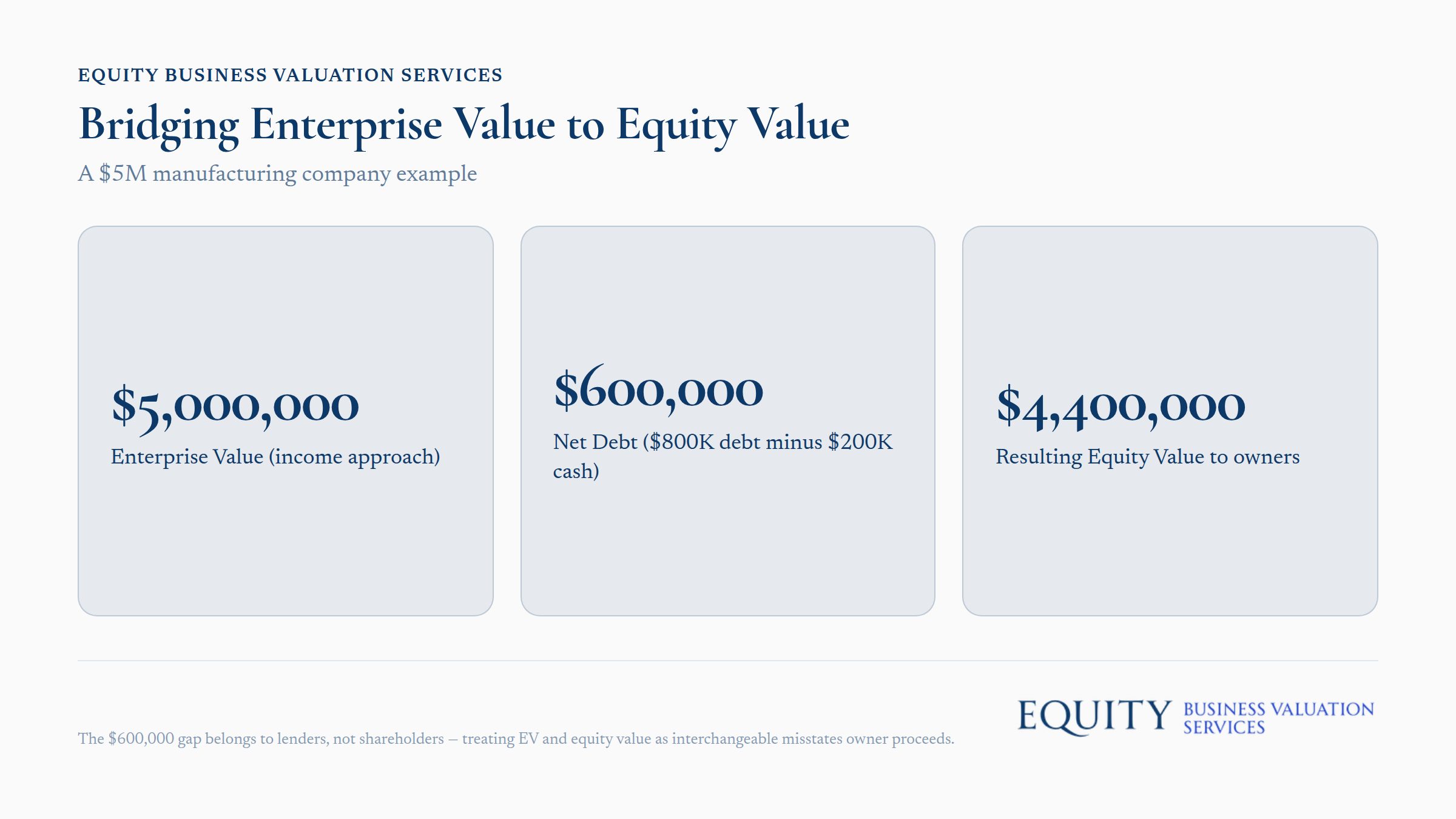
Example: A private manufacturing company is valued at a $5,000,000 enterprise value using the income approach. The company carries $800,000 in outstanding debt and holds $200,000 in cash on its balance sheet, with no preferred stock and no minority interest to account for.
The bridge works out as follows:
- Net debt = $800,000 debt - $200,000 cash = $600,000
- Equity Value = $5,000,000 enterprise value - $600,000 net debt = $4,400,000
The $5 million figure reflects what a buyer would pay to control the entire operating business, debt obligations included. The $4.4 million figure is closer to what the current owners would actually receive before taxes and transaction costs, because $600,000 of the enterprise value is effectively owed to creditors, offset by the cash already on hand.
Key takeaway: The $600,000 gap between these two numbers is not a rounding error or a modeling choice. It is real money that belongs to lenders, not shareholders, and any report or negotiation that treats the two figures interchangeably will misstate what the owners actually hold.
Why Buyers and Sellers Talk Past Each Other
Deal headlines and negotiations frequently quote one figure while the parties are actually negotiating the other, which is the single biggest source of confusion in private company transactions.
A buyer often anchors a conversation on enterprise value because it reflects the full economics of the operating business and makes for a cleaner comparison against similar companies. A seller, meanwhile, cares most about what lands in their pocket after debt is settled, which is equity value. When a business owner hears an $8 million enterprise value quoted in a preliminary conversation and mentally treats that as their payout, the eventual purchase agreement, which nets out debt, working capital adjustments, and transaction costs, can come as an unwelcome surprise.
Lenders add another layer of confusion. A lender evaluating collateral often looks at enterprise value to gauge the strength of the underlying business, while the borrower's actual equity position, what they would retain after the loan is repaid, is a separate calculation entirely. Getting a formal valuation that clearly labels which figure is which prevents these mismatched conversations before they cost anyone money.
Why the IRS Cares Which Figure You Report on Forms 706 and 709
The IRS taxes the fair market value of the equity interest actually transferred, not the enterprise value of the underlying business. This distinction is central to any gift or estate tax filing involving a closely held business interest.
Form 706 (the federal estate tax return) and Form 709 (the federal gift tax return) both require the filer to report the fair market value of the specific interest changing hands, whether that is 100% of the company or a 15% minority stake held by a decedent or donor. See IRS.gov for current filing guidance. Because equity value already accounts for debt, preferred claims, and the size of the ownership slice being transferred, it is the correct figure for these filings, not the enterprise value of the business as a whole.
Reporting enterprise value on a gift or estate filing, or failing to apply the debt adjustment correctly, can overstate the taxable value of the interest transferred and create an unnecessary tax exposure. This is one reason a qualified appraisal walks through the full valuation methodology rather than handing over a single headline number; a defensible report, built using the three standard approaches to valuing a business, documents exactly how enterprise value, if used as a starting point, was bridged down to the equity value actually being reported.
What This Means for Your Appraisal Fee
A business valuation engagement is quoted as a fixed fee after we scope the assignment, never billed by the hour. Fee ranges reflect the complexity of the entity, the number of ownership interests involved, the completeness of the company's financial records, and whether the report needs to meet IRS-qualified standards for a gift, estate, or charitable filing.
As a general reference point, standard business valuation engagements typically start at $4,500, with IRS-qualified reports starting at $5,500; most engagements fall between $7,500 and $12,000, and the most complex multi-entity or litigation-driven assignments run $15,000 to $20,000 or more. Full details are available on our business valuation pricing page. None of these figures move because of the value of the business itself; they move based on the scope of work required to support the conclusion.
Getting the Right Number on the Right Document
Equity value and enterprise value are not interchangeable, and the gap between them, everything captured in the debt, cash, preferred stock, and minority interest line items, is often the exact amount of money at stake in a negotiation or a tax filing. Our appraisers hold credentials with organizations such as the ASA and NACVA and prepare every report in accordance with USPAP, so the figure that lands on your closing statement, your lender's file, or your Form 706 is the one the assignment actually calls for. If you are preparing for a sale, a gift, or an estate filing and need to know which number applies to your situation, request an appraisal and our team will scope the engagement before any work begins.
This article is provided for general informational purposes only and does not constitute legal, tax, or financial advice. Readers should consult a qualified attorney or CPA regarding their specific circumstances.