
Blog
Donating Private Company Stock to Charity: Lessons From the Hoensheid Case
Donating private company stock to charity can produce a substantial tax deduction, but the IRS has disallowed deductions over bad timing, unqualified appraisers, and incomplete Form 8283 paperwork. This guide uses Estate of Hoensheid v. Commissioner to show donors exactly what to get right.
Donating private company stock to charity sounds like a clean win: you avoid capital gains tax on the appreciation, the charity gets a valuable asset, and you claim a fair market value deduction. In practice, it's one of the most heavily scrutinized moves in charitable giving, and the IRS has a real track record of unwinding these deductions when the paperwork or the timing is off. The Tax Court's decision in Estate of Hoensheid v. Commissioner, T.C. Memo. 2023-34, is the clearest recent illustration of how a well-intentioned stock gift can go wrong, and it's worth understanding in detail before you donate a single share.
What Happened in Estate of Hoensheid v. Commissioner
The donor, Scott Hoensheid, held closely-held shares in Commercial Steel Treating Corporation (CSTC), a Michigan-based company. In early 2015, CSTC's owners began exploring a sale of the business. On April 1, 2015, a private equity firm submitted a letter of intent to acquire the company. By mid-April, with the deal already taking shape, Scott began discussing the idea of donating a block of his CSTC shares to a donor-advised fund at Fidelity Charitable rather than selling the shares outright and donating cash afterward, a structure that, done correctly, lets a donor avoid capital gains tax on the appreciation while still funding a charitable gift.
The mechanics of the timeline turned out to matter enormously. The court found that the transfer of 1,380 shares to Fidelity Charitable was not actually completed until July 13, 2015, just two days before the CSTC sale closed on July 15, 2015. By that point, the private equity buyer's acquisition was, in the court's words, a virtual certainty. The stock had already been priced, the deal terms were locked in, and the only step remaining was closing paperwork.
Hoensheid claimed a charitable deduction of $3,282,511 based on the fair market value of the donated shares. The Tax Court rejected it, finding fault on two separate, independent grounds:
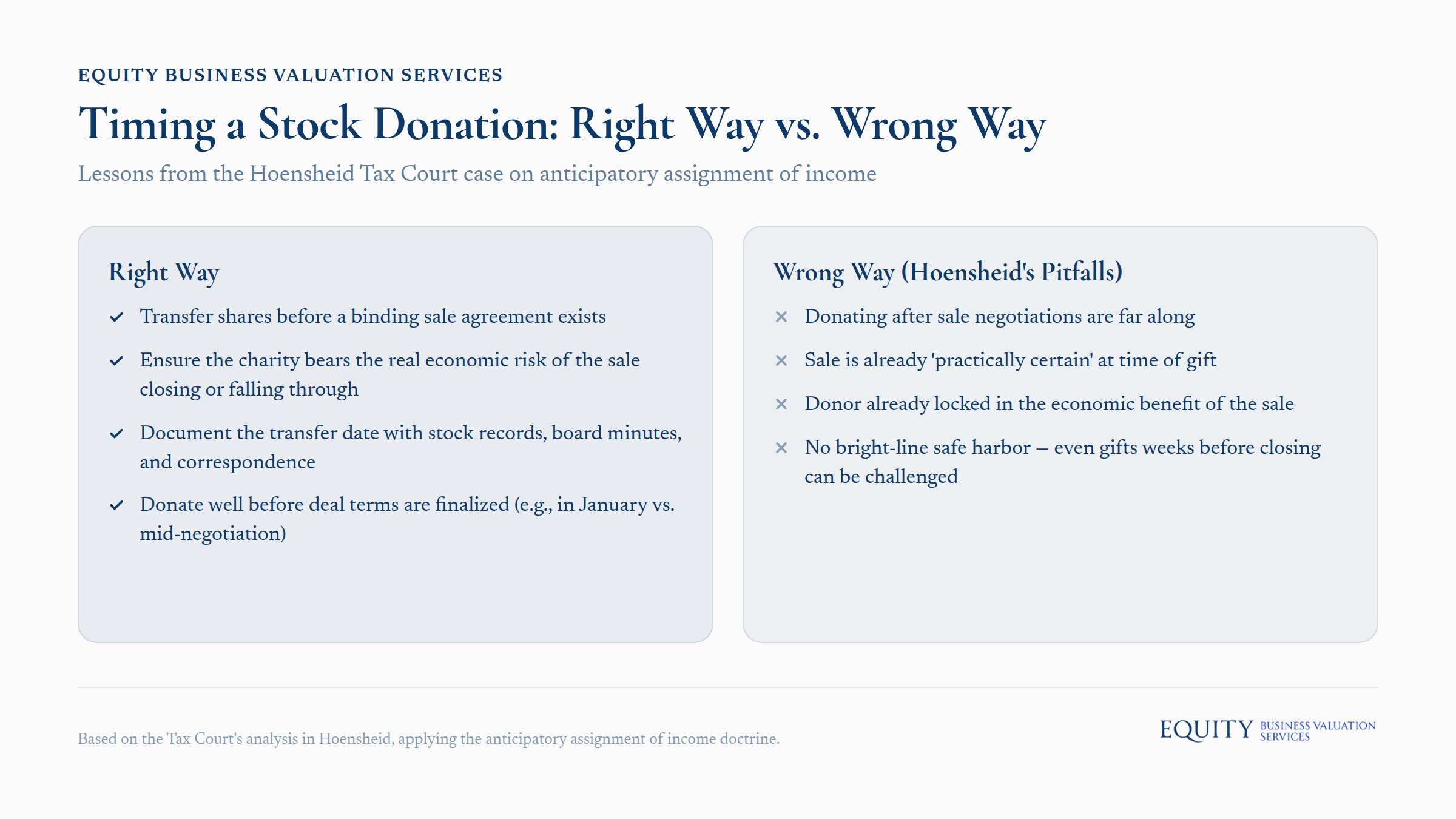
Assignment of income. Because the sale was so far along by July 13 that the right to the proceeds was effectively fixed, the court treated the transaction as if Hoensheid had sold the stock himself and then donated the cash. That meant he owed capital gains tax on the shares regardless of the donation, since the gift came too late to shift the tax consequences of the sale to the charity.
No qualified appraisal. The valuation supporting the deduction was prepared by an investment banker who was already working on the CSTC sale, not by an independent, credentialed appraiser. The court found he lacked recognized appraisal credentials, did not hold himself out to the public as an appraiser, and produced a report that used an incorrect valuation date and failed to adequately describe his own qualifications.
Either failure alone would have been enough to sink the deduction. Together, they made Hoensheid a rare case where the IRS won decisively on both the timing question and the paperwork question, which is exactly why it has become the go-to cautionary tale for anyone donating private company stock ahead of a sale. We'll walk through each issue in detail below, along with what a defensible version of this same gift would have looked like.
Form 8283 Documentation Requirements for Private Stock Gifts
Key takeaway: IRS Form 8283 is required once noncash donations exceed $500 for the year, but the requirements escalate sharply as the value climbs, and private company stock has no public price to fall back on.
The filing thresholds work like this:
Total noncash contribution value | What's required |
|---|---|
Over $500 | File Form 8283 with the return |
Over $5,000 | Qualified appraisal required; complete Section B, signed by appraiser and donee |
$500,000 and above | Complete appraisal report itself must be attached to the return under IRC Section 170(f)(11)(D) |
Publicly traded securities are exempt from the appraisal requirement because a daily market price already establishes fair market value. Privately held stock doesn't get that exemption. Because closely held shares have no readily available quotation, the IRS treats them like any other hard-to-value property once the deduction passes $5,000, meaning a qualified appraisal is mandatory, not optional.
The qualified appraisal itself must be obtained no earlier than 60 days before the contribution date and no later than the due date of the return, including extensions. Waiting until you're already preparing your tax filing to arrange an appraisal is a frequent, and entirely preventable, scramble.
How to Properly Document a Private Company Stock Donation
Confirm the value against the thresholds. Anything over $5,000 needs a qualified appraisal; over $500,000 needs the full appraisal report attached to the return.
Engage an independent appraiser before the sale process gets too far along. The appraiser should have no compensation tied to the underlying transaction and should hold recognized credentials such as those from the American Society of Appraisers or NACVA.
Time the transfer of shares before any binding sale agreement. Get the gift documented, dated, and completed while the sale remains genuinely uncertain.
Secure a written acknowledgment from the charity describing the property received and confirming whether any goods or services were provided in exchange.
Complete Section B of Form 8283 in full, with matching values across the appraisal, the acknowledgment letter, and the form itself, and with both the appraiser's and the charity's signatures.
Keep the full file, including engagement letters, board minutes, transfer records, and correspondence, in case the IRS asks questions years later.
FAQ
Q: Do I need a qualified appraisal if I'm donating publicly traded stock instead of private company shares? No. Publicly traded securities are exempt from the qualified appraisal requirement because their value is established by daily market quotations. The appraisal requirement applies specifically to property, like private company stock, that has no readily available market price.
Q: Can the investment banker handling my company's sale also appraise my donated shares? Generally no. A qualified appraiser cannot have a financial interest in the transaction being valued. The Tax Court in Hoensheid found that a banker compensated based on the deal's success did not meet the independence standard the IRS requires.
Q: What happens if I donate stock after a sale agreement is already signed? The IRS may apply the anticipatory assignment of income doctrine and treat the transaction as a sale by you followed by a cash gift, which means you'd owe capital gains tax on the sale regardless of the donation. Timing the gift before any binding agreement is the safer approach.
Q: Is a self-prepared valuation ever acceptable for a stock donation over $5,000? No. Once the claimed deduction exceeds $5,000, IRS rules require a qualified appraisal prepared by an independent appraiser, not a valuation performed by the donor, a company insider, or anyone with a stake in the outcome.
Getting the Valuation Right From the Start
The common thread through Hoensheid is that every failure point, timing, appraiser independence, and report completeness, was preventable with the right process in place from the beginning. A defensible charitable stock donation starts with an independent valuation from a team that has no financial interest in whether the underlying sale happens at all.
Our business valuation services are built specifically for this kind of engagement, and our pricing reflects the scope of the valuation, not a stake in your transaction. If you're planning to donate private company stock to charity, request an appraisal before the sale process moves any further along, timing is everything here.
This article is provided for general informational purposes only and does not constitute legal, tax, or financial advice. Readers should consult a qualified attorney or CPA regarding their specific circumstances.