
Blog
Why Donating Complex Assets to a Donor-Advised Fund Requires a Qualified Business Valuation
Donating closely held equity, business interests, or real estate to a donor-advised fund can turn an appreciated, illiquid asset into a tax-efficient gift, but the IRS requires a qualified, USPAP-compliant business valuation for any claimed deduction over $5,000. This guide walks through the timing rules, Form 8283 requirements, and who can (and cannot) serve as the qualified appraiser.
Published
Converting a stake in a closely held company, a parcel of investment real estate, or a partnership interest into a charitable gift sounds simple until a donor asks what the IRS will actually accept as proof of value. These assets have no daily stock ticker and no comparable sale down the street. That gap between "what we believe it's worth" and "what the IRS will substantiate" is exactly where a qualified business valuation does its work, and it is the single most commonly mishandled step in complex-asset giving.
Donor-advised funds (DAFs) have become a popular vehicle for this kind of giving. A donor makes an irrevocable contribution to an account held by a sponsoring public charity, claims a deduction in the year of contribution (subject to the applicable limitations), and later recommends grants to qualified charities over time. For donors who are planning a business sale, a liquidity event, or an exit from a long-held property, routing the appreciated interest through a DAF before the sale closes, rather than donating cash after the fact, can avoid recognizing capital gain on the donated portion of the asset. Our business valuation for charitable donation team regularly works alongside advisors structuring exactly this kind of gift.
What Donating a Business Interest to a DAF Actually Accomplishes
The appeal is straightforward: instead of selling an appreciated asset, paying tax on the gain, and donating the after-tax proceeds, a donor contributes the asset itself. If structured correctly, the donor may deduct the fair market value of the contributed interest and the sponsoring charity, as a tax-exempt entity, can later sell the asset without the same gain recognition the donor would have faced.
This matters most to owners who are already negotiating a sale or anticipate one. A founder selling a company, a family selling a commercial property, or a partner exiting an LLC all have appreciated, low-basis assets that are difficult to give away through ordinary cash gifts. A DAF sponsor willing to accept nonpublic assets gives these donors a mechanism to fund years of future giving with a single, well-timed contribution, while the sponsor handles the eventual liquidation.
A DAF sponsor's willingness to accept an asset is a due-diligence and administrative decision, not a valuation. The donor still carries full responsibility for substantiating the deduction under federal tax rules, regardless of how smoothly the sponsor's intake process goes.
Timing the Gift: Before the Sale, Not After
The order of operations is the part advisors cannot afford to get wrong. If a donor contributes the business interest, partnership unit, or real estate to the DAF before a binding sale agreement exists, the donor is generally treated as having given away the asset itself, and the subsequent sale is the charity's transaction, not the donor's. If the donor instead waits until after a sale is essentially locked in, perhaps because the donor has already signed a definitive agreement or the terms are no longer realistically subject to change, the IRS can invoke the assignment-of-income doctrine (or a step-transaction analysis) to argue that the gain belongs to the donor regardless of who technically holds the asset at closing.
This is not a theoretical risk. It is the central issue in a well-known federal case involving a closely held stock donation made shortly before a corporate sale, which our analysis of the Hoensheid case and what it means for private stock donations walks through in detail. The practical lesson for advisors: the gift needs to be complete, in substance and not just on paper, before the sale becomes a near-certainty. That means contributing the interest early, documenting the transfer independently of the sale negotiations, and avoiding any arrangement where the donor retains effective control over whether or how the sale proceeds.
Watch out: A signed letter of intent is not a bright line, but the closer a transaction gets to a binding agreement, the harder it becomes to argue the donor gave away an unsold asset rather than assigned income from an already-arranged sale.
Why the IRS Requires a Qualified Appraisal Over $5,000
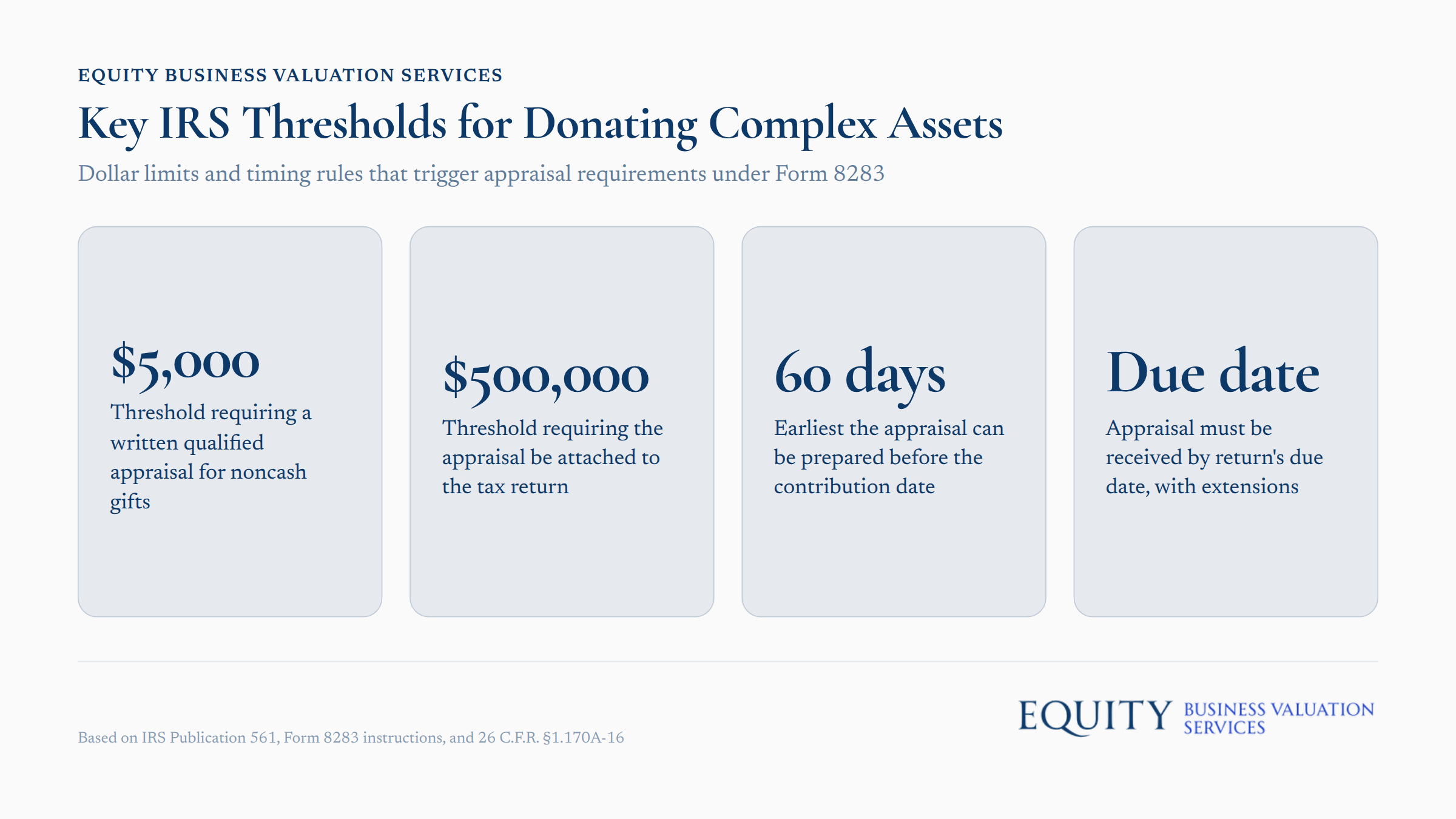
A written qualified appraisal is generally required for any claimed noncash charitable deduction over $5,000 for property that lacks a readily available market price, which describes almost every closely held business interest, partnership unit, LLC interest, or real estate parcel. IRS Publication 561 sets the standard for determining fair market value of a closely held business interest as the price a willing buyer would pay a willing seller, with neither party under compulsion and both having reasonable knowledge of the relevant facts.
The appraisal requirement is implemented through Form 8283. For donations in this category, the donor must complete Section B of Form 8283, have the appraiser sign the declaration, and in many cases obtain the donee organization's signature acknowledging receipt. If the claimed deduction exceeds $500,000, the completed appraisal generally must be attached to the return itself rather than simply retained in the donor's files. The underlying substantiation requirements are set out in the Treasury regulations, including 26 C.F.R. §1.170A-16.
Not everyone is eligible to prepare this appraisal. Form 8283's instructions disqualify several categories of appraiser, including:
- The donor, or the party who prepared the appraisal for purposes other than the donation itself
- The donee organization receiving the gift, since the IRS is explicit that a recipient charity is not a qualified appraiser merely because it signs the acknowledgment
- A party to the transaction in which the donor acquired the property, unless the donation occurs within two months of acquisition and the claimed value does not exceed the acquisition price
- Any person employed by, married to, or related to anyone listed above, or anyone whose relationship would cause a reasonable person to question independence
- An appraiser who regularly appraises for any of the disqualified parties above and does not perform the majority of appraisals in that tax year for other clients
Timing matters as much as independence. The appraisal must be prepared no earlier than 60 days before the date of the contribution, and the donor must receive it before the due date, including extensions, of the return on which the deduction is first claimed.
Key takeaway: For a gift valued over $5,000 of closely held equity, a partnership interest, or real estate, there is no shortcut around a written qualified appraisal prepared by an independent, qualified appraiser inside this specific timing window.
What Financial Advisors Need to Know About Appraiser Independence
For advisors structuring these gifts on behalf of clients, the valuation is not a formality to check off alongside the legal documents. It is the piece of the file an IRS examiner will scrutinize first if the deduction is ever questioned, and the burden of proof in a gift valuation audit sits with the donor, not the IRS. A thin appraisal, one that states a number without walking through the valuation approach, the data relied on, and the reasoning behind any discounts, gives an examiner an easy target even when the underlying number is reasonable.
Independence deserves particular attention in DAF-structured gifts because of how these transactions are often arranged. If the same advisor who recommended the DAF sponsor, or a party connected to the deal, also selects or influences the appraiser, that relationship can undercut the appraisal's credibility even where the valuation conclusion is sound. Advisors protect their clients by engaging an appraiser who has no stake in the sponsor relationship, the sale transaction, or the referral arrangement, and who is retained specifically to value the exact interest being contributed rather than the business as a whole.
That last distinction matters more than it sounds. A valuation of a 100% controlling interest in a company is a different analysis than a valuation of the 12% nonvoting interest the donor is actually contributing. The report needs to reflect the rights, restrictions, voting power, and marketability of the specific interest transferred, including any buy-sell agreements, transfer restrictions, or lack-of-control and lack-of-marketability considerations that apply to that interest and not to the enterprise as a whole.
How the Mechanics Work: Donate, Sell, Grant
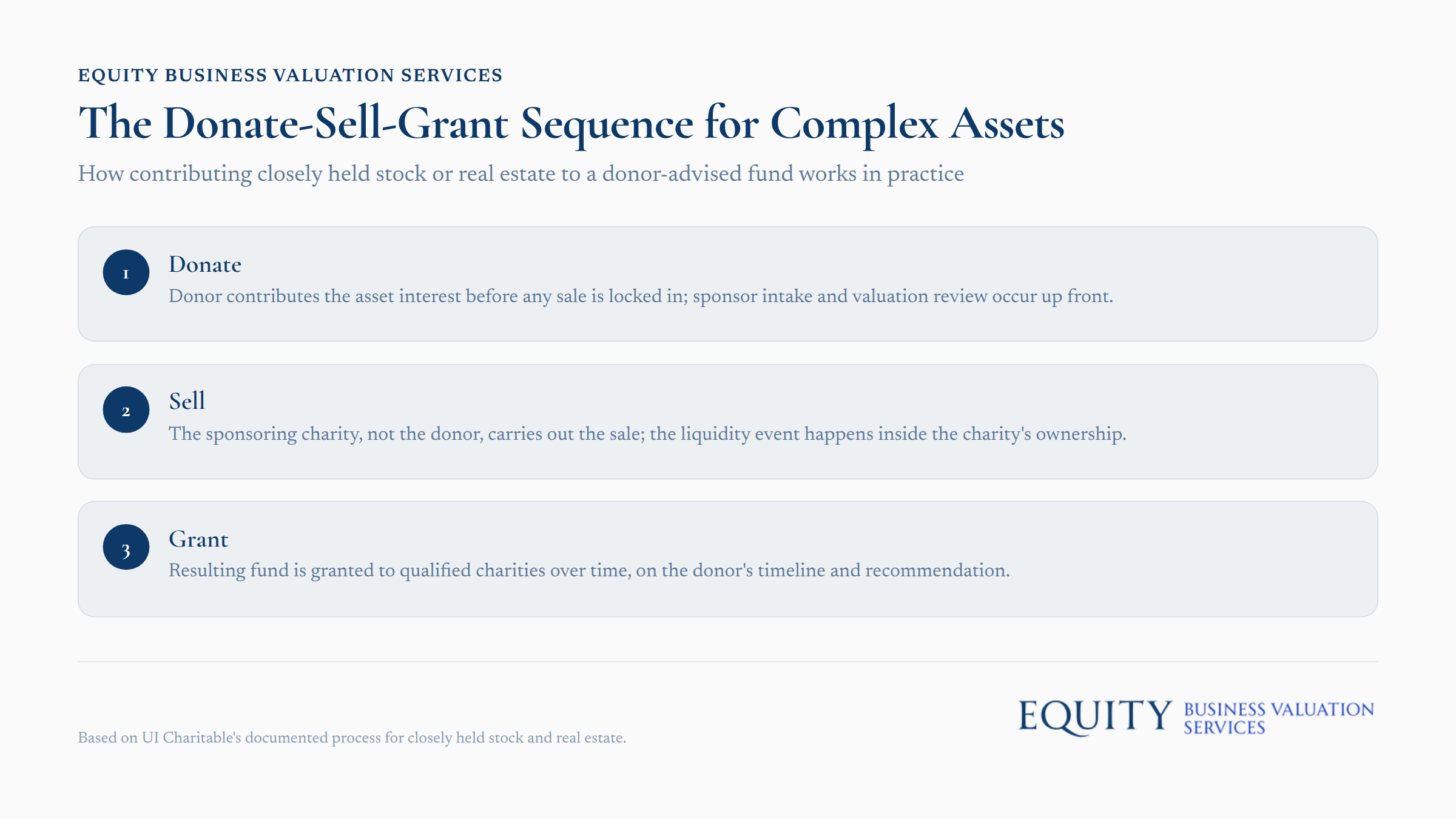
Operationally, complex-asset giving through a DAF generally follows a three-stage sequence: the donor contributes the interest before any sale is locked in, the sponsoring charity (not the donor) carries out or participates in the eventual sale, and the resulting fund is then granted out to qualified charities over time at the donor's recommendation. Organizations that run established donor-advised fund programs for complex assets, such as UI Charitable's documented process for closely held stock and real estate, illustrate this donate-sell-grant structure in practice: the sponsor's intake and valuation review happens up front, the liquidity event happens inside the charity's ownership, and the charitable dollars are deployed on the donor's timeline rather than all at once.
The donor's deduction is anchored to the fair market value on the date of contribution, determined by the qualified appraisal, not to whatever price the asset eventually fetches in the sponsor's sale. A valuation conclusion that is too high invites IRS challenge and penalty exposure; one that is too conservative leaves charitable deduction value on the table. Getting that number right, and being able to defend it, is the whole point of engaging a qualified appraiser before the contribution is made.
Our Role in Substantiating the Deduction
Our business valuation appraisers prepare the written, USPAP-compliant valuations that support these contributions, covering closely held equity, partnership and LLC interests, and the business or real estate components of complex gifts. Each engagement is scoped to the specific interest being donated: its size, its rights, its restrictions, and the intended use of the report as substantiation for a federal charitable deduction. Reports are prepared as a fixed fee, quoted after we understand the entity, the interest being transferred, and the timeline, never billed by the hour.
Because the appraisal has to stand on its own if the IRS ever asks questions, our reports document the valuation approach selected (income, market, or asset-based), the data relied on, and the basis for any discounts applied to the specific interest transferred. That is the standard an examiner expects to see, and it is the standard that protects the deduction a donor and their advisor worked to structure correctly.
This article is provided for general informational purposes only and does not constitute legal, tax, or financial advice. Readers should consult a qualified attorney or CPA regarding their specific circumstances.