
Blog
Discount for Lack of Control vs. Marketability: How the Two Valuation Discounts Differ
A discount for lack of control accounts for decision-making power a minority owner doesn't have, while a discount for lack of marketability accounts for how hard that ownership stake is to sell. This guide shows how our appraisers calculate and combine both discounts, with a worked example the IRS and courts would recognize.
When a business valuation involves a minority stake in a closely held company, two discounts almost always enter the conversation: the discount for lack of control (DLOC) and the discount for lack of marketability (DLOM). They sound similar and often get applied together, which is exactly why they get confused. They measure two different things, rely on two different bodies of evidence, and get calculated in a specific order. Getting the distinction wrong is one of the fastest ways to draw scrutiny from the IRS or a tax court.
Our appraisers apply both discounts regularly in business valuations prepared for estate tax reporting and gift tax filings, where the value of a minority interest in a family business or partnership has to hold up to examination years after the report is filed.
What Is a Discount for Lack of Control (DLOC)?
A discount for lack of control measures the value gap between owning a controlling interest in a company and owning a minority interest that cannot direct how the company operates. A minority owner typically cannot force a sale of the business, set or change distribution policy, hire or fire management, or approve major capital decisions. That absence of power is worth something to a buyer, and a DLOC quantifies it.
DLOC is most often derived from control premium studies: data on what acquirers actually paid above the trading price of publicly held companies to obtain control. The conversion from a control premium to a discount uses a simple formula:
DLOC = 1 - [1 / (1 + control premium)]
Example: If comparable acquisition data shows a 30% average control premium, the implied DLOC is 1 - (1 / 1.30), or roughly 23%. A control premium and a DLOC describe the same relationship from opposite directions.
What Is a Discount for Lack of Marketability (DLOM)?
A discount for lack of marketability measures the reduction in value because an ownership interest cannot be converted to cash quickly, unlike a share of stock traded on a public exchange. A buyer of an illiquid interest has to accept the cost, delay, and uncertainty of finding a private buyer, so that buyer will pay less for the interest today.
DLOM is typically supported by empirical studies rather than a single formula, including restricted stock studies (comparing prices of freely traded shares to otherwise identical shares subject to a resale restriction), pre-IPO studies (comparing private transaction prices to the eventual public offering price), and option-pricing models that estimate the cost of hedging against an inability to sell. Unlike DLOC, a DLOM can apply to a controlling interest too. A 100% owner of a private company with no ready buyer still holds an illiquid asset.
DLOC vs. DLOM at a Glance
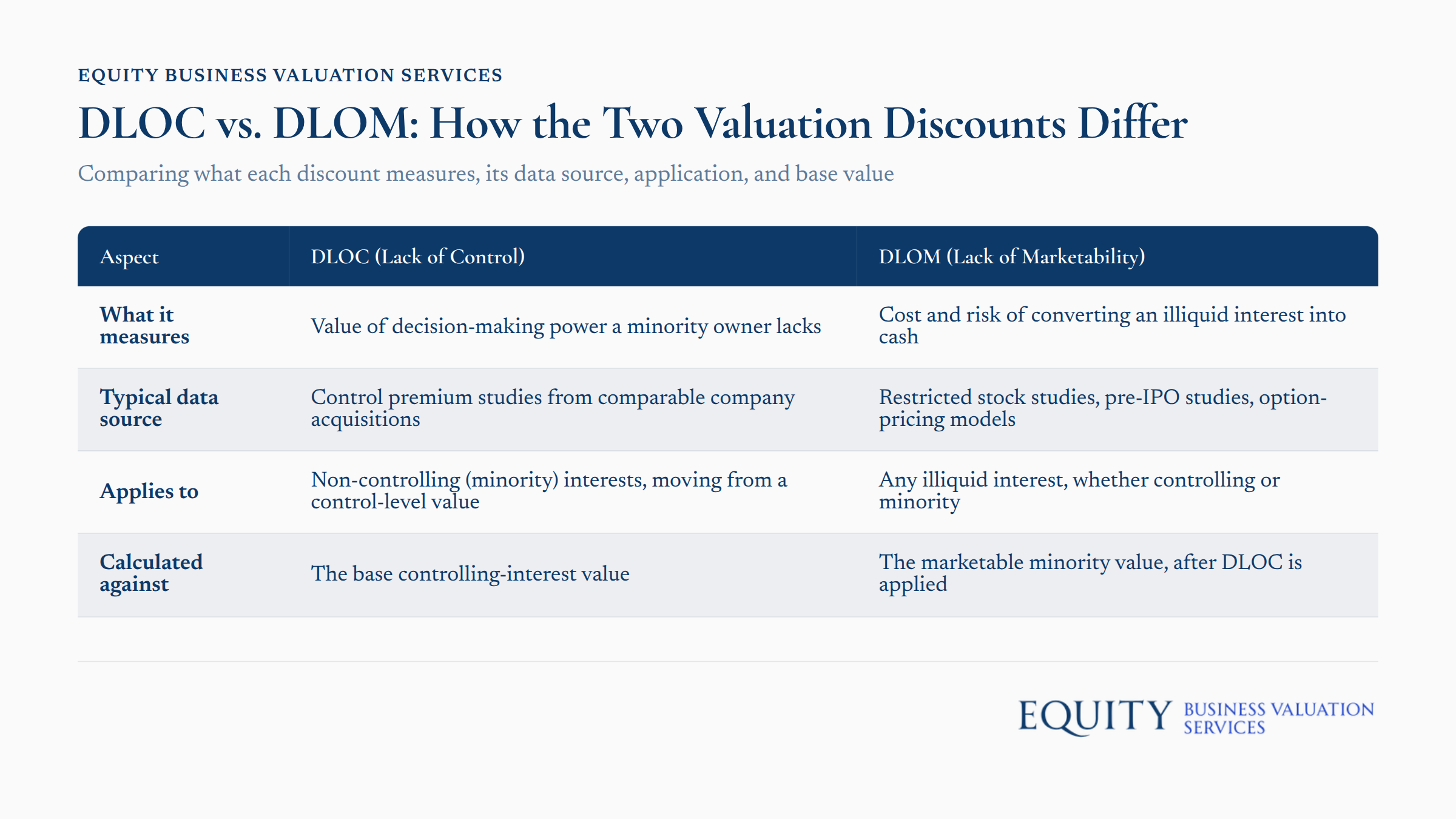
The table below summarizes how the two discounts differ in what they measure, where the supporting data comes from, and which interests they apply to.
| Aspect | Discount for Lack of Control (DLOC) | Discount for Lack of Marketability (DLOM) |
|---|---|---|
| What it measures | The value of decision-making power a minority owner lacks | The cost and risk of converting an illiquid interest into cash |
| Typical data source | Control premium studies from comparable company acquisitions | Restricted stock studies, pre-IPO studies, option-pricing models |
| Applies to | Non-controlling (minority) interests, moving from a control-level value | Any illiquid interest, whether controlling or minority |
| Calculated against | The base controlling-interest value | The marketable minority value, after DLOC is applied |
How the Two Discounts Combine
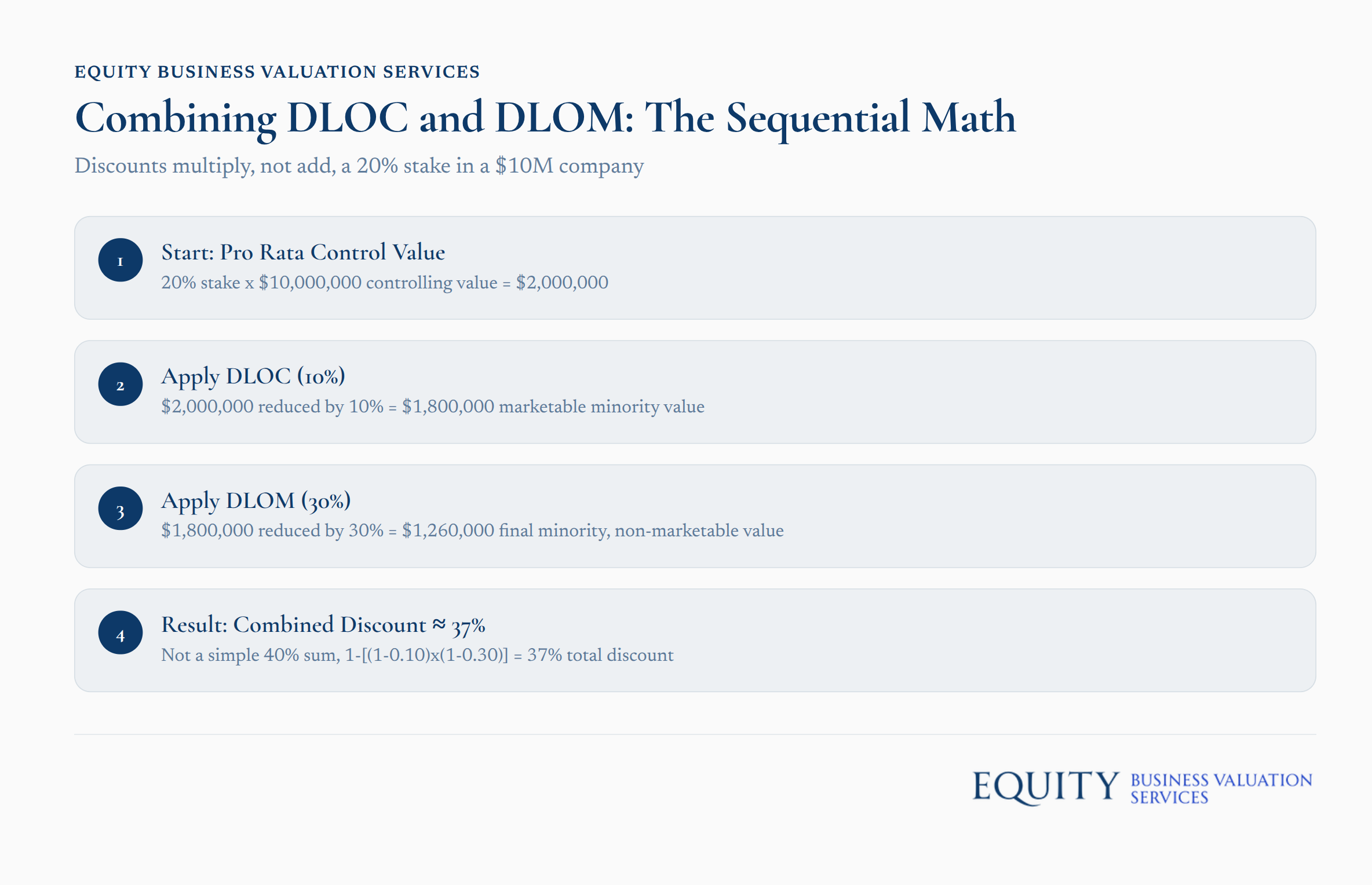
When a business valuation involves a minority, non-marketable interest, which is the common case for a stake in a family business or partnership, both discounts apply in sequence, not all at once. Our appraisers start from a controlling-interest value, apply the DLOC to reach a marketable minority value, and then apply the DLOM to that reduced figure to reach the final minority, non-marketable value.
The combined effect is multiplicative, not additive. A 10% DLOC and a 30% DLOM do not add up to a 40% total discount. The correct formula is:
Combined discount = 1 - [(1 - DLOC) x (1 - DLOM)]
Example: Suppose a closely held company carries a controlling-interest value of $10,000,000, and the interest being valued is a 20% stake. The pro rata share of that control value is $2,000,000. Applying a 10% DLOC brings the marketable minority value to $1,800,000. Applying a 30% DLOM to that figure brings the final value to $1,260,000. Measured against the original $2,000,000 pro rata share, that is a combined discount of about 37%, not the 40% a simple sum would suggest.
Pro tip: Always confirm which base value a discount is being applied against. A DLOC applied to the wrong starting figure, or a DLOM applied before the DLOC instead of after, changes the final number even when both percentages are correct.
How the IRS and Tax Court Scrutinize These Discounts
Revenue Ruling 59-60 is the foundational IRS guidance on valuing closely held business interests, and it directs appraisers to weigh all relevant factors, including the nature of the interest, the degree of control it carries, and its marketability, rather than applying a mechanical, one-size-fits-all discount. Examiners and courts read stacked discounts closely, and a report that treats DLOC and DLOM as an off-the-shelf combination invites challenge.
The Tax Court's decision in Mandelbaum v. Commissioner remains the leading case analyzing the specific factors that support a discount for lack of marketability, including the company's dividend policy, the cost and time required to arrange a sale, restrictions on transferring the interest, and the size of the block being valued. Courts have repeatedly rejected discounts that appraisers could not tie to case-specific facts, and they have been equally skeptical of double-counting the same risk under two different labels.
A related, and easy to make, mistake is folding a marketability factor into the control discount, or vice versa, and then applying a second discount for the same risk under a different name. Because the two discounts measure genuinely different things, that kind of overlap is one of the clearest signals of an unsupported valuation.
Our appraisers prepare business valuations for gift tax filings with this scrutiny in mind, documenting each discount separately so the report can withstand review years after it is filed. A related question, how appraisers isolate a partner's discountable slice of an entity in the first place, is covered in our guide to minority discount treatment in a partnership buyout.
Why Each Discount Needs Its Own Evidence
A DLOC and a DLOM cannot be justified by the same data, and neither can be justified by a rule of thumb borrowed from a prior engagement. Supporting a DLOC requires control premium data from transactions genuinely comparable to the subject company's industry and size. Supporting a DLOM requires marketability studies, transfer restrictions found in the entity's governing documents, and analysis specific to how and when that particular interest could realistically be sold.
Watch out: A report that cites a single blended discount, or that applies a round number like "35% combined" without separately deriving the DLOC and DLOM components, is exactly the kind of unsupported valuation that draws an IRS challenge or gets excluded in litigation.
Our valuation team holds credentials including the ASA and NACVA, and prepares every report in accordance with USPAP as set by The Appraisal Foundation, with each discount independently supported by its own body of evidence. That separation is what allows a minority-interest valuation to hold up under examination, whether the reviewing party is an IRS agent, an opposing expert, or a judge.
Key takeaway: DLOC addresses what an owner cannot control; DLOM addresses what an owner cannot easily sell. They are calculated against different base values, supported by different evidence, and combined multiplicatively rather than added together.
If your estate, gift, or partnership matter involves a minority interest that needs a defensible combined discount, request an appraisal from our team and we will scope the engagement and quote a fixed fee before work begins.
This article is provided for general informational purposes only and does not constitute legal, tax, or financial advice. Readers should consult a qualified attorney or CPA regarding their specific circumstances.