
Blog
When Do You Need a Business Valuation for a Portugal Golden Visa or D2 Visa?
A business valuation for Portugal Golden Visa applications is not a legal filing requirement on its own, but it becomes essential documentation whenever your investment route involves buying into, capitalizing, or founding a Portuguese company. This guide explains which routes typically call for a valuation and what a USPAP-compliant report should include.
US investors pursuing Portugal's Golden Visa or D2 entrepreneur visa often assume the immigration paperwork is entirely a legal matter, handled by an attorney and a fund manager. In practice, the business-focused investment routes that remain open under the Golden Visa program, along with the D2 visa's business plan requirement, frequently hinge on one financial question: what is this company actually worth, and how much of that value does the investor's capital represent? That's where a business valuation becomes relevant, not as a government-mandated form, but as supporting evidence that helps an attorney or fund manager document the investment amount claimed in the application.
This article covers which Golden Visa and D2 routes typically call for a valuation, what a USPAP-compliant report includes, and how it fits alongside the other professionals on an applicant's team. We are a US-based business valuation firm. We do not practice Portuguese immigration law, and we do not represent our reports as accepted by AIMA, Portuguese immigration authorities, CMVM, or any other government body.
What Changed in Portugal's Golden Visa Program
Portugal removed the real estate investment route from its Golden Visa program, closing off what had long been the most common path for foreign investors. The routes that remain are tied to company creation, capital investment in Portuguese businesses, and job creation, which is a meaningful shift for US investors who assumed a property purchase would qualify them.
The current official investment categories, as listed on AIMA's residence authorization page, include capital transfers into Portuguese companies alongside specific job creation or maintenance conditions. Practitioner summaries tracking the 2023 legal reforms confirm that the real estate route was eliminated in favor of business and fund-oriented investment categories. For US investors, this means the business-creation and capital-reinforcement routes are no longer a niche alternative. They are now the primary path for anyone pursuing the Golden Visa through direct investment rather than a qualifying fund.
The Two Business-Focused Investment Routes That Remain
Two business-oriented routes currently anchor the Golden Visa's non-fund options. Both require documentation of the exact capital amount invested and the company structure receiving it, which is precisely where a valuation typically comes in.
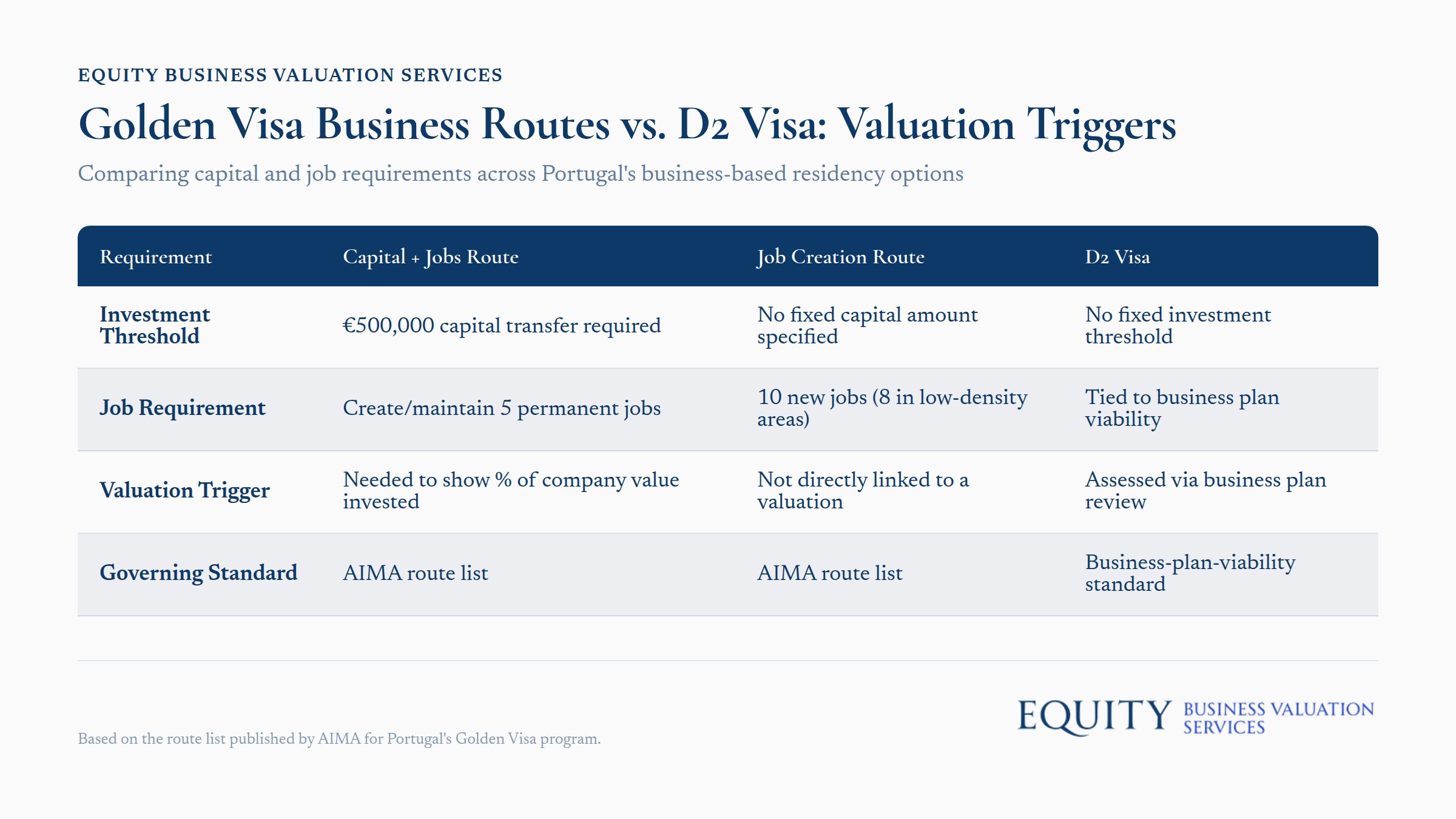
- Capital investment with job creation or maintenance. An investor transfers 500,000 EUR into a Portuguese company, either forming a new one or reinforcing the share capital of an existing one, while helping create or maintain at least 5 permanent jobs for the required holding period, per the route list published by AIMA.
- Job creation route. An investor creates at least 10 new full-time jobs in Portugal, or 8 jobs if the business is located in a low-density area, without a fixed capital transfer amount attached to this specific category.
Neither route's public rule text says "submit a valuation report" in so many words. What it does require is proof of the qualifying investment amount and, where an existing company is involved, clarity on ownership structure and job conditions. If an applicant is buying shares in an existing Portuguese business or injecting capital alongside other shareholders, the file needs to show what portion of the company's value that 500,000 EUR actually represents. Without that context, an immigration attorney has no clean way to demonstrate the investment meets the threshold.
The D2 Entrepreneur Visa Has No Fixed Capital Threshold
The D2 visa does not carry a statutory minimum investment amount. Instead, Portuguese authorities assess whether the applicant's business plan is viable and whether the applicant has sufficient means to run the business and support themselves while doing so.
Current guidance summarized by immigration practitioners states plainly that Portuguese law does not specify a minimum investment for the D2, leaving the assessment to the viability of the plan and the financial capacity behind it. That's a very different posture from the Golden Visa's fixed 500,000 EUR threshold. It also means a US investor's capital needs vary widely depending on the business model: a consulting practice and a manufacturing startup will require very different sums to be credible.
Because there's no fixed number to hit, a valuation is not a stated legal requirement for a D2 filing. Where it becomes useful is when the D2 application involves acquiring an existing Portuguese business rather than starting one from scratch. In that scenario, documentation of the target company's fair market value helps show the purchase price is commercially reasonable, which supports the overall credibility of the business plan.
Why a Business Valuation Matters for These Applications
A business valuation is generally not a standalone legal requirement for either the Golden Visa or the D2 visa. It becomes practically necessary whenever the qualifying route involves buying equity in an existing company, reinforcing an existing company's capital, or acquiring a business as part of a D2 plan.
In each of those scenarios, someone in the application chain (usually the immigration attorney or the fund manager coordinating the investment) needs a defensible figure for what the company or the ownership interest is worth. A valuation prepared in accordance with USPAP, the Uniform Standards of Professional Appraisal Practice, gives that figure a documented, methodology-based foundation rather than a number pulled from a term sheet or a founder's own estimate.
Watch out: A valuation report is supporting documentation, not a guarantee of any outcome. We do not claim our reports are accepted by AIMA or any Portuguese government body, and no appraisal firm can make that promise on your behalf.
What a USPAP-Compliant Business Valuation Includes
A valuation prepared for this purpose typically documents three things: the fair market value of the enterprise or the specific ownership interest involved, the methodology used to reach that conclusion, and the relationship between the invested capital and the resulting equity stake.
Depending on the transaction, our valuation team applies one or more of the three recognized valuation approaches:
- Income approach. Values the business based on its capacity to generate future cash flow, common when the target has an operating history.
- Market approach. Compares the company to similar businesses that have recently sold or been valued, useful when comparable transaction data exists.
- Asset approach. Values the business based on its underlying assets and liabilities, often relevant for newly formed entities with limited operating history.
Example: A US investor plans to acquire a 40% stake in an existing Porto-based logistics company for 500,000 EUR under the capital reinforcement route. A valuation of the company as a whole establishes its total fair market value, then applies that percentage to show what the 500,000 EUR investment actually represents in ownership terms, information the investor's attorney needs to document the application correctly.
How the Valuation Fits Alongside Your Attorney and Fund Manager
A business valuation is one piece of a larger application file, not a replacement for legal counsel or fund documentation. Our role is limited and specific: we determine fair market value and document it in a USPAP-compliant report.
Key takeaway: We do not provide Portuguese immigration legal advice, and we do not advise on Portuguese company law, corporate structuring, or fund selection. Those decisions stay with the investor's Portuguese attorney and, where applicable, the licensed fund manager overseeing a qualifying investment fund.
What we do provide is a report the attorney can incorporate into the broader submission alongside proof of funds, corporate registration documents, and the attorney's own legal filings. Coordinating early, before the capital transfer is finalized, tends to produce a cleaner file than trying to reverse-engineer a valuation after the fact.
What We Need From You to Prepare the Valuation
To scope and prepare a valuation for this purpose, we typically request the following from the client or their advisor:
- Corporate documents for the target company, including formation records and current cap table or ownership structure.
- Financial statements, ideally 2 to 3 years of historical data if the company has an operating history.
- Transaction details, including the proposed investment amount, the percentage of ownership involved, and the structure of the deal (new formation, share purchase, or capital reinforcement).
- Business plan or projections, particularly for newly formed entities without financial history.
- Context on the intended use, so the report is framed correctly as supporting documentation for the immigration filing.
Engagements of this kind are quoted as a fixed fee after we review the scope, which depends on the complexity of the entity, the completeness of available records, and the depth of analysis the transaction requires. We do not bill hourly.
Frequently Asked Questions
Q: Is a US-prepared business valuation acceptable for a Portugal Golden Visa filing? A USPAP-compliant valuation prepared by a US-based team can serve as supporting documentation within the broader application package assembled by your Portuguese attorney or fund manager. We do not represent it as pre-approved or guaranteed to be accepted by AIMA or any Portuguese authority; acceptance decisions rest entirely with the reviewing body.
Q: What documents do you need from me to perform the valuation? At minimum, we need the target company's corporate documents, available financial statements or projections, and the specific transaction details, including the investment amount and ownership percentage involved. We will scope the exact requirements once we understand which Golden Visa or D2 route your application follows.
Q: How does this fit with my immigration attorney's own requirements? Our valuation is one input into your attorney's application file. We coordinate on timing and formatting so the report integrates cleanly with the attorney's legal filings and the fund manager's documentation, but the attorney remains responsible for the legal strategy and submission itself.
Q: Do you advise on Portuguese company law or which investment fund to choose? No. We are a business valuation firm, not an immigration law practice or investment advisory. Fund selection, corporate structuring, and Portuguese legal compliance stay with your attorney and licensed financial advisors in Portugal.
Q: How long does a valuation like this typically take? Turnaround depends on the complexity of the entity being valued and how complete the financial records are when we start. We provide a specific timeline as part of the fixed-fee quote once we've scoped the engagement, rather than a generic estimate that may not match your situation.
Getting Started
If your Golden Visa or D2 application involves buying into, capitalizing, or founding a Portuguese company, talk to your immigration attorney early about whether a valuation strengthens your file. When it does, our team prepares a USPAP-compliant report scoped to your specific transaction and timeline. Request a business valuation quote to get started.
This article is provided for general informational purposes only and does not constitute legal, tax, or immigration advice. Readers should consult a qualified Portuguese immigration attorney regarding their specific circumstances.