
Blog
When Do You Need a Business Valuation for IRS Form 3520 Reporting?
A business valuation for IRS Form 3520 establishes the fair market value of a foreign gift, bequest, or trust distribution involving a business interest. This guide explains when that valuation is required, what documentation it needs, and how it fits alongside your CPA's filing.
IRS Form 3520 reports transactions most U.S. taxpayers never encounter: gifts and bequests from foreign persons, and distributions from foreign trusts. When one of those transactions involves a business interest, whether it's shares in a foreign company, a partnership stake, or a set of business assets, the taxpayer needs a defensible fair market value on the date of the gift or distribution. This guide walks through when that valuation is needed, what it requires, and how it fits into a Form 3520 filing your CPA or tax attorney prepares.
What Does Form 3520 Report?
Form 3520 is an annual information return that U.S. persons and executors file to report specific dealings with foreign trusts and foreign persons, not a tax return in itself. According to the IRS Form 3520 instructions, the form covers ownership interests in foreign trusts, certain transfers of property to foreign trusts, distributions received from foreign trusts, and the receipt of large gifts or bequests from foreign persons.
The IRS page on gifts from a foreign person explains that reporting is triggered once the aggregate value of gifts or bequests from a nonresident alien individual or a foreign estate exceeds a threshold amount the IRS sets and periodically adjusts. A separate, lower aggregate threshold applies to purported gifts from foreign corporations or foreign partnerships. Because these thresholds and the filing deadline change from year to year, always confirm the current figures with the IRS or your tax preparer rather than relying on a number you saw in an older article.
Form 3520 also has a companion form for foreign trusts with U.S. owners, and distributions a foreign trust makes to a U.S. beneficiary get reported separately from gifts. In every case, the form asks for a dollar figure, either the value of the property received or the gross value of what moved through the trust. That dollar figure is where a business valuation becomes relevant.
When Do You Need a Business Valuation for Form 3520 Reporting?
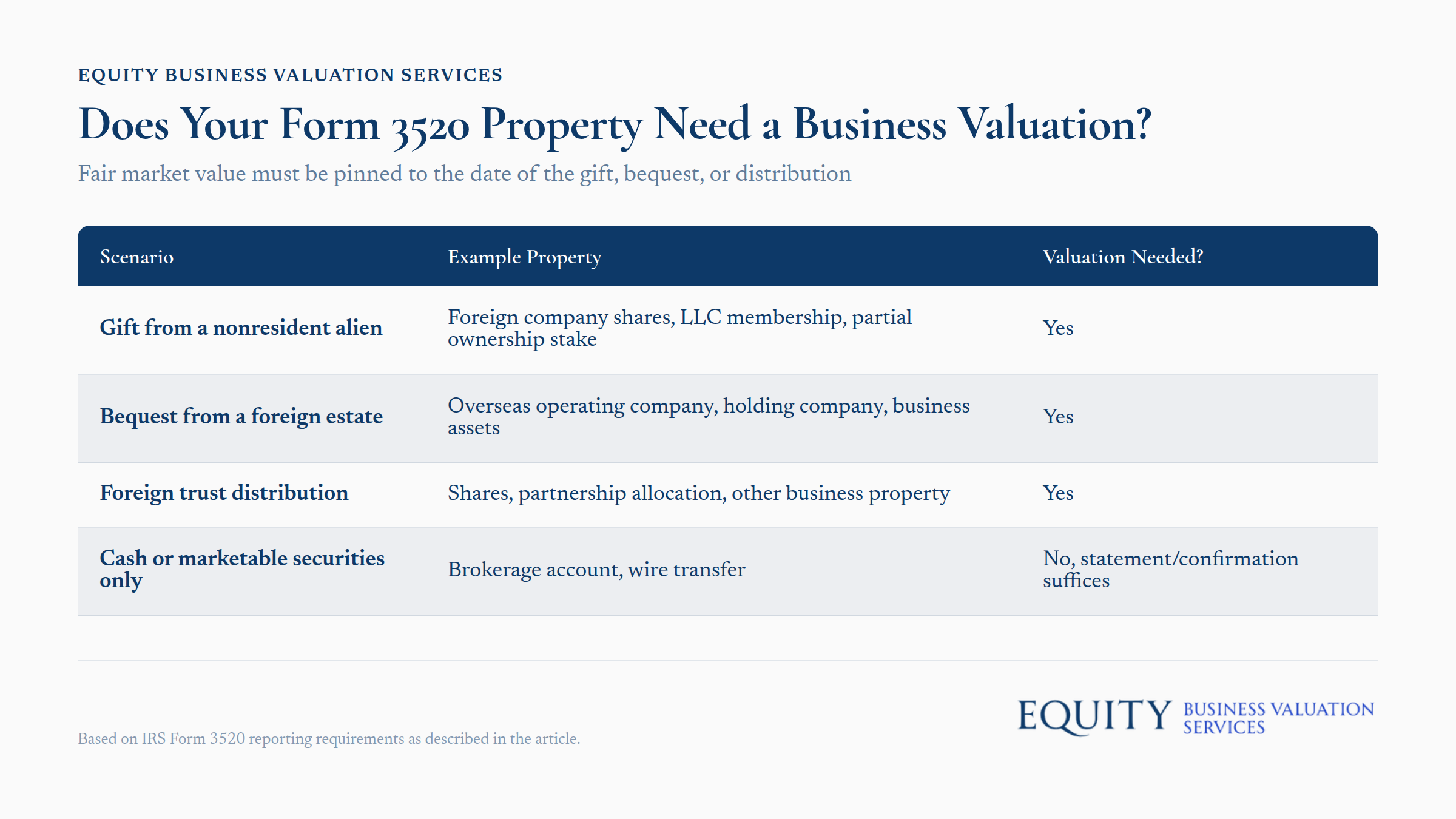
You need a business valuation for Form 3520 when the property being reported is, or includes, an interest in a business rather than cash or publicly traded securities. Three scenarios come up most often in practice.
- A gift of a business interest from a nonresident alien individual. A U.S. person receives shares in a family-owned foreign company, a membership interest in a foreign LLC, or a partial ownership stake as a personal gift.
- A bequest of a business interest from a foreign estate. A U.S. heir inherits an ownership stake in an overseas operating company, a holding company, or a portfolio of business assets through a will or foreign probate proceeding.
- A foreign trust distribution that includes a business interest. Rather than cash, the trust distributes shares, a partnership allocation, or other business property to a U.S. beneficiary.
In each case, the reportable amount is the fair market value of that interest as of the specific date the gift, bequest, or distribution occurred, not its value today and not its original cost basis. If the only property involved is cash or a brokerage account of marketable securities, a business valuation generally is not needed; the account statement or wire confirmation establishes the value. It's the presence of a closely held or foreign business interest, without a ready market price, that creates the need for a professional opinion of value.
Why a Professional Valuation Matters for Form 3520 Compliance
A professional valuation matters because Form 3520 penalties, when they apply, are calculated as a percentage of the reported value, which means the number you put on the form carries real weight. A valuation prepared by a qualified appraiser gives you a defensible basis for that number rather than a rough guess or a figure pulled from an old cap table.
We want to be direct about what a valuation can and cannot promise. No appraiser can guarantee that the IRS will accept a reported value without question; that determination rests entirely with the IRS. What our business valuation for gift tax engagements deliver is a report prepared in accordance with the Uniform Standards of Professional Appraisal Practice (USPAP) and built to meet the documentation expectations that apply to IRS filings involving gifted or inherited business interests. The same approach applies when the business interest arrives through a foreign estate, where a report prepared for business valuation for estate tax purposes establishes fair market value as of the date of death or transfer.
Watch out: A valuation performed months or years after the gift, bequest, or distribution date is far less useful than one prepared as of the actual transfer date. Fair market value is a snapshot, and the further you get from that date, the harder it becomes to reconstruct market conditions, financial performance, and comparable transaction data that existed at the time.
Our appraisers hold credentials with organizations such as the American Society of Appraisers (ASA) and the National Association of Certified Valuators and Analysts (NACVA), and every engagement follows the asset-based, market, and income approaches recognized as the standard framework for valuing a business interest under IRS guidance on the valuation of assets.
What Documentation Does the Valuation Process Require?
The valuation process moves faster and produces a more defensible opinion when you gather the underlying records before the engagement begins. A business interest valuation for Form 3520 purposes typically draws on the following documentation:
- Financial statements: Two to five years of income statements, balance sheets, and cash flow statements for the business, translated to U.S. dollars where the entity is foreign.
- Ownership records: A cap table, partnership agreement, operating agreement, or stock ledger showing exactly what interest was transferred and what rights attach to it.
- Entity formation documents: Articles of incorporation, foreign equivalents, or trust deeds that establish the entity's structure and jurisdiction.
- Prior valuations, if any: Earlier appraisals, buy-sell agreement valuations, or investor term sheets that establish a historical value trend.
- Transfer documentation: The gift letter, trust distribution statement, or probate record that identifies the exact date the interest changed hands, since that date sets the valuation effective date.
Incomplete records don't necessarily stop a valuation, but gaps in financial history or ownership documentation typically mean more analytical work to reconstruct missing information, which affects the scope and fee of the engagement.
How a Business Valuation Fits Into the Form 3520 Filing Process
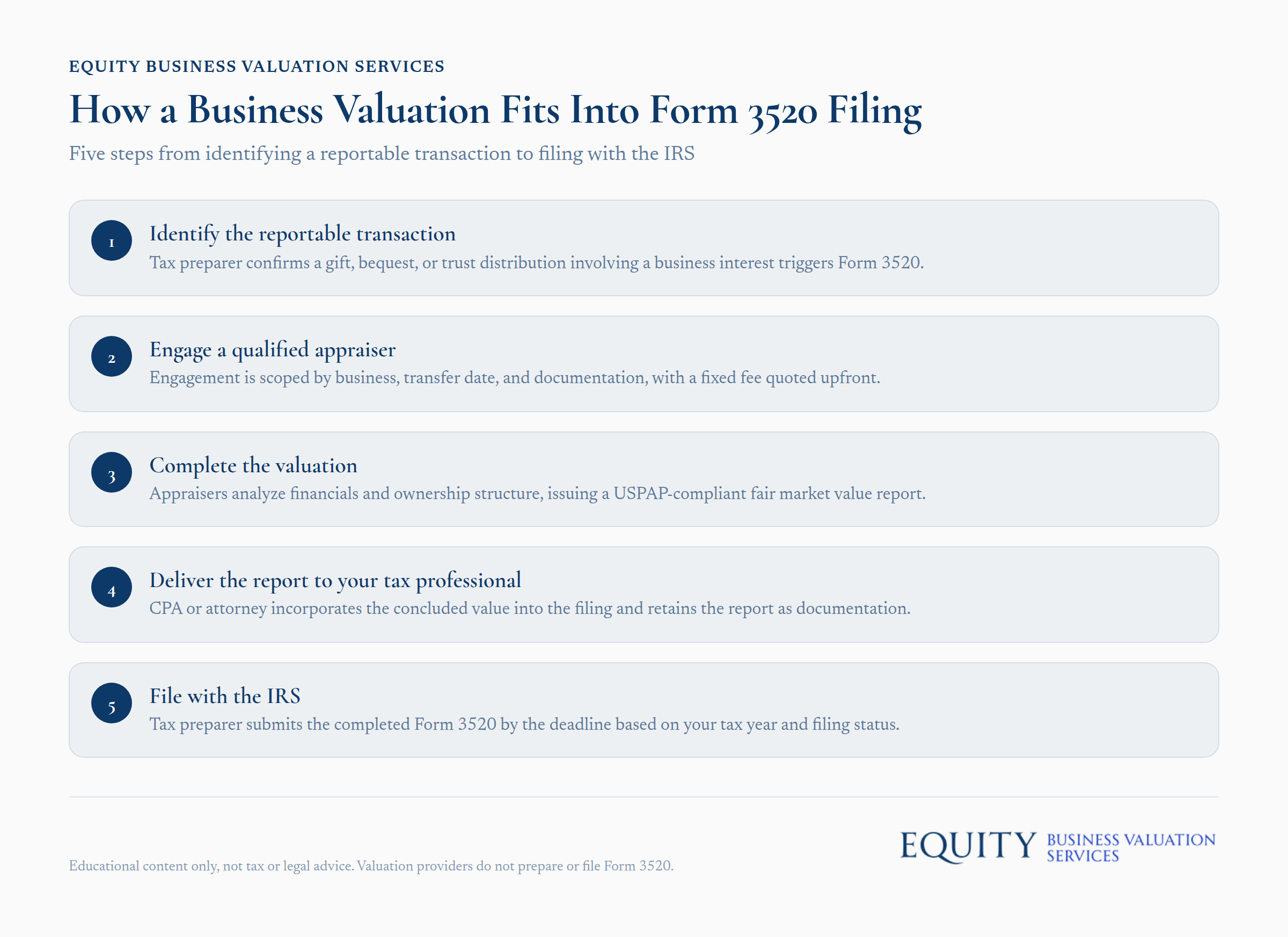
A business valuation is one input into a Form 3520 filing, not the filing itself. We provide the underlying appraisal of the business interest; your CPA or tax attorney uses that appraisal, along with the rest of your financial picture, to prepare and file the actual Form 3520 and any related schedules.
- Identify the reportable transaction. Your tax preparer determines that a gift, bequest, or trust distribution involving a business interest needs to be reported and confirms which parts of Form 3520 apply.
- Engage a qualified appraiser. We scope the engagement based on the business, the transfer date, and the documentation available, and quote a fixed fee before work begins.
- Complete the valuation. Our appraisers analyze the financial records and ownership structure and issue a USPAP-compliant report stating fair market value as of the transfer date.
- Deliver the report to your tax professional. Your CPA or attorney incorporates the concluded value into the Form 3520 filing and retains the report as supporting documentation.
- File with the IRS. Your tax preparer submits the completed form by the applicable deadline, which they will confirm based on your specific tax year and filing status.
This article is educational and does not constitute tax or legal advice. We prepare the business valuation; we do not prepare or file Form 3520, and you should work directly with a CPA or tax attorney familiar with foreign trust and foreign gift reporting to complete your filing.
Frequently Asked Questions
Q: Who actually needs a business valuation for Form 3520 reporting? Anyone who received a gift, bequest, or foreign trust distribution that includes an interest in a business rather than cash or publicly traded securities. If the transaction is entirely cash or marketable securities, a valuation generally isn't necessary because the value is already established by market prices.
Q: What date does the valuation need to reflect? The valuation should reflect fair market value as of the date the gift, bequest, or distribution occurred, not the current date and not the date the return is filed. Reconstructing value as of a past date is possible but works best with complete financial and ownership records from that period.
Q: Do I still need a CPA if I get a business valuation? Yes. A business valuation establishes the fair market value of the business interest; it does not complete or file Form 3520. Your CPA or tax attorney handles the actual return, determines which thresholds and deadlines apply to your situation, and coordinates the overall filing.
Q: What if I don't have complete financial records for the foreign business? Provide what you have. Our appraisers can often work with partial records, tax filings from the foreign jurisdiction, or bank statements, though gaps in documentation typically require additional analytical work, which we'll flag during scoping before the engagement begins.
Q: Can the same valuation be used for other purposes, like the foreign country's own tax filings? Sometimes, but not automatically. A USPAP-compliant valuation prepared for U.S. reporting purposes may be useful supporting documentation elsewhere, but you should confirm with local counsel or a tax professional in the relevant jurisdiction whether it satisfies that country's specific requirements.
This article is provided for general informational purposes only and does not constitute legal, tax, or financial advice. Readers should consult a qualified attorney or CPA regarding their specific circumstances.
If you've received a gift, bequest, or foreign trust distribution involving a business interest, request a business valuation quote and we'll scope a fixed-fee engagement built around your transfer date and documentation.