
Blog
Business Valuation for Divorce: How Appraisers Determine a Defensible Number
A business valuation for divorce hinges on which legal standard a state applies (fair market value or fair value) and on separating personal goodwill from divisible enterprise value. This guide breaks down the classification, goodwill, and methodology decisions that determine whether a valuation report holds up in court.
Divorce is one of the few contexts where the same business can carry two very different numbers depending on who is asking and why. A business valuation prepared for a divorce proceeding follows a different set of rules than one prepared for estate planning or a sale, and getting the standard of value wrong can shift real money to the wrong side of the settlement. This guide walks through how appraisers classify the interest, treat goodwill, pick a valuation date, and build a number that survives cross-examination.
What Standard of Value Applies in a Divorce?
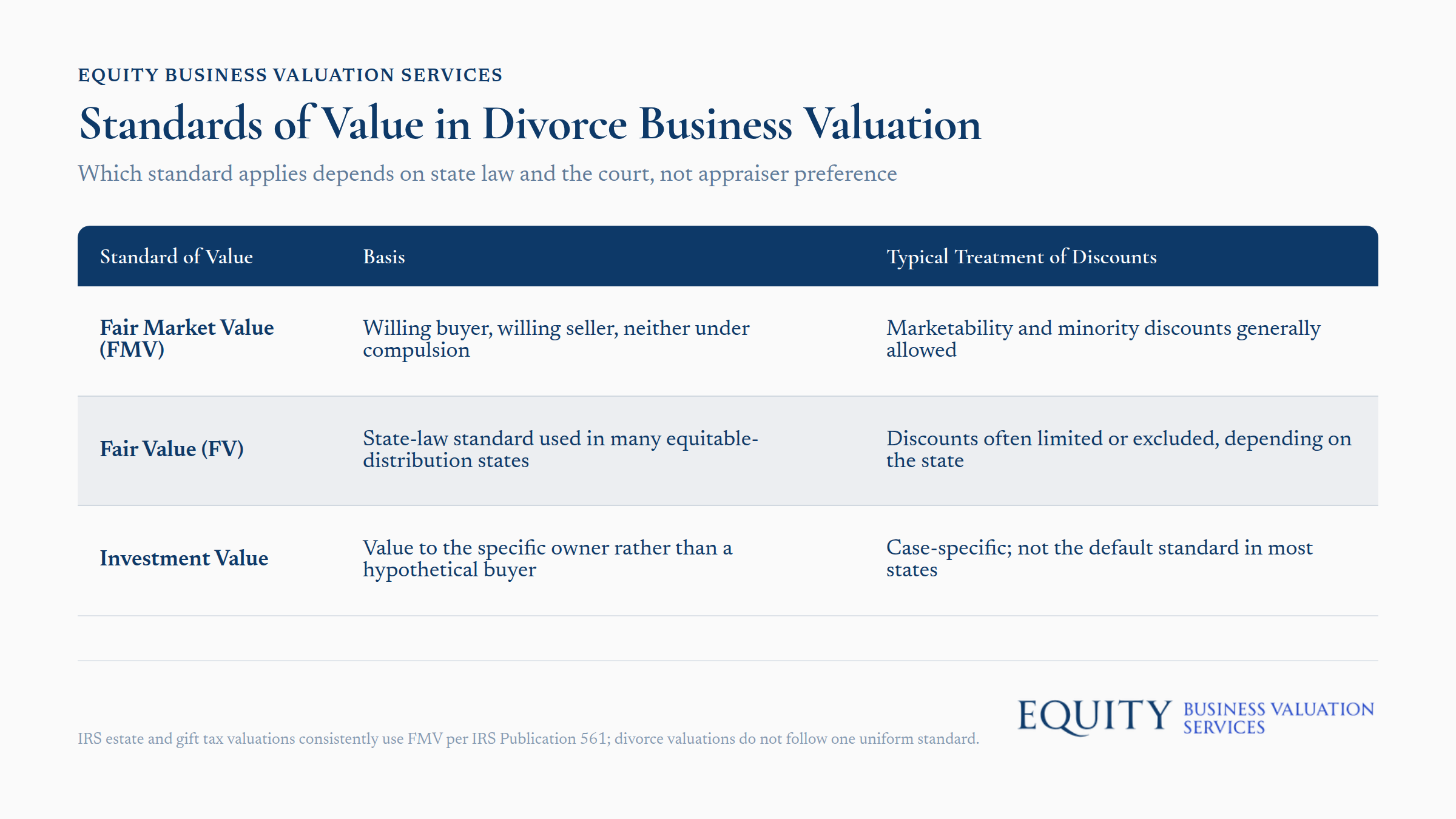
There is no single national standard for divorce valuations. Many states apply fair market value (FMV), the hypothetical willing buyer and willing seller standard familiar from estate and gift tax work. A large number of equitable-distribution states instead apply fair value (FV), a standard created by state law that often excludes minority and marketability discounts depending on the jurisdiction. A smaller group of states looks to investment value, meaning the interest's worth to the specific owner rather than a hypothetical buyer.
Contrast this with IRS estate and gift tax valuations, which consistently apply fair market value under the framework laid out in IRS Publication 561. That consistency does not carry over to divorce. Which standard governs a given case is set by state law and the presiding court, not by the appraiser's preference, and it is one of the first questions an appraiser should confirm with the attorney handling the matter.
| Standard of value | Basis | Typical treatment of discounts |
|---|---|---|
| Fair market value (FMV) | Willing buyer, willing seller, neither under compulsion | Marketability and minority discounts generally allowed |
| Fair value (FV) | State-law standard used in many equitable-distribution states | Discounts often limited or excluded, depending on the state |
| Investment value | Value to the specific owner rather than a hypothetical buyer | Case-specific; not the default standard in most states |
Is the Business Marital Property or Separate Property?
Before an appraiser can value the business, the interest has to be classified. Separate property generally includes an ownership interest acquired before the marriage or received by gift or inheritance, along with its traceable premarital value. Marital or community property generally includes the interest or the appreciation built up during the marriage.
In many equitable-distribution states, appraisers and courts distinguish between two types of growth:
- Active appreciation: growth driven by a spouse's efforts, decisions, or labor during the marriage, which is typically treated as marital.
- Passive appreciation: growth driven by market conditions, industry trends, or other factors unrelated to marital effort, which can remain separate depending on the state.
Community property states start from a different presumption: property acquired during the marriage is presumed to be community property unless the owning spouse can trace it back to a separate source. When a business existed before the marriage and grew substantially during it, appraisers typically value the whole interest first, then apportion the premarital baseline away from the marital appreciation, rather than treating the entire enterprise as automatically divisible.
Personal Goodwill vs. Enterprise Goodwill: What Gets Divided
Goodwill is often the single largest, and most contested, component of a closely held business's value. The distinction between personal and enterprise goodwill determines how much of that value actually belongs to the marital estate.
- Enterprise goodwill attaches to the business itself: its name, systems, location, workforce, and transferable customer relationships. This portion is generally treated as divisible.
- Personal goodwill attaches to a specific owner's individual reputation, skill, or relationships, and often requires that owner's continued involvement to generate value. Many states exclude personal goodwill from the marital estate because it cannot be sold separately from the person who created it.
Appraisers test the distinction with a practical question: would the value transfer to a new owner if the current owner walked away? If the answer is yes, the value leans enterprise goodwill. If the business would collapse without that specific person, it leans personal goodwill. States vary widely on whether personal goodwill is excluded at all, so this determination has to be checked against the jurisdiction's own case law, not assumed from general practice.
Watch out: Business owners sometimes assume all goodwill is personal simply because they built the company themselves. Courts look at transferability, not effort. A well-run business with systems, staff, and repeat customers that don't depend on one individual can carry substantial enterprise goodwill even if the founder is a strong personality.
Why the Valuation Date Matters
The effective date of the valuation can change the number as much as the methodology does. Many states use the date of separation, though this varies by jurisdiction, and business performance between separation and the divorce decree can move substantially, especially for businesses tied to seasonal revenue, a single large client, or a volatile industry.
Some states go further and require a second valuation date if state law treats post-separation, pre-decree changes in value as separate property. That means the appraiser may need to value the business twice: once at separation and again closer to trial, then reconcile the difference.
Pro tip: Confirm the effective date with the attorney handling the case before the engagement starts, not after the report is drafted. State law, not the appraiser, determines the date, and picking the wrong one means redoing the analysis.
How Appraisers Build a Defensible Number
Appraisers reach a value conclusion using one or more of three recognized approaches to valuing a business: income, market, and asset-based. Divorce work leans on the same methodology used in other valuation contexts, applied with extra attention to the standard of value and goodwill questions above.
- Income approach: estimates value from expected future earnings or cash flow, often through a discounted cash flow analysis or a capitalization of normalized earnings.
- Market approach: compares the business to sales of similar companies or uses guideline public company data, when reliable comparables exist.
- Asset approach: values the business as total assets minus liabilities, adjusted to current fair value rather than historical book value.
Before applying any approach, appraisers typically review at least three years of financial statements and normalize the earnings by adjusting for owner compensation, personal expenses run through the business, non-recurring income or expenses, and related-party transactions. For a partial or minority interest, the appraiser may also consider discounts for lack of control or lack of marketability, though whether those discounts apply at all depends on whether the state uses fair market value or fair value as its standard.
Example: A business owner draws a below-market salary and runs a family vehicle lease through the company. An appraiser normalizing earnings would add back the excess expense and adjust compensation to a market rate before capitalizing the resulting cash flow, producing a materially different value than the owner's tax return would suggest on its own.
Why Courts Require an Independent, USPAP-Compliant Appraisal
Courts lean on independent appraisals because a spouse's own number, on either side, is inherently self-interested. An independent appraiser applies a recognized methodology rather than an outcome-driven estimate, and documents every input and adjustment so a judge, opposing counsel, or a forensic reviewer can test the work.
That documentation standard is why reports prepared in accordance with the Uniform Standards of Professional Appraisal Practice (USPAP) carry weight in family court. Appraisers working in this space typically hold credentials from organizations such as the American Society of Appraisers (ASA) and the National Association of Certified Valuators and Analysts (NACVA), and the methodology itself traces back to standards long used in business appraisal practice. A report built this way explains the data relied on, the normalization adjustments made, the approach selected, and the reasoning behind any discounts, which is exactly what an opposing expert needs in order to test the analysis rather than simply dispute it.
What Does a Business Valuation for Divorce Cost?
Appraisal fees are quoted as a fixed fee after scoping the assignment, never billed hourly. For a business valuation, our published pricing starts at $4,500 for a standard report and $5,500 for an IRS-qualified report, with most engagements running $7,500 to $12,000 and the most complex assignments (multiple entities, disputed goodwill, or a second valuation date) reaching $15,000 to $20,000 or more.
What drives the fee is the scope of the work, not the size of the number that comes out the other end: how many entities are involved, how complete the financial records are, how much normalization the earnings require, and whether the report has to withstand cross-examination in a contested hearing versus support a negotiated settlement.
Getting a Number that Holds Up
A business valuation for divorce is only as strong as the classification and goodwill decisions behind it. The standard of value, the marital versus separate split, and the treatment of personal goodwill all have to be right before the income, market, or asset approach ever gets applied, and all three are governed by state law rather than appraiser judgment. Confirm those questions with the attorney handling the case early, and choose an appraiser who documents each step clearly enough for a judge or opposing expert to follow.
If you need a defensible, USPAP-compliant business valuation for a divorce proceeding, request an appraisal and our team will scope the engagement based on the entity, the jurisdiction's standard of value, and the intended use of the report.
This article is provided for general informational purposes only and does not constitute legal, tax, or financial advice. Readers should consult a qualified attorney or CPA regarding their specific circumstances.