
Blog
Business Valuation for E-2 Visa Petitions: When Does It Strengthen Your Case?
A business valuation isn't a checkbox requirement for an E-2 visa petition, but it's often the strongest evidence you can offer for substantial investment and capital at risk. Here's when USCIS officers actually rely on one, and what L-1 and EB-5 petitions need instead.
Immigration attorneys and CPAs preparing an E-2 treaty investor petition often ask the same question: does the file need a formal business valuation, or will financial statements and a purchase agreement do? The honest answer is that no regulation requires one. But in a meaningful share of real petitions, especially ones involving an existing business purchase, a valuation is the difference between an officer taking the petitioner's word for the numbers and an officer seeing independent, third-party support for them. This guide walks through when a business valuation actually earns its place in an E-2 file, then covers how L-1 and EB-5 petitions use the same kind of evidence differently.
What E-2 Visa Regulations Actually Require
An E-2 petition does not need a business valuation by regulation. It needs proof of three things: a substantial amount of capital invested or actively being invested, a bona fide and operating commercial enterprise, and capital that is genuinely at risk rather than parked in a refundable account.
The governing standard requires that the investment be substantial in relation to the total cost of the enterprise, that the funds be committed and irrevocable, and that the business be more than marginal, meaning it must generate enough income to support the investor and family or produce a significant economic impact beyond that. USCIS's own E-2 treaty investor guidance lays out these elements directly: the investment must be substantial relative to the enterprise's total cost, and it must ensure the investor's financial commitment to successful operation.
Notice what's missing from that list: a required valuation report. USCIS reviews purchase agreements, tax returns, bank statements, and financial statements as its default evidence. A valuation only enters the picture when those documents alone don't clearly establish what the enterprise is actually worth.
The Proportionality Test
USCIS applies what practitioners generally call a proportionality test for the substantial investment element. There is no fixed dollar minimum in the regulation. Instead, officers weigh the amount invested against the total cost of purchasing or establishing that specific enterprise. A lower-cost business needs a proportionally higher percentage invested to clear the bar; a higher-cost enterprise can satisfy the standard with a smaller percentage. That comparison only works if the officer has a credible number for what the enterprise is actually worth.
When a Business Valuation Strengthens an E-2 Petition
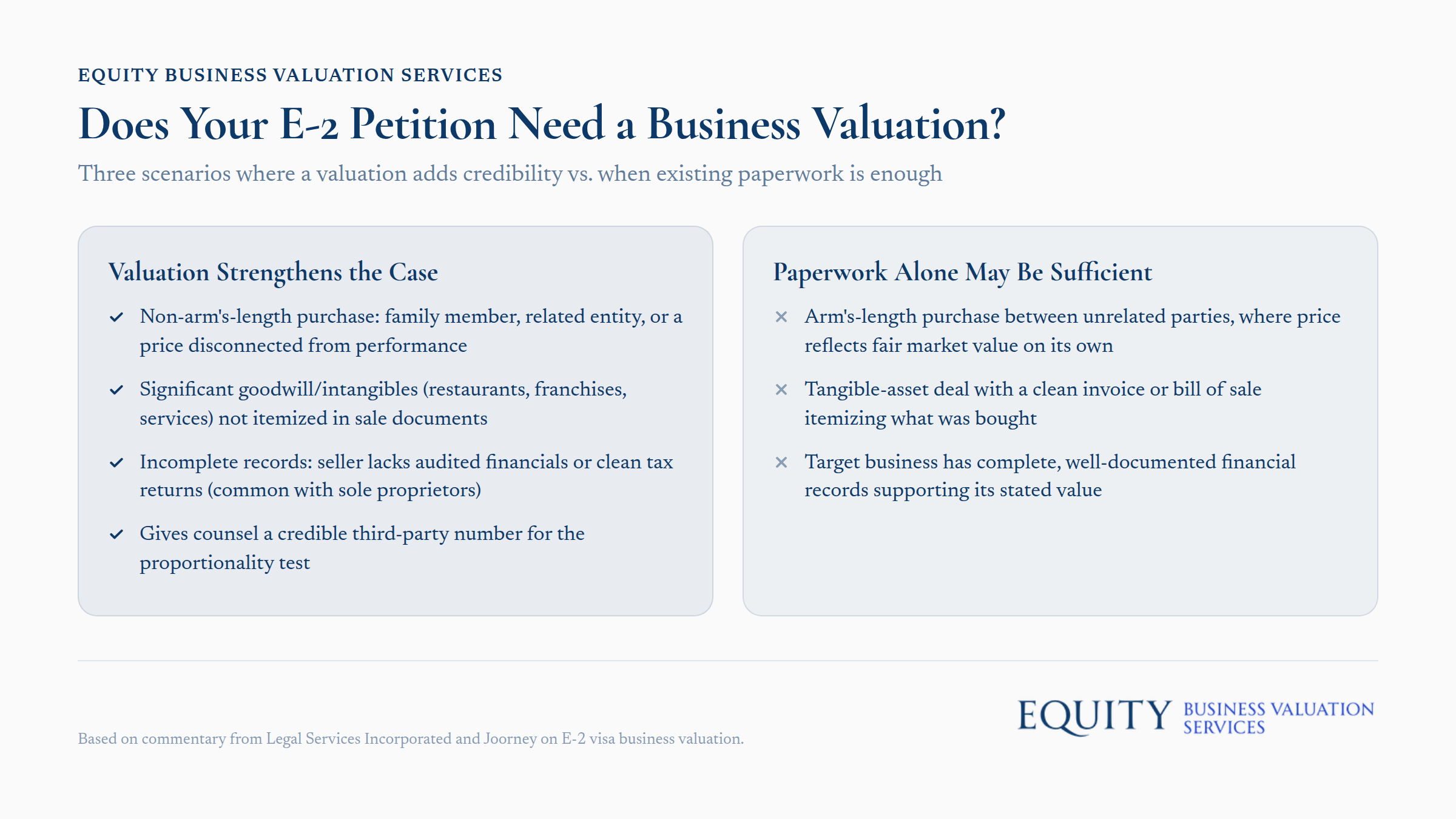
A valuation earns its place in an E-2 file whenever the enterprise's total cost or fair market value isn't obvious from the underlying paperwork alone. Three scenarios come up most often in practice.
The first is a purchase of an existing business where the price paid needs independent support. If the transaction was negotiated at arm's length between unrelated parties, the purchase price itself is usually decent evidence of value. Industry commentary on E-2 filings consistently notes that a valuation becomes far more important once the deal is not arm's length, such as a purchase from a family member, a related entity, or at a price that looks disconnected from the business's actual performance. Legal Services Incorporated's guidance on E-2 valuation makes this point directly: when the purchase price doesn't stand on its own as market evidence, the petitioner needs to show how that number was derived.
The second scenario involves intangible assets and goodwill. Many small business acquisitions, restaurants, franchises, service businesses, include a substantial goodwill component that isn't itemized on an invoice or bill of sale. A valuation breaks the purchase price into tangible assets, intangible assets, and goodwill, giving the officer a defensible basis for what portion of the investment reflects real enterprise value.
The third scenario is simply incomplete records. Some target enterprises, particularly smaller ones being acquired from a sole proprietor, don't have audited financials or a clean set of tax returns. A valuation report can reconstruct a defensible fair market value from the records that do exist, filling a gap that invoices and bank statements can't close on their own.
Across these situations, the underlying purpose is consistent: a valuation gives immigration counsel a credible, third-party number to plug into the proportionality test, rather than asking the officer to accept the petitioner's own assertion of what the business is worth.
What the Valuation Actually Documents
An E-2 valuation report, when one is warranted, is built to answer three specific questions the officer is going to ask anyway.
- What is the enterprise's fair market value, or the fair market value of the specific interest being purchased? This is the denominator in the proportionality test.
- How much of that value does the investor's capital actually represent? This connects the dollar amount invested back to the enterprise's total cost.
- Is the capital genuinely at risk, and is the price paid a defensible reflection of what the business is worth, not an inflated or understated figure designed to manufacture a result?
Appraisers working on these engagements typically apply the same three approaches used in any business valuation: the income approach, which capitalizes projected earnings; the market approach, which compares the enterprise to similar transactions or public comparables; and the asset approach, which values the underlying tangible and intangible assets directly. Which approach carries the most weight depends on the type of business. A service enterprise with thin assets usually leans on income and market evidence; an equipment-heavy operation leans more on the asset approach.
Key takeaway: the valuation isn't decorative paperwork. It's the analytical bridge between the purchase price the investor paid and the proportionality test the officer is required to apply.
L-1 Petitions: Valuation as Supporting Evidence, Not a Requirement
L-1 intracompany transferee petitions have no regulatory valuation requirement at all. The core elements are a qualifying relationship between the foreign and U.S. entities, the beneficiary's managerial, executive, or specialized knowledge role, and, for new office petitions, evidence that the U.S. entity can actually support that role.
A valuation shows up in L-1 files in more specific, structural situations:
- Multi-entity corporate structures. When ownership runs through several layers of holding companies, a valuation can help demonstrate control and the qualifying relationship in a way that a simple org chart doesn't.
- Recent mergers, restructurings, or sales. If the U.S. or foreign entity recently changed hands or reorganized, a valuation can explain how the qualifying relationship survived the transaction.
- Financial capacity questions. When the classification hinges on whether the U.S. entity is large enough to support a genuine executive or managerial role, a valuation of the entity's assets and operations adds weight to that argument.
Outside of those fact patterns, L-1 petitions typically rely on payroll records, organizational charts, and financial statements rather than a standalone valuation report.
EB-5 Petitions: Fair Market Value and Source-of-Funds Documentation
EB-5 immigrant investor petitions lean on valuation evidence more heavily than either E-2 or L-1, mostly because USCIS policy requires that all capital contributed be valued at fair market value in U.S. dollars. That requirement makes a valuation central, rather than optional, in a few common fact patterns.
The first is a non-cash contribution. When an investor contributes property, equipment, or an ownership interest instead of straight cash, someone has to establish what that contribution is worth in dollar terms, and a valuation is the standard way to do it.
The second is an existing business being acquired or restructured as the new commercial enterprise. If the EB-5 capital is funding a purchase or reorganization rather than a ground-up startup, a valuation supports both the investment amount and the job creation projections built on top of it.
The third, and often the most scrutinized, is source-of-funds documentation that traces back to the sale of a business or a major asset. When an investor's EB-5 capital originated from selling a company or a significant stake in one, a valuation of that prior sale helps corroborate that the transaction reflected genuine fair market value rather than a transfer priced to manufacture a specific investment figure. The same report can support job creation projections tied to the capital's deployment.
E-2, L-1, and EB-5: How Valuation Use Compares
| Visa Category | Regulatory Requirement | When a Valuation Is Typically Used |
|---|---|---|
| E-2 Treaty Investor | No valuation mandated; must show substantial investment, capital at risk, non-marginal enterprise | Non-arm's-length purchase, significant goodwill or intangible assets, incomplete seller records |
| L-1 Intracompany Transferee | No valuation mandated; must show qualifying relationship and role | Multi-entity ownership structures, recent mergers or restructurings, financial capacity for the classification |
| EB-5 Immigrant Investor | Capital must be valued at fair market value in U.S. dollars | Non-cash contributions, acquisition or restructuring of the enterprise, source of funds tied to a prior business sale |
What We Need From You to Start the Valuation
Before we can scope and quote an immigration-related business valuation, we typically ask for the underlying documents an attorney or applicant already has on hand:
- Formation and ownership documents, including articles of incorporation, operating or partnership agreements, and cap tables where applicable.
- The purchase agreement for the enterprise being acquired, along with any bill of sale or asset schedule.
- Financial statements and tax returns, generally the most recent 2 to 3 years, or whatever the enterprise has available.
- Franchise agreements, if the business operates under a franchise structure, since these affect both value and marginality analysis.
- A business plan or financial projections, particularly for EB-5 filings where job creation figures depend on the capital's deployment.
USCIS and practitioner guidance on E-2 evidence generally points to this same core set of records: bank statements, transaction documents, and corporate filings that show capital has actually moved and the enterprise is real. The valuation builds on top of that record rather than replacing it.
Pro tip: send the complete document set to your appraiser before the valuation kicks off. Missing formation documents or an incomplete cap table are the most common reasons an immigration valuation stalls midway through.
How the Valuation Fits Into Your Petition Timeline
A business valuation is one workstream inside a larger petition preparation process, not a separate track that runs on its own clock. Once we receive the document set above, we scope the engagement based on the entity's complexity, the completeness of its financial records, and whether the analysis needs to cover a single enterprise or multiple related entities.
Attorneys generally build the valuation into the petition timeline the same way they'd schedule any other piece of supporting evidence: request it early enough that it doesn't become the last document holding up filing. We don't publish a fixed turnaround because scope varies by entity, but we do quote the engagement as a fixed fee before work begins, so there's no ambiguity about cost once the analysis is underway.
Engagements for immigration-related business valuations typically fall under our standard business valuation scope, quoted as a fixed fee starting from $4,500, with the final figure set by entity complexity, the number of entities involved, and the depth of analysis the petition requires. We never bill by the hour.
Credentials and Standards Behind the Report
Our appraisers hold credentials with organizations such as the ASA and NACVA, and every business valuation report is prepared in accordance with USPAP. That standard governs methodology and disclosure regardless of the report's intended use, whether it's headed to a court, an insurer, or, in this case, a USCIS adjudicator or consular officer.
It's worth being direct about what that standards compliance does and doesn't do. Preparing a report to USPAP standards means the analysis follows a recognized, defensible methodology. It is not, and cannot be, a guarantee that USCIS or a consular officer will approve the underlying petition. That decision belongs entirely to the adjudicating officer.
Frequently Asked Questions
Q: Do I actually need a valuation for my E-2 petition, or will my purchase agreement and tax returns be enough? For many arm's-length purchases with clean financial records, the purchase agreement and financials are enough on their own. A valuation becomes worth the cost when the deal isn't arm's length, when goodwill or intangible assets make up a meaningful share of the price, or when the seller's records are too incomplete to establish value on their own.
Q: What documents do you need from us to start an immigration business valuation? We generally need formation and ownership documents, the purchase agreement or bill of sale, 2 to 3 years of financial statements and tax returns, any franchise agreements, and a business plan or projections if the filing involves job creation figures, as it typically does for EB-5.
Q: How does the valuation fit into our overall filing timeline? It runs alongside the rest of your petition preparation rather than after it. Send the document set as soon as it's available so scoping can start early; the analysis timeline depends on the entity's complexity and how complete the records are, so we don't quote a fixed turnaround until we've seen the file.
Q: Does a business valuation guarantee our petition will be approved? No. No valuation or appraisal can guarantee a USCIS or consular decision. What it does is strengthen the evidentiary record by giving the officer a credible, independently derived number to apply to the substantial investment, capital at risk, or fair market value tests, rather than asking them to take the petitioner's figures on faith.
Q: Can the same valuation be used for both a USCIS filing and a consular interview abroad? Generally yes. E-2 cases can be adjudicated either by USCIS for a change of status or extension, or by a consular officer abroad for a new visa, and a well-documented valuation report supports either path since it's built around the same substantial investment and fair market value questions both adjudicators examine.
Ready to Strengthen Your Petition With a Defensible Valuation
If you're preparing an E-2, L-1, or EB-5 petition and the purchase price, capital contribution, or source-of-funds documentation needs independent support, request a business valuation quote and we'll scope the engagement around your specific enterprise and filing timeline.
This article is provided for general informational purposes only and does not constitute legal, tax, or immigration advice. Readers should consult a qualified immigration attorney regarding their specific petition and evidentiary requirements.