
Blog
The 3 Approaches to Valuing a Business: Asset, Income, and Market Explained
Every credentialed business appraiser works from three recognized approaches to valuing a business: asset, income, and market. This guide explains what each measures, when it applies, and how appraisers reconcile them into one defensible conclusion of value.
If you've ever asked a CPA or appraiser how much your company is worth, you've probably heard some version of "it depends on the approach." That's not a dodge. Professional business valuation rests on three recognized approaches, asset, income, and market, and a competent appraiser considers all three before settling on a final number.
Understanding these three approaches to valuing a business matters whether you're planning an estate, negotiating a buyout, donating a private company interest, or just trying to understand what your ownership stake is actually worth. This guide walks through what each approach measures, when it applies, and how appraisers weigh them together into a single, defensible conclusion.
What Are the Three Approaches to Valuing a Business?
The asset approach, income approach, and market approach are the three broad frameworks recognized across professional valuation practice for estimating what a business, business interest, or security is worth. Each approach answers a different underlying question: what does the business own, what does it earn, or what have similar businesses sold for.
These three approaches are recognized by the American Society of Appraisers and by NACVA, along with the AICPA's Accredited in Business Valuation (ABV) credential program. Within each approach sit specific methods, the more granular calculations an appraiser actually runs. Discounted cash flow and capitalization of earnings, for example, are methods under the income approach. The guideline public company method and the guideline transaction method fall under the market approach.
Key takeaway: No single approach is automatically correct. A qualified appraiser considers all three, then reconciles the results based on which approach best fits the facts of that specific business.
The Asset Approach: Valuing What a Business Owns
The asset approach values a business based on the value of its assets net of liabilities, essentially building a fair-market-value balance sheet rather than relying on the company's historical accounting figures.
The most common method here is the adjusted net asset value method, where an appraiser restates every asset and liability at current fair market value rather than book value. Real estate gets appraised at what it would sell for today, not what it cost decades ago. Equipment gets adjusted for depreciation and obsolescence. Intangible assets, like customer lists or trademarks, may need to be identified and valued separately if they aren't already reflected on the balance sheet.
This approach tends to carry the most weight for asset-heavy businesses that don't generate earnings in proportion to what they own: holding companies, real estate investment entities, and businesses in liquidation or wind-down. It generally carries less weight for a healthy operating company whose value comes primarily from ongoing profitability rather than its balance sheet.
Watch out: Don't confuse book value with fair market value. A piece of equipment fully depreciated to zero on the books might still have real resale value, and a decades-old building carried at its original purchase price could be worth many times that today.
The Income Approach: Valuing What a Business Earns
The income approach values a business by converting its expected future economic benefits, typically cash flow or earnings, into a single present value. It answers the question a buyer actually cares about: what will owning this business be worth to me going forward?
Two methods dominate this approach:
Discounted cash flow (DCF): Projects a company's future cash flows over a period, usually 3 to 5 years, then discounts them back to present value using a rate that reflects the risk of achieving those projections.
Capitalization of earnings: Takes a single, normalized measure of current or average historical earnings and divides it by a capitalization rate to arrive at value in one step, rather than forecasting multiple years individually.
The income approach tends to be most reliable for established operating companies with a track record of stable or predictable cash flow. It's less useful for a business with no earnings history, an early-stage company, or one facing near-term disruption that makes forecasting unreliable.
A Worked Example: Capitalization of Earnings
Example: Suppose a private manufacturing company has normalized annual earnings of $500,000 after adjusting for owner compensation and one-time expenses. The appraiser determines an appropriate capitalization rate of 20% based on the company's risk profile, industry, and size. Dividing $500,000 by 0.20 produces an indicated value of $2,500,000.
That capitalization rate isn't pulled from a chart. It's built from a discount rate (reflecting the company's specific risk factors, industry volatility, and size) minus an expected long-term growth rate, and it's one of the areas where an appraiser's judgment and experience carry real weight.
Pro tip: Small changes in the capitalization rate produce large swings in value. A 2-point shift, from 20% to 18%, moves the same $500,000 in earnings from a $2.5 million valuation to a $2.78 million valuation. This is why the rate itself deserves as much scrutiny as the earnings figure.
The Market Approach: Valuing What Similar Businesses Sold For
The market approach values a business by comparing it to similar businesses, ownership interests, or transactions that have actually sold, the same logic a real estate appraiser uses when comparing a house to recent sales of comparable homes nearby.
Two methods are most common:
Guideline public company method: Uses valuation multiples (such as price-to-earnings or enterprise value to EBITDA) drawn from publicly traded companies in the same or a similar industry, then applies those multiples to the subject company's financials.
Guideline transaction method: Uses pricing multiples from actual sales of comparable private companies, often drawn from M&A transaction databases, rather than public trading data.
This approach is most useful when there's enough reliable comparable data to support it, an established industry with active M&A activity or a set of reasonably similar public companies. It's harder to apply for a highly specialized business with no clean comparables, or in an industry where recent transaction data is thin or unreliable.
How Revenue Ruling 59-60 Shapes All Three Approaches
Appraisers don't apply these three approaches in a vacuum. The framework for valuing closely held stock for federal tax purposes traces back to IRS Revenue Ruling 59-60, which lists factors an appraiser must weigh, including the company's history and nature, the economic outlook for its industry, book value and financial condition, earning capacity, dividend-paying capacity, goodwill and intangible value, prior sales of the stock, and the market price of comparable publicly traded companies.
That list reads almost like a summary of all three approaches at once, and that's not a coincidence. Revenue Ruling 59-60 is the foundational authority behind fair market value determinations for estate tax (IRS Form 706) and gift tax (IRS Form 709) filings, and its influence extends well beyond tax valuations into essentially every professional business appraisal.
Comparing the Three Approaches at a Glance
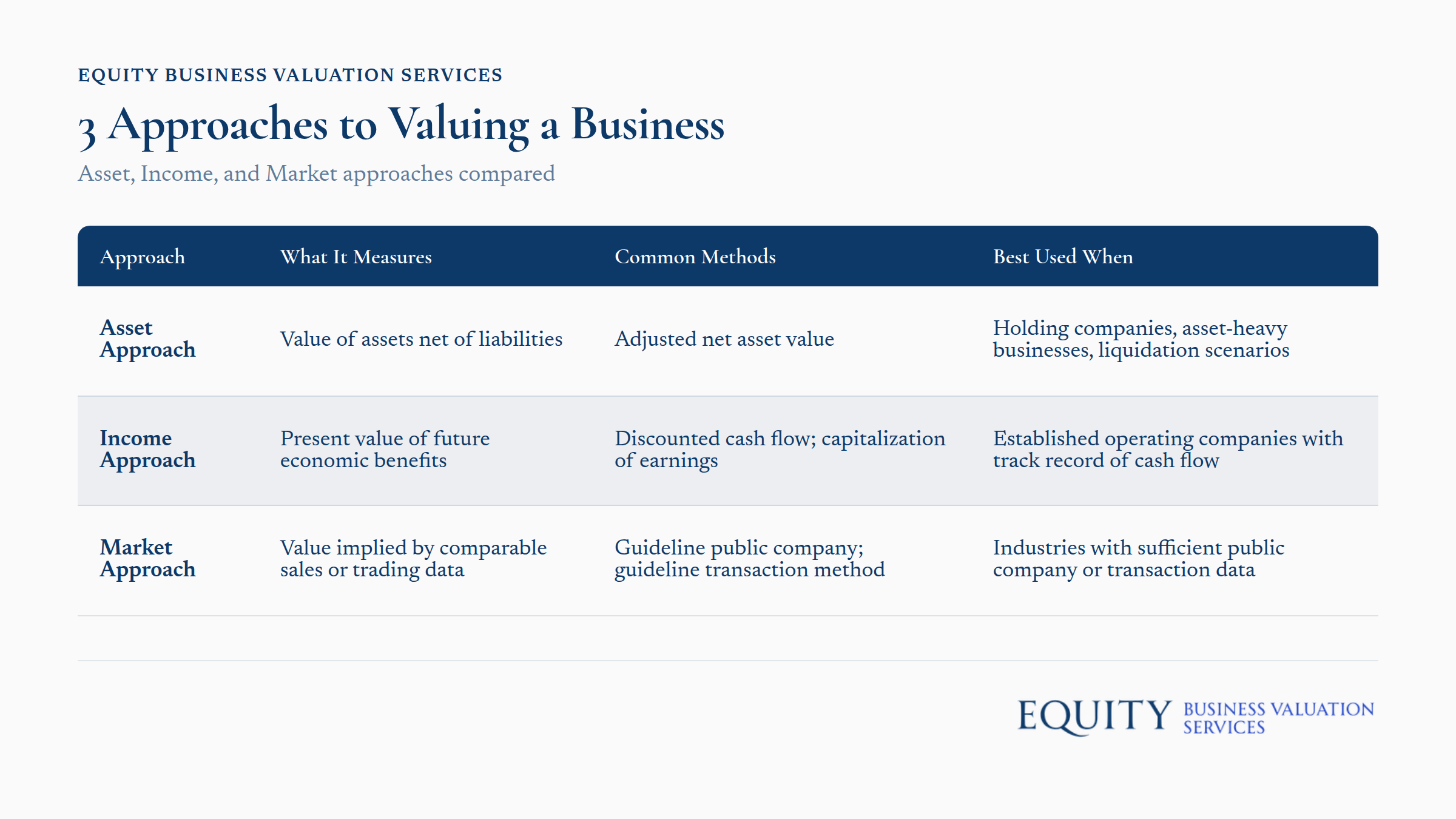
The table below summarizes what each approach measures, its common methods, and the situations where it tends to carry the most weight.
How Appraisers Reconcile Multiple Approaches Into One Value
Appraisers rarely rely on a single approach in isolation, and they almost never simply average the results of two or three methods together. Reconciliation is a judgment-driven process, not a fixed formula.
In practice, an appraiser typically:
Applies each relevant approach given the facts of the business, its industry, and the purpose of the valuation.
Weighs the reliability of each indication based on data quality, how well the method fits the company's characteristics, and how defensible the assumptions are.
Gives the most weight to the approach best suited to the facts, often anchoring the conclusion in one primary method while using the others as a sanity check.
Documents the reasoning behind the final weighting so the conclusion is transparent and defensible if it's ever questioned by the IRS, a court, or another party to a transaction.
A business with strong recurring cash flow and thin asset holdings, for example, will usually lean heavily on the income approach, with the asset approach serving mainly as a floor value check. A holding company with minimal operating activity but significant real estate or investment holdings will usually lean the other way. This is exactly the kind of judgment call that separates a credentialed appraiser's opinion from a back-of-envelope estimate, and it's why USPAP (the Uniform Standards of Professional Appraisal Practice, published by The Appraisal Foundation) requires appraisers to consider and document each applicable approach rather than defaulting to whichever produces the most convenient number.
Which Approach Applies to your Business?
There's no universal answer, and that's the point. The right combination of approaches depends on your industry, your company's financial history, the purpose of the valuation (estate planning, a sale, divorce, litigation, a gift), and the quality of comparable data available.
What you can count on is this: a credentialed appraiser holding credentials such as the ASA or NACVA's designations will consider all three approaches, apply the ones that fit your business, and explain why the final conclusion is weighted the way it is. Anything less is guesswork dressed up as a valuation.
If you need a defensible opinion of value for estate planning, a gift of private company stock, a buy-sell agreement, or litigation, our team at Equity Business Valuation Services prepares USPAP-compliant reports that apply and reconcile all three approaches based on the specific facts of your business. Learn more about our business valuation services or review our pricing to get started, or request an appraisal directly.
This article is provided for general informational purposes only and does not constitute legal, tax, or financial advice. Readers should consult a qualified attorney or CPA regarding their specific circumstances.